

Juniper Networks standardizes precision timing for AI and media data centers
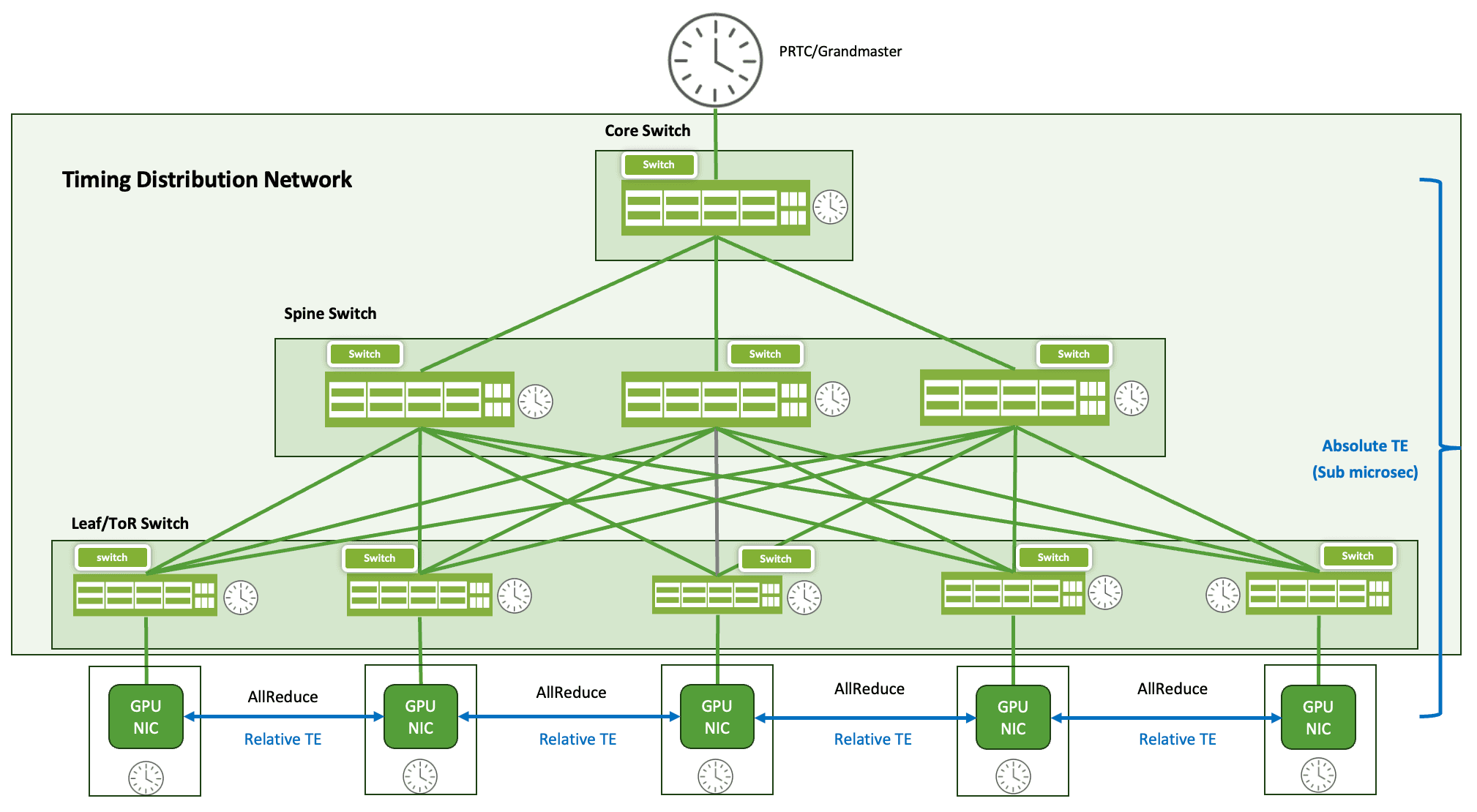
Juniper Networks has published a technical overview explaining the critical role of Precision Time Protocol (PTP) and related synchronization standards like SMPTE ST 2059-1 for AI and IP-based media data center clusters. The post details how accurate clock synchronization enables low-latency performance in compute fabrics, financial trading environments, and broadcast media workflows.
Key Takeaways
- Broadcast media applications require timing accuracy within 1 microsecond to achieve frame alignment and prevent lip-sync errors.
- Open Compute Project (OCP) Model1 standards mandate a maximum absolute time error of 2.5 microseconds between the Grandmaster clock and any network interface card.
- Synchronizing GPUs for AI training enables 'sync-to-desync' power control, staggering workload execution by 2 microseconds to flatten power spikes.
- Precision timing reduces database write latency by shrinking the safety margin (2ε) to approximately 200 nanoseconds compared to traditional millisecond delays.
Why It Matters
The transition to IP-based media and large-scale AI training necessitates a shift from best-effort networking to deterministic synchronization. For streaming providers, PTP implementation ensures that audio, video, and metadata streams remain perfectly aligned across distributed cloud architectures. This technology reduces the 'commit-wait' window in distributed databases, directly improving the responsiveness of real-time streaming metadata and personalizing algorithms. As AI clusters scale to thousands of nodes, these timing standards become the baseline for managing power consumption and network congestion. Industry analysts should monitor the adoption of the ITU-T G.8275.2 profile, which serves as a critical bridge between telecom bearer networks and data center fabrics.
Additional Context
The push for nanosecond-level precision follows recent infrastructure upgrades by major cloud and networking providers. Per a May 2026 report from Synergy Research Group, the rapid build-out of 'AI-first' data centers has increased demand for specialized timing hardware, as traditional Network Time Protocol (NTP) is insufficient for sub-microsecond requirements. This alignment with OCP standards reflects a broader industry trend toward open-source hardware specifications to maintain interoperability between vendors like NVIDIA and Arista. In parallel, Cisco announced in February 2026 that its latest Nexus series switches would incorporate enhanced hardware timestamping specifically to support the SMPTE ST 2110 suite, which relies on the ST 2059-1 timing mentioned by Juniper.
Furthermore, the integration of 5G edge computing into the streaming pipeline has tightened synchronization tolerances. According to a June 2026 technical brief from Ericsson, telecommunications providers are deploying Grandmaster clocks at the network edge to support ultra-low latency streaming and augmented reality applications. This move is designed to address the 'GNSS vulnerability' cited by Juniper, using terrestrial backup paths to maintain time accuracy when satellite signals are jammed or unavailable. These developments collectively indicate that precision timing is no longer a niche requirement for high-frequency trading but a core utility for the global streaming and AI compute stack.
Read full article at community.juniper.net
Enjoy our coverage?
Add StreamingMeme as a preferred source on Google to see more of our streaming news at the top of your Search results.
Add as preferred source