

Grass Valley details software-defined production shift following Olympic-scale stress tests
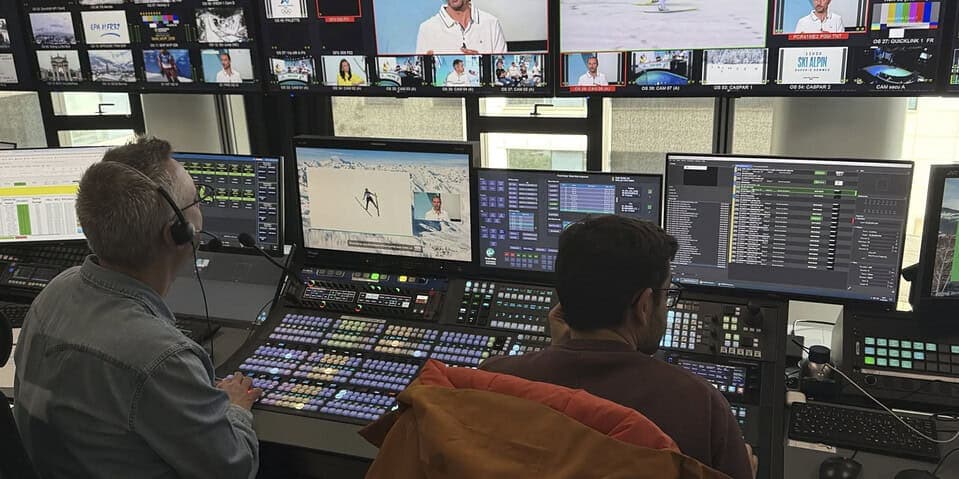
Grass Valley discusses the shift toward software-defined 'Dynamic Media Facilities,' emphasizing that modern resilience is achieved through flexibility, observability, and hybrid cloud-on-premises orchestration. The company highlights Warner Bros. Discovery’s use of the AMPP platform to manage large-scale sports production workflows, including 42 linear channels and 62,000 hours of content.
Key Takeaways
- WBD's AMPP platform supported 650 concurrent users at peak during the Milano Cortina 2026 Games.
- The software-defined infrastructure managed 42 linear channels and 62,000 hours of recorded content.
- Warner Bros. Discovery uses a microservices architecture allowing individual components like Framelight X to be updated without disrupting live systems.
- Industry leaders Canal+ and NRK are adopting hybrid models, balancing local on-premises control with cloud scalability.
- AMPP Hub provides local orchestration to maintain operational continuity even if cloud connectivity is interrupted.
Why It Matters
This shift marks the transition of software-defined production from experimental proof-of-concept to a primary operating model for Tier-1 global sports. By decoupling production logic from hardware, broadcasters can scale resources instantly to match event peaks—such as the 4,000 daily recording tasks seen at the Olympics—without the capital expenditure of permanent physical racks. For the ecosystem, this proves that IP-native, microservices-led workflows can match the 24/7 reliability of SDI. Watch for whether smaller regional broadcasters adopt these "Dynamic Media Facility" models as a way to lower entry costs for high-quality live production.
Additional Context
The transition to Dynamic Media Facilities (DMF) occurs as the broadcast industry reaches a technical tipping point. Per Haivision’s 2026 Broadcast Transformation Report, 78% of broadcasters have now adopted SRT for video transport, while the shift toward software-defined infrastructure is accelerated by the move away from aging SDI equipment. Major networks like Sinclair have recently introduced 'Broadcast as a Service' (BaaS) models, removing local master control hardware in favor of cloud-resident orchestration. This shift aligns with broader corporate strategies at Warner Bros. Discovery (WBD), which has been optimizing its technical stack to support a lean, high-output sports and news division during its proposed reorganization into separate Global Networks and Streaming entities.
Technical maturity in standard protocols like SMPTE ST 2110 and the emergence of the Media Exchange Layer (MXL) are providing the interoperability required for these dynamic environments. Recent reporting from TV Technology in March 2026 indicates that the most significant trend for 2026 is 'truly hybrid' live production, where linear IP video is combined with on-prem processing to optimize both latency and reliability. For WBD, these technological updates were a prerequisite for managing the Milano Cortina 2026 Games, which saw a 103% increase in streaming hours viewed compared to Beijing 2022. This volume further validates the industry move toward microservices architectures capable of managing massive, multi-language data streams across distributed teams.
Read full article at sportsvideo.org
Enjoy our coverage?
Add StreamingMeme as a preferred source on Google to see more of our streaming news at the top of your Search results.
Add as preferred source