

Fluendo's H.266 GStreamer encoder outperforms x265 at equivalent bitrates
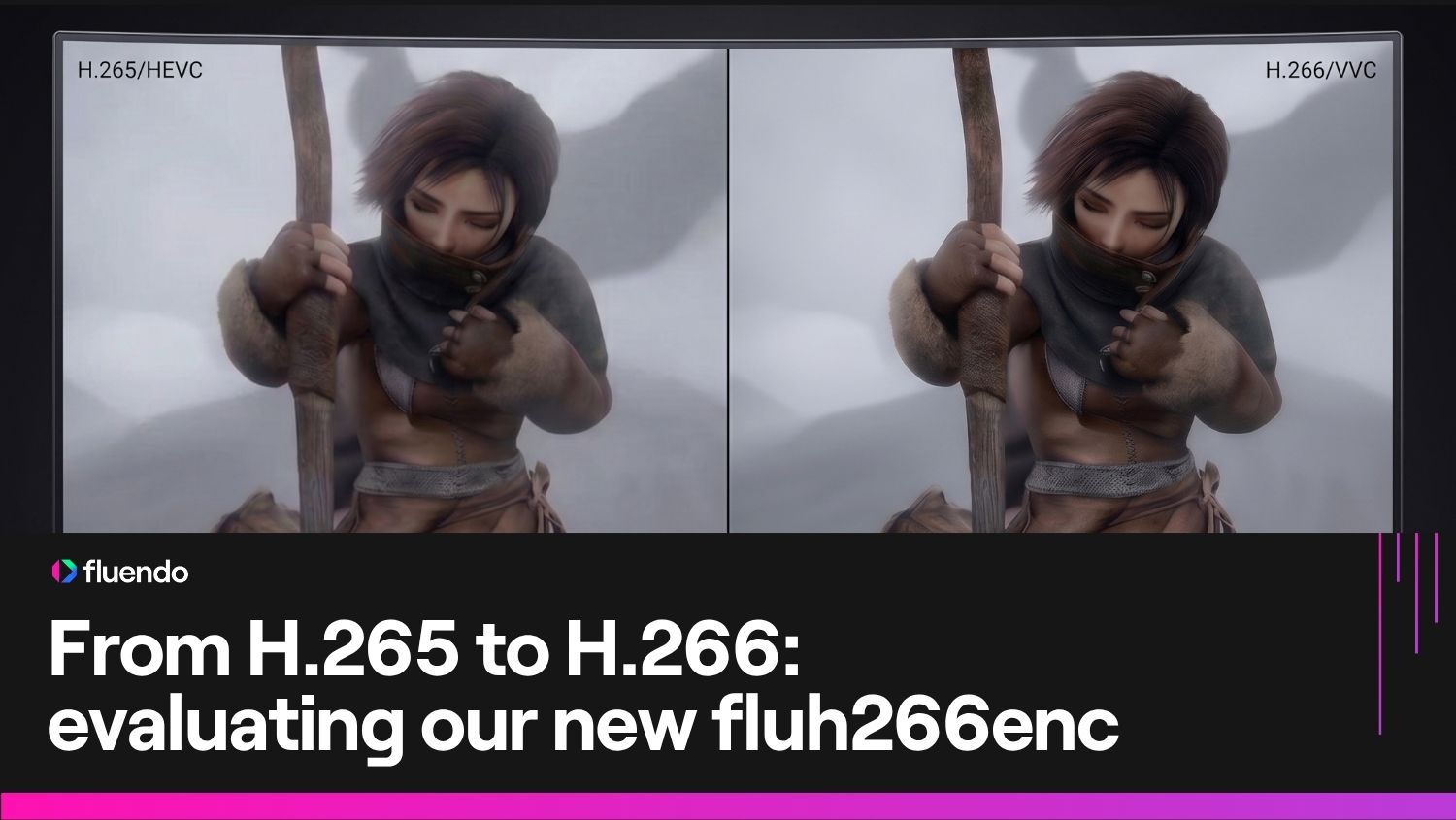
Fluendo has released fluh266enc and fluh266dec, new GStreamer elements for VVC/H.266 software encoding and decoding based on the Fraunhofer vvenc library. Internal testing shows the H.266 encoder delivers superior visual quality and compression efficiency compared to the reference H.265 x265enc software encoder, requiring significantly less bitrate for equivalent quality.
Key Takeaways
- fluh266enc produced higher VMAF scores than x265enc at the same target bitrate across natural video and desktop screen-cast content
- x265's slowest preset was required to match compression efficiency achieved by fluh266enc's fastest preset
- Side-by-side comparison at 500 kbps using the open-source film 'Sintel' showed fluh266enc preserving fine details while x265enc exhibited visible compression artifacts
- fluh266enc and fluh266dec are GStreamer elements built on Fraunhofer's open-source vvenc and vvdec libraries
- Development was funded through the SPIRIT Open Call 1 STREAM project for scalable telepresence
Why It Matters
Fluendo's benchmarks provide concrete evidence that H.266/VVC software encoding can deliver substantial bandwidth savings over H.265 without requiring the slowest encoding profiles — a meaningful data point for pipeline architects evaluating codec transitions. The GStreamer integration makes VVC encoding accessible to a developer base that already uses the framework, lowering the barrier to experimentation. However, the broader VVC ecosystem remains early: hardware decode is scarce, browser support is nonexistent, and patent pool complexity persists. Watch whether Fluendo or others publish similar benchmarking against AV1 encoders like SVT-AV1, which is the codec VVC must displace in many production decisions.
Additional Context
VVC adoption remains minimal despite the standard being finalized in July 2020. Per Streaming Media Magazine (Jan Ozer, early 2025), no major publisher deployments exist four years post-finalization. The closest to a real deployment was a technology demo by Brazilian broadcaster Globo during the 2024 Paris Olympics, delivering UHD 2160p video at 10Mbps using VVC enhanced with MPEG-5 LCEVC. Fraunhofer's VVenC — the same library Fluendo builds on — is the primary open-source VVC encoder with realistic production speed, while MainConcept offers a commercial live VVC encoder used in broadcast trials. Industry sentiment at Mile High Video 2025 (per Streaming Learning Center) was mixed. Ateme reported concrete uptake in Brazil's TV 3.0 initiative, which uses VVC as part of its broadcast toolkit. MulticoreWare's Andrew Frost noted that customers 'aren't quite ready to move past HEVC,' citing device support gaps and an underdeveloped business case. Akamai's Will Law reported 'very, very little' VVC interest on the CDN side, with H.264 still dominant and some HEVC uptake for 4K. VLC's Jean-Baptiste Kempf remained skeptical of mass VVC adoption, citing patent complexity worse than HEVC's. Hardware decode remains the gating factor. Intel's Lunar Lake chips, released September 2024, were the first PC processors with VVC decode. MediaTek announced the Pentonic 800 SoC with VVC for TVs. No major mobile SoC ships VVC decode as of early 2025, per Nokia's Justin Ridge (March 2025 blog). Robert Moore of the Media Coding Industry Forum told Digital Media World that Qualcomm and MediaTek — holding 50–60% of global mobile SoC share — will likely determine VVC's mobile trajectory, with the question being 'which one will go first.' ATSC approved VVC for ATSC 3.0, and Brazil began VVC test broadcasts in April 2025 with plans to use it for the 2026 FIFA World Cup. Per MpegFlow (May 2026), VVC offers 5–15% better compression than AV1 but runs roughly 2–3x slower than x265 at equivalent presets. No major browser ships VVC decode. Consumer streaming adoption is not expected before 2028, with the practical codec ladder for most streamers remaining AV1 → HEVC → H.264.
Read full article at fluendo.com
Get this in your inbox → Subscribe
Enjoy our coverage?
Add StreamingMeme as a preferred source on Google to see more of our streaming news at the top of your Search results.
Add as preferred source