

Final Cut Pro 12.3 adds AI Auto Mask and edit detection
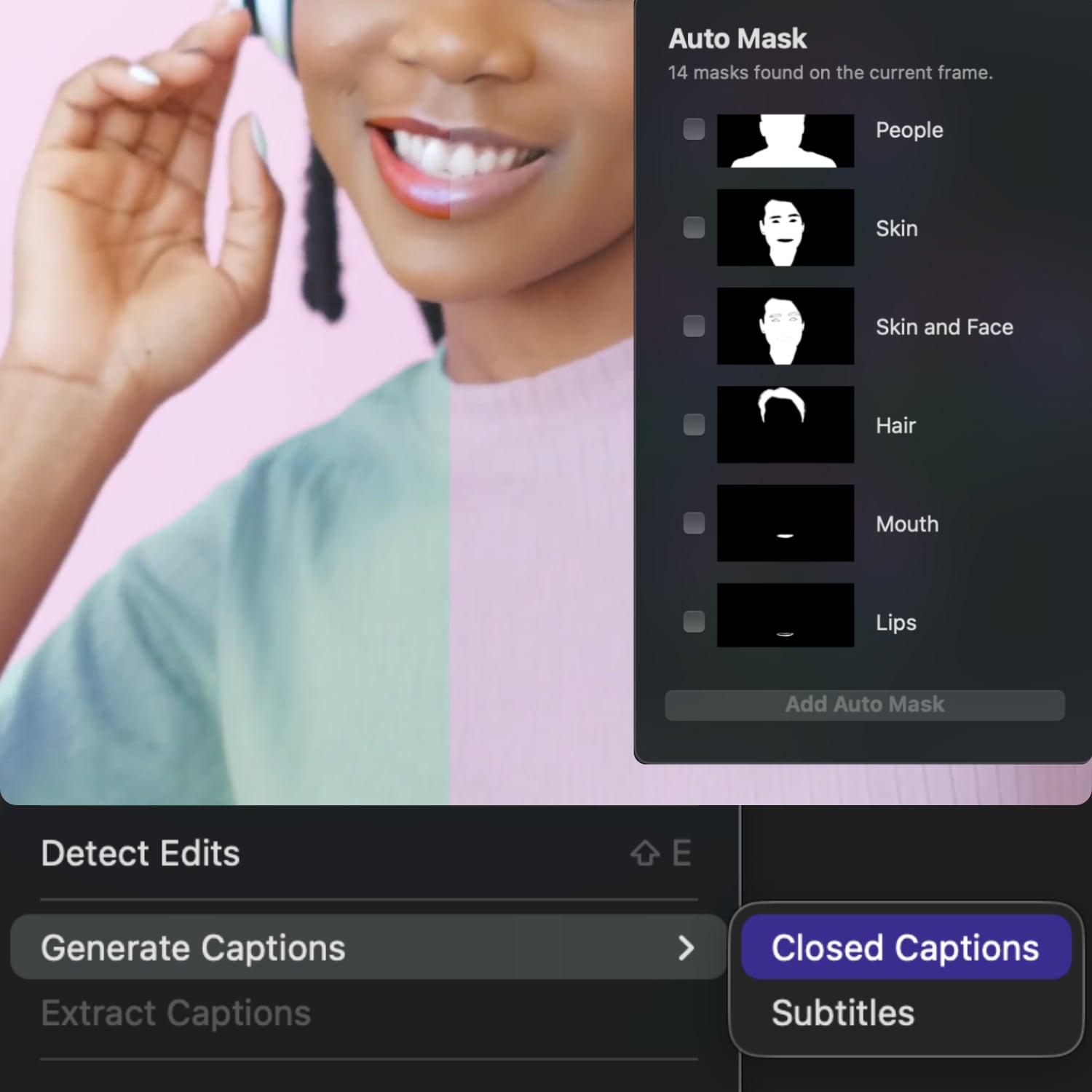
Apple has released Final Cut Pro 12.3, featuring new AI-based Auto Mask tools, burned-in caption generation, and edit detection capabilities. The update also streamlines proxy workflows by replacing H.264 with HEVC and introduces performance improvements across the app suite.
Key Takeaways
- AI Auto Mask enables instant image segmentation to isolate subjects, including hair, skin, and backgrounds, without manual tracking.
- Generate Captions tool uses on-device AI to transcribe audio into hard-coded subtitles or closed captions for social media formats.
- Detect Edits feature analyzes flat video files to automatically identify shot changes and insert through edits on the timeline.
- Proxy media generation transitioned from H.264 to HEVC to optimize storage and provide native HDR support for modern Mac systems.
- Background rendering is now disabled by default, addressing long-standing user concerns regarding rapid storage consumption on smaller hard drives.
Why It Matters
This release signals Apple's shift toward functional AI that prioritizes efficiency and social media output over purely generative effects. By integrating sophisticated masking and transcription natively, Apple reduces the need for third-party plugins and round-tripping to competitors like DaVinci Resolve for simple finishing tasks. For the enterprise, the move to HEVC proxies and improved iPhone integration via Final Cut Camera reflects a push toward a unified, lightweight professional pipeline. Strategically, it reinforces the Apple Creator Studio's value proposition as it competes with Adobe's Firefly-driven generative tools and Blackmagic Design's collaborative cloud infrastructure. Watch for regional expansion of the AI transcription feature, which is currently restricted to U.S. English.
Additional Context
The release of Final Cut Pro 12.3 arrives five months after the January 2026 launch of the Apple Creator Studio subscription. Per Apple, the $12.99 monthly service bundled Final Cut Pro, Logic Pro, and the newly acquired Pixelmator Pro into a single cross-platform license. This update adds deeper integration with Pixelmator Pro, allowing editors to send video frames directly to the image editor for thumbnail creation. In contrast, Adobe’s 2026 updates for Premiere Pro have focused on generative AI via Firefly. Per Digital Camera World, June 2026, Adobe now offers generative extend and object removal tools, positioning itself as a leader in creating assets that were not originally filmed. Meanwhile, Blackmagic Design continues to dominate the high-end collaborative space. Per Authentype in early 2026, DaVinci Resolve’s version 20 introduced real-time multi-user timelines with latency under 200ms globally, catering to large-scale post-production facilities. Apple’s focus remains firmly on the solo 'preditor' and the social-first creator, a segment that has grown significantly. According to Forbes, June 2026, Apple’s on-device AI approach offers a privacy-centric alternative to cloud-processed competitors, though it currently lacks some of the broader collaborative features found in the Blackmagic Cloud ecosystem. Additionally, the update to Compressor 5.3 adds APMP profile support for 180° 3D footage, reinforcing Apple Vision Pro’s hardware-software link for immersive content creators.
Read full article at provideocoalition.com
Get this in your inbox → Subscribe
Enjoy our coverage?
Add StreamingMeme as a preferred source on Google to see more of our streaming news at the top of your Search results.
Add as preferred source