

FIFA final features 125 cameras and first-ever halftime show
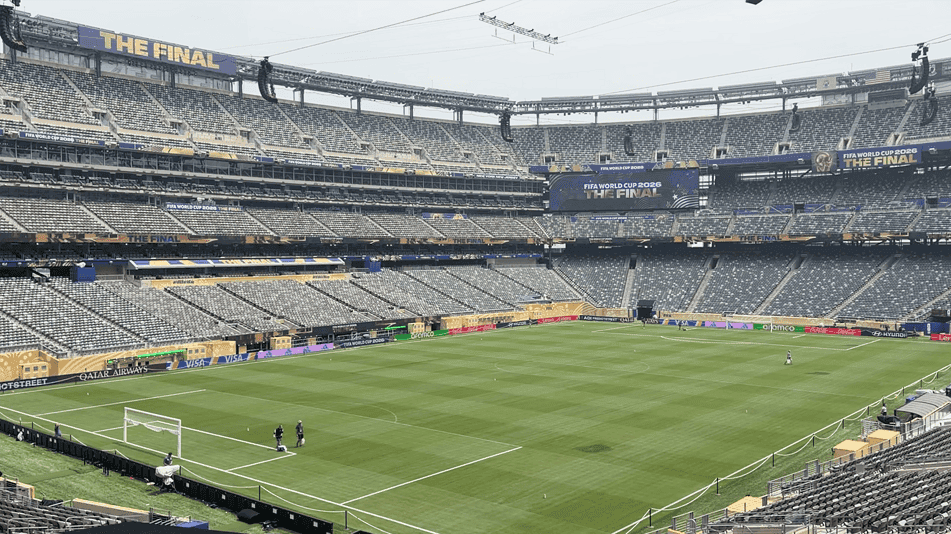
Host Broadcast Services (HBS) is deploying a massive production infrastructure for the 2026 FIFA World Cup Final, featuring 60 match cameras, 54 replay trains, and specialized aerial and RefCam perspectives. The production leverages a multi-region network connecting sites in the U.S., Spain, and Argentina to deliver live feeds to an expected global audience of over 1.5 billion people.
Key Takeaways
- Match 104 production includes 60 match cameras and 57 microphones, supported by 54 replay record trains and 14 additional feed channels.
- First-ever World Cup Final Halftime Show features Madonna, Shakira, BTS, and Justin Bieber, produced by Global Citizen and Live Nation.
- HBS is deploying a multi-region network connecting live reaction feeds from watch parties in Madrid, Buenos Aires, and New York-New Jersey.
- Technical workflow leverages RefCam for referee-POV shots and specialized Spidercam deployment across large North American stadium footprints.
Why It Matters
The massive technical scale of the final signifies a shift where elite sports production must now match the complexity of global entertainment spectacles. Connectivity is the core hurdle; HBS is leveraging a multi-region network to synchronize fan reactions across three continents. This decentralized yet high-fidelity broadcast model sets a new benchmark for ultra-low-latency remote production at scale. For the industry, this validates the transition toward 5G-enabled, high-camera-count workflows as a standard for tier-one global rights. Watch for the performance of the integrated Global Citizen halftime show, which serves as a test case for merging traditional match coverage with high-bandwidth concert production in a single broadcast block.
Additional Context
The technical backbone for the 2026 tournament relies heavily on a centralized International Broadcast Centre (IBC) in Dallas, Texas. Per TVBEurope (June 2026), Host Broadcast Services (HBS) is utilizing SMPTE ST 2110 networking and JPEG XS compression to manage low-latency transmission from 16 North American host cities. Verizon, serving as the official telecommunications sponsor, has installed roughly 2,400 antennas and six million feet of fiber at MetLife Stadium alone to support total data consumption expected to exceed 50 terabytes per match, according to RCR Wireless News (April 2026). This infrastructure supports the Lenovo Referee View system and high-throughput uplink for fans.
Beyond raw connectivity, FIFA is emphasizing AI-driven tactical tools. Per AVIXA (July 2026), the tournament utilizes semi-automated offside technology supported by dozens of tracking cameras that monitor 29 body points on each player. These cameras feed real-time data into a system that generates 3D player avatars for broadcast replays. Domestic rights holders are also scaling their unique workflows; per TV Technology (June 2026), Fox Sports is routing match feeds from the Dallas IBC to production hubs in Los Angeles, while Telemundo is using Unreal Engine-powered virtual studios in Miami to localize coverage for all 16 host cities without building physical sets in each market.
Read full article at sportsvideo.org
Enjoy our coverage?
Add StreamingMeme as a preferred source on Google to see more of our streaming news at the top of your Search results.
Add as preferred source