
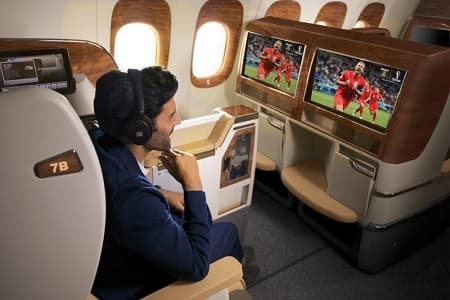
Emirates has announced that one million passengers have connected to its Starlink-powered inflight Wi-Fi service within the first seven months of deployment. The service, currently available on 36 aircraft, utilizes multiple satellite antennas to deliver up to 2 Gbps of bandwidth, enabling high-definition streaming and live communication for passengers.
The milestone signals a shift in inflight entertainment (IFE) where satellite-based low-latency connectivity serves as a primary delivery mechanism for streaming rather than just a browsing utility. By delivering gigabit-scale bandwidth, Emirates effectively eliminates the performance gap between home and cabin networks, commoditizing high-definition video calls and cloud-based applications at cruising altitude. This sets a high-speed baseline for the global long-haul market, pressuring legacy GEO satellite providers to defend their share against SpaceX's growing LEO footprint. Watch for the integration of live television directly into this data pipe, which could potentially phase out dedicated broadcast hardware in future fleet retrofits.
The rapid adoption at Emirates is part of a larger territorial battle for the cabin as LEO satellite constellations challenge established geostationary (GEO) providers. Per Valour Consultancy in March 2026, Starlink has built a backlog of more than 5,000 committed commercial aircraft, though it faces intensified competition from multi-orbit strategies. Incumbents like Viasat and Panasonic Avionics are responding by integrating LEO capacity—such as the Telesat Lightspeed or OneWeb networks—into their existing GEO portfolios to offer similar low-latency performance without requiring airlines to scrap legacy hardware entirely.
Market competition is further diversifying as new entrants arrive. Per Reuters in June 2026, Amazon's LEO network, rebranded as Amazon Leo, has secured launch deals with Delta Air Lines and JetBlue Airways, aiming for first connected flights in 2027. Delta plans to deploy the service on 500 aircraft, prioritizing integration with its AWS-powered technology ecosystem. This push follows a broader industry trend toward free high-speed Wi-Fi, which Ookla data from late 2025 suggests has become a critical variable in passenger satisfaction and corporate travel contract renewals.
Regionally, Middle Eastern carriers are leading the first wave of large-scale LEO deployments. Per Aviation Week in January 2026, Qatar Airways completed its Starlink rollout across nearly 120 widebody aircraft, including its entire Airbus A350 fleet. Qatar reported that its passengers accounted for nearly half of the 21 million global Starlink inflight connections logged in 2025. These deployments coincide with multi-billion-dollar cabin retrofits, such as Emirates’ $5 billion program, which aim to modernize fleet interiors and entertainment systems to accommodate rising data demand from remote workers and high-definition streaming users.
Add StreamingMeme as a preferred source on Google to see more of our streaming news at the top of your Search results.
Add as preferred source