

Databricks Unifies Streaming Analytics: Spark Real-Time Mode Achieves Sub-Second Latency
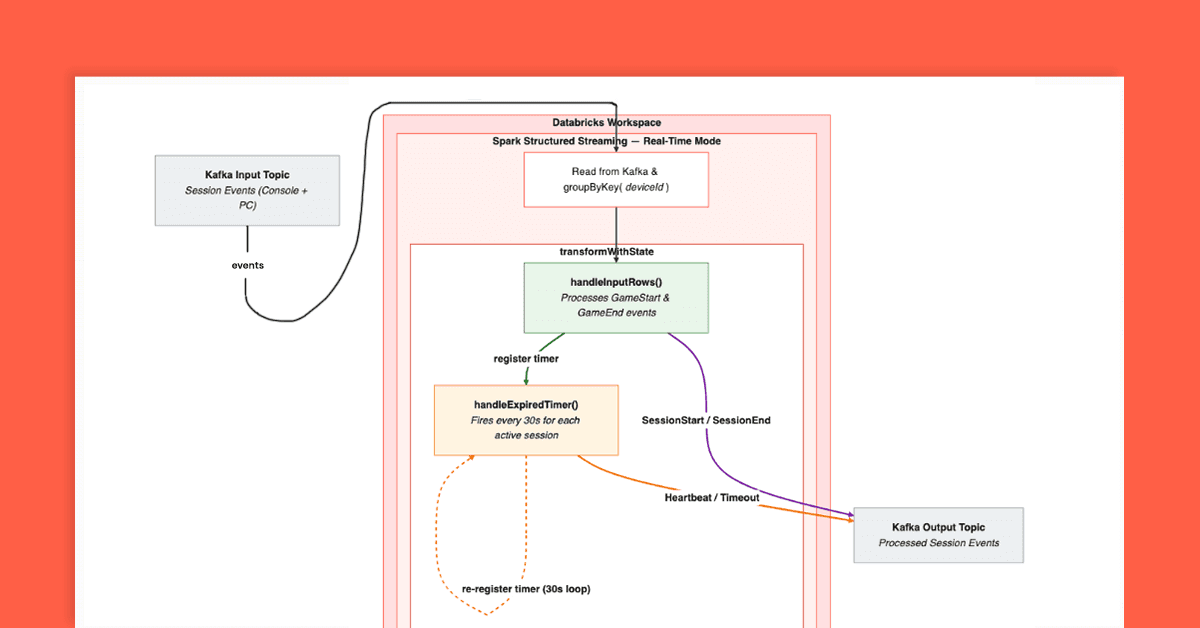
Databricks has introduced Apache Spark Real-Time Mode, enabling sub-second latency for use cases like gaming sessionization, utilizing existing Spark APIs. This allows streaming professionals to unify architectures and achieve millisecond performance for complex stateful processing. The new feature, incorporating the transformWithState operator, delivers significantly faster processing than micro-batch mode, with 432ms p99 latency for session tracking.
Key Takeaways
- Apache Spark Real-Time Mode achieves 432ms p99 latency for session tracking, marking a 20x improvement over micro-batch mode.
- The new transformWithState operator enables complex stateful processing with object-oriented state management and timer-driven logic.
- Real-Time Mode processes ~500K input events per minute and emits ~8M heartbeat records, demonstrating 16x input-to-output amplification.
- The feature allows unified architecture, eliminating the need for separate streaming engines like Apache Flink or custom in-house solutions.
Why It Matters
This development from Databricks directly impacts real-time data processing in streaming, particularly for applications requiring immediate feedback like gaming, IoT, or real-time alerting. By enabling sub-second precision within the familiar Spark ecosystem, companies can avoid infrastructure fragmentation and operational complexity associated with managing multiple data engines. This could accelerate development cycles for mission-critical operational applications. Watch for adoption rates among companies currently running Spark Structured Streaming that previously needed separate solutions for ultra-low-latency stateful processing.
Read full article at databricks.com
Enjoy our coverage?
Add StreamingMeme as a preferred source on Google to see more of our streaming news at the top of your Search results.
Add as preferred source