

Corporate broadcast AV market to reach $43 billion by 2025
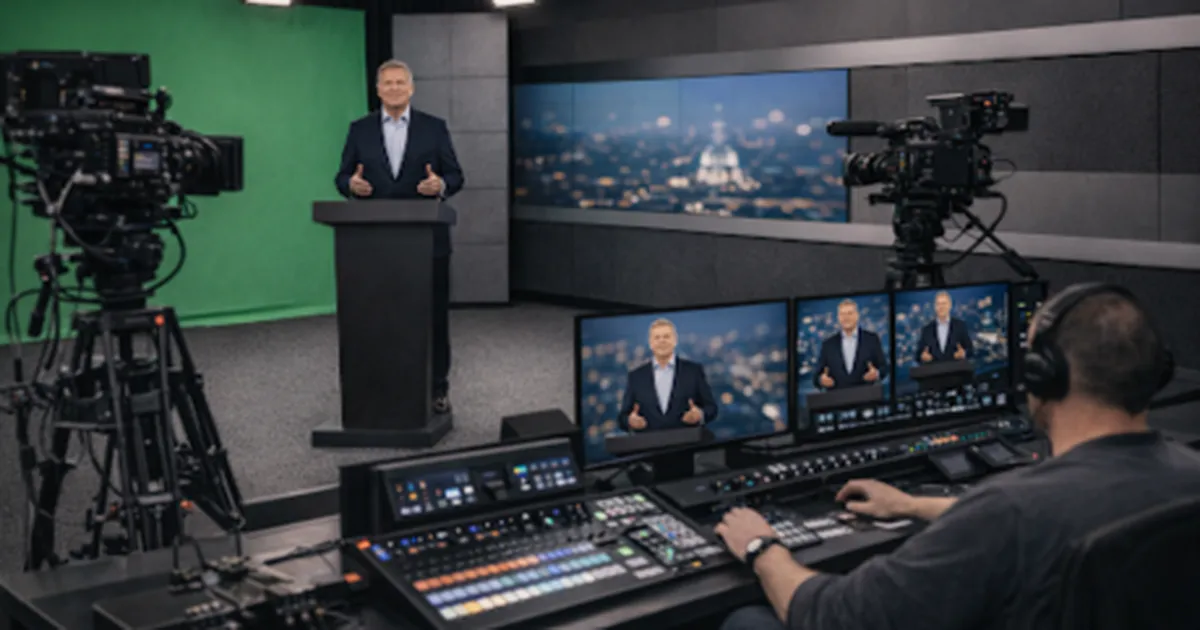
AVIXA reports the broadcast AV market is projected to reach $43 billion by 2025, driven by corporate enterprises building permanent in-house production studios. This shift requires technology integrators to align broadcast-grade production workflows—including IP-based signal chains and NDI/ST 2110 standards—with existing enterprise IT infrastructure.
Key Takeaways
- Broadcast AV market projected to grow at a 5.46% compound annual rate through 2029.
- Corporate attendance at NAB Show 2026 nearly doubled year-over-year to 13,000 professionals.
- Integration labor for corporate studios exceeds meeting rooms due to complex IP routing and talent-based commissioning.
- Standard scoping often misses essential broadcast requirements like vision mixers, stream encoding, and network segmentation.
- UK financial services and German manufacturing firms are leading the adoption of board-level executive production suites.
Why It Matters
The transition from executive webcams to permanent broadcast facilities represents a fundamental change in the corporate technology stack. Leading enterprises now require broadcast-level determinism and signal integrity formerly reserved for television stations, necessitating a pivot toward IP-native architectures. This creates a high-margin opportunity for integrators who can navigate the friction between broadcast engineering and existing IT network policies. However, firms that fail to qualify specific production outputs and operational resilience during discovery risk significant budget overruns and technical delivery failures. Watch for the adoption rate of IPMX as a pragmatic bridge for firms that find SMPTE ST 2110 too complex for standard IT environments.
Additional Context
The expansion of the corporate broadcast sector is part of a broader resilience in the professional AV industry. According to AVIXA’s August 2025 Industry Outlook and Trends Analysis (IOTA), total pro AV revenue is expected to grow from $332 billion in 2025 to $402 billion by 2030. While macroeconomic pressures like high interest rates and geopolitical uncertainty have slowed the overall growth rate from 5.3% to 3.9%, the broadcast AV segment has emerged as the second-largest solution area, trailing only conferencing and collaboration. This ranking underscores a material shift in how enterprises view video: it has moved from a simple meeting tool to mission-critical infrastructure for the experience economy.
Technologically, the industry is witnessing a consolidation around specific IP protocols to manage this growth. Per reporting from NewscastStudio and industry announcements in April 2026, there is a clear divide between deterministic, high-precision workflows using SMPTE ST 2110 and more accessible, software-driven deployments using NDI and Dante AV. Audinate, for example, demonstrated at NAB 2026 how Dante is unifying audio and video control specifically for these modern hybrid environments. This interoperability is essential as corporate media teams, which saw a 140% surge in content creator attendance at NAB 2026, demand faster production speeds and lower technical barriers to entry.
Despite the move toward IP, the transition remains technically demanding. External data from Haivision’s 2026 broadcast survey indicates that SDI still serves as the backbone for 82% of traditional operations, highlighting the complexity of migrating to all-IP environments. For the corporate sector, the challenge is even steeper as they must balance broadcast-grade quality with standard Gigabit Ethernet limitations. As noted at ISE 2026, the market for IP-to-IP converter gateways is expanding rapidly to help bridge these disparate asset classes and provide the redundancy required for high-stakes executive communications.
Read full article at avixa.org
Enjoy our coverage?
Add StreamingMeme as a preferred source on Google to see more of our streaming news at the top of your Search results.
Add as preferred source