

Congatec launches Ryzen AI X100 module for high-performance edge vision
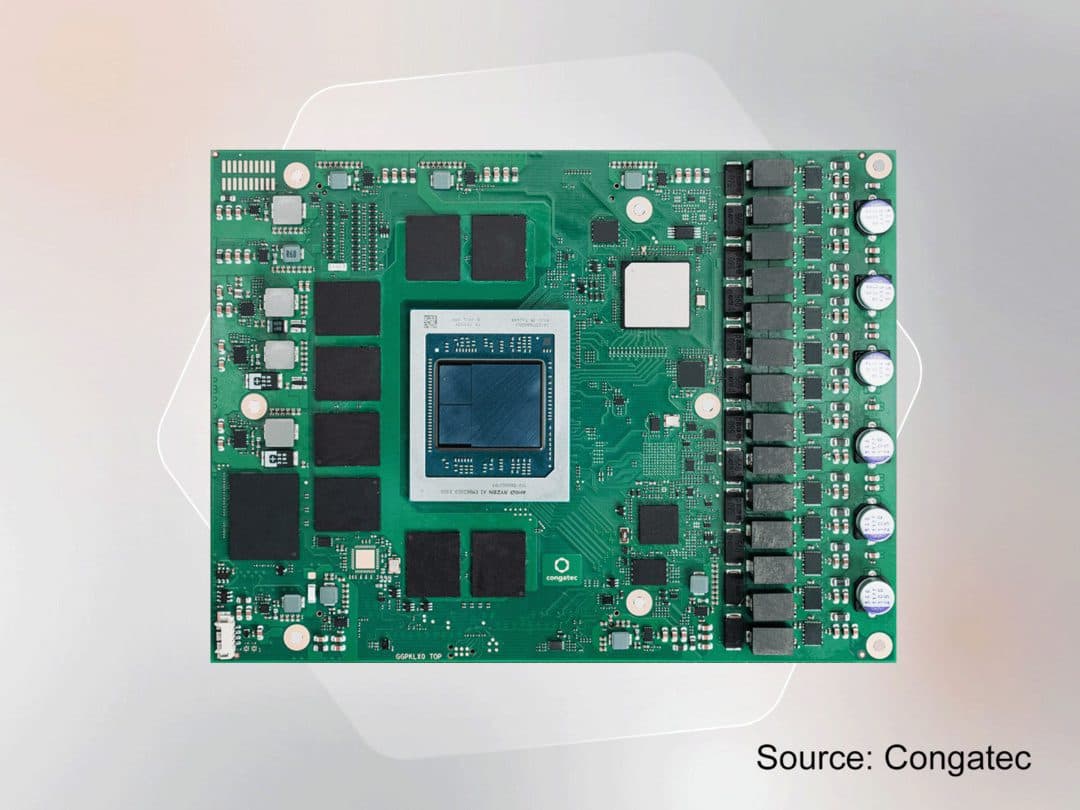
Congatec has launched the conga-HPC/cRX1, a new computer-on-module featuring AMD Ryzen AI Embedded X100 Series processors. The module integrates CPU, GPU, and NPU resources to support local inference and real-time processing, aimed at hardware-intensive edge applications such as industrial automation and robotics.
Key Takeaways
- Integrated XDNA 2 NPU delivers up to 50 TOPS for always-on, low-power inference tasks.
- Radeon RDNA 3.5 GPU provides 29.7 TFLOPS of FP32 compute, capable of driving four 4K displays.
- Unified LPDDR5X-8533 memory reaches 128 GB, reducing data movement bottlenecks between compute domains.
- Industrial 'i' variants operate in extreme temperatures ranging from -40 °C to +85 °C.
- Designed for IEC 62443-4-1 compliance to meet upcoming EU Cyber Resilience Act requirements.
Why It Matters
The move toward 'physical AI' requires consolidating sensing, inference, and control into a single, low-latency silicon footprint. By leveraging the Ryzen AI X100, congatec provides a modular path for OEMs to scale complex machine vision and robotics applications while avoiding the power and space costs of discrete GPUs. This integration is critical as the industry shifts from cloud-based processing to deterministic edge execution. For the streaming and media ecosystem, this hardware enables sophisticated real-time video analytics and local metadata generation at the point of capture. Industry observers should watch for the first production deployments in autonomous commercial vehicles and medical imaging scheduled for Q4 2026.
Additional Context
The launch coincides with AMD's broader 'Advancing AI 2026' event in San Francisco, where the chipmaker positioned the Ryzen AI Embedded X100 as its primary vehicle for the 'physical AI' market. According to AMD reports from July 2026, the X100 series is built on Strix Halo-class silicon and is projected to outperform rivals like NVIDIA's Jetson T500 by up to three times in specialized medical applications. Production for the X100 is slated for Q4 2026, with launch partners including Arbor, iBase, and IEI joining congatec in offering modular solutions. Per ITPro (July 2026), these hardware releases are supported by the new Rocm.ai software stack, which uses AI coding agents to simplify GPU and NPU optimization for developers.
Simultaneously, the European Union has accelerated its regulatory timeline for embedded security. According to the European Commission (July 2026), vulnerability-reporting obligations under the Cyber Resilience Act (CRA) are scheduled to begin on September 11, 2026. This has forced hardware vendors like congatec to prioritize 'security by design' in their latest modules to ensure market access before full CRA enforcement in late 2027. This regulatory pressure is driving a shift toward modules that include TPM 2.0 and meet IEC 62443-4-1 standards as a baseline requirement for industrial equipment.
In the competitive landscape, the computer-on-module market is expected to reach $1.9 billion in 2026, according to Grand View Research (June 2026). While ARM-based modules currently hold the largest market share, the introduction of x86-based platforms with integrated NPUs—such as the X100 and Intel’s Core Ultra Series 3—is intensifying competition for high-end robotics and automation workloads. Per TweakTown (July 2026), AMD’s strategy emphasizes an open software ecosystem, allowing users to migrate up to 75% of existing CUDA code to the ROCm stack, directly challenging NVIDIA’s dominance in the edge AI development pipeline.
Read full article at eenewseurope.com
Enjoy our coverage?
Add StreamingMeme as a preferred source on Google to see more of our streaming news at the top of your Search results.
Add as preferred source