

Canada orders CRTC to review 15% streaming revenue contribution mandate
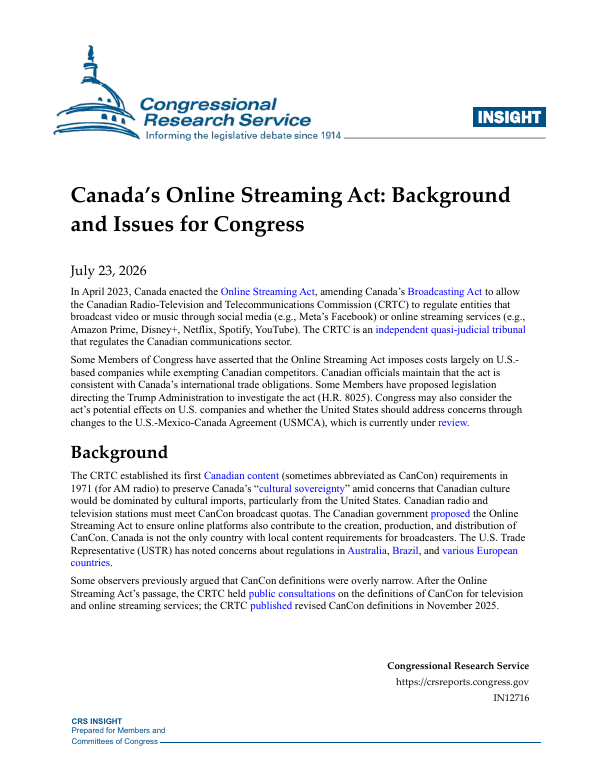
The Canadian government has ordered the CRTC to review a controversial decision that would require streaming services to contribute 15% of annual revenue to local content funds. This directive follows concerns over potential consumer price hikes and ongoing trade tensions regarding the Online Streaming Act.
Key Takeaways
- Minister Marc Miller ordered the CRTC to reassess the 15% levy, originally intended to triple previous 5% contribution requirements.
- Federal officials announced C$600 million (US$426 million) in annual government investment to offset potential funding gaps for local producers.
- The 15% mandate applied to platforms with annual Canadian broadcasting revenues exceeding C$25 million (US$18 million), including Netflix and Disney+.
- U.S. lawmakers and trade officials flagged the mandate as a barrier during the ongoing review of the U.S.-Mexico-Canada Agreement (USMCA).
Why It Matters
The directive effectively pauses a massive fiscal shift that would have redirected an estimated US$7 billion over five years from U.S. streamers to Canadian media funds. By intervening, the Canadian government is attempting to decouple cultural funding from consumer pricing while navigating a delicate USMCA review where cultural protectionism has become a primary trade irritant. For the industry, this signals a tactical retreat from aggressive revenue-sharing models in favor of direct state subsidies. Stakeholders should track whether the CRTC's 'new policy directions' result in a permanent rollback of the 5% base levy or simply a more flexible reinvestment framework.
Additional Context
The decision to reverse the CRTC’s 15% mandate comes amid significant pressure from both industry groups and foreign diplomats. In June 2026, the Motion Picture Association (MPA) and the U.S. Ambassador to Canada argued that the tripling of local investment obligations constituted a discriminatory trade barrier. Per The Logic (June 2026), the original CRTC ruling had also sought to alleviate financial pressure on traditional Canadian broadcasters by lowering their contribution rates from 45% to 25%, a balance that may now be upended. Concerns regarding consumer impact were central to the government’s pivot. Minister Marc Miller noted at the Banff World Media Festival in June 2026 that the government envisions directing the new C$600 million federal investment toward the Canada Media Fund and French-language content to provide immediate stability. However, some domestic creators have criticized the move; organizations like ACTRA have characterized the shift to taxpayer funding as a concession to U.S. platforms at the expense of established regulatory goals. Trade enforcement remains a looming threat. According to ITIF (March 2026), U.S. House Representative Lloyd Smucker introduced legislation to trigger a Section 301 investigation into the Online Streaming Act, which could lead to retaliatory tariffs on Canadian goods. While the USMCA’s Article 32.6 provides an exemption for cultural industries, the U.S. retains the right to implement 'measures of equivalent commercial effect,' keeping the streaming levy at the center of broader cross-border digital trade negotiations.
Read full article at everycrsreport.com
Get this in your inbox → Subscribe
Enjoy our coverage?
Add StreamingMeme as a preferred source on Google to see more of our streaming news at the top of your Search results.
Add as preferred source