

Bolt Graphics Zeus GPU targets 2027 launch to challenge Nvidia dominance
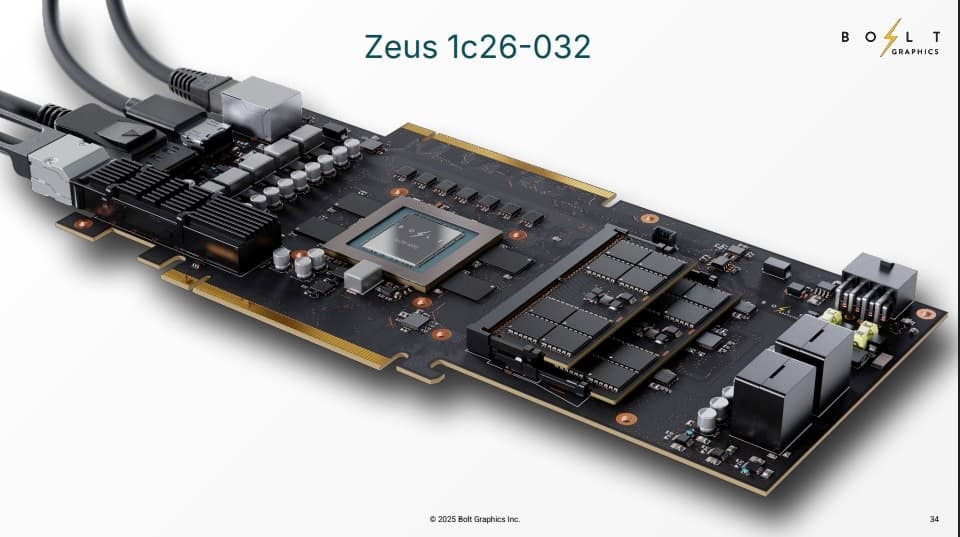
Startup Bolt Graphics showcased its new Zeus GPU architecture at SIGGRAPH 2026, claiming significant performance gains in real-time path tracing via custom SIMD layout and RISC-V processors. The hardware is designed for professional 3D rendering and simulation workflows, with initial market delivery targeted for late 2027.
Key Takeaways
- Targets late 2027 for initial hardware delivery following a successful 12nm test chip tape-out in April 2026.
- Claims a 17x reduction in rendering costs by focusing on raw path-tracing silicon power over AI tensor cores.
- Requires only 28 Zeus GPUs to achieve real-time path tracing compared to an estimated 280 Nvidia RTX 5090 units.
- The flagship Zeus 4C configuration delivers 307 gigarays of path-tracing performance on a 500W power budget.
- Integrated Glowstick technology provides real-time path tracing directly within viewports for Autodesk Maya, Blender, and Unreal Engine.
Why It Matters
Bolt Graphics is positioning itself as a specialized alternative to the general-purpose AI trajectory of Nvidia and AMD. By prioritizing raw path-tracing throughput and RISC-V flexibility, Zeus addresses the specific latency and cost bottlenecks currently hampering photorealistic production in AEC and VFX workflows. This specialized architecture suggests a fragmentation of the professional GPU market, where specialized silicon could displace current flagships for high-end simulation tasks. Watch for the porting of this architecture to TSMC’s 5nm process node, which will be the critical hurdle for meeting the December 2027 delivery target.
Additional Context
The emergence of Bolt Graphics coincides with a shift in the semiconductor market where challengers are increasingly targeting specific bottlenecks rather than competing across Nvidia’s entire software stack. Per Network World in May 2026, the Zeus architecture is drawing initial interest from ad agencies and engineering firms specifically for its 'no AI tricks' approach to rendering, which preserves the integrity of scientific simulation and copyrighted art. Industry analyst Jon Peddie noted that while the consumer gaming market remains an uphill battle, Bolt’s specialized focus on high-end scientific and visual graphics addresses a professional sector currently strained by high hardware costs and supply shortages.
In terms of connectivity and scale, Bolt has also distinguished its hardware by integrating native 400 GbE and 800 GbE Ethernet interfaces directly into the GPU, per Digital Engineering in March 2025. This allows for massive, direct GPU-to-GPU interconnects without the traditional overhead found in standard PCIe configurations. This focus on backend infrastructure aligns with trends seen in other startups like Groq and Tenstorrent, which use RISC-V or custom interconnects to bypass memory and latency constraints.
Strategic partnerships are already forming ahead of the 2027 release. Per CG Virtual Studio in July 2025, cloud provider CenterGrid has partnered with Bolt to integrate Zeus technology into its virtual studio cloud workstations. This collaboration aims to provide artists with up to 10x faster cloud rendering speeds at 4K resolution, leveraging Zeus's ability to support up to 2TB of RAM per GPU. As production renderers like Arnold and V-Ray prepare for more complex path-tracing demands, the pressure on TSMC’s 5nm capacity will determine if these startups can meet the volume requirements of major studios.
Read full article at architosh.com
Enjoy our coverage?
Add StreamingMeme as a preferred source on Google to see more of our streaming news at the top of your Search results.
Add as preferred source