
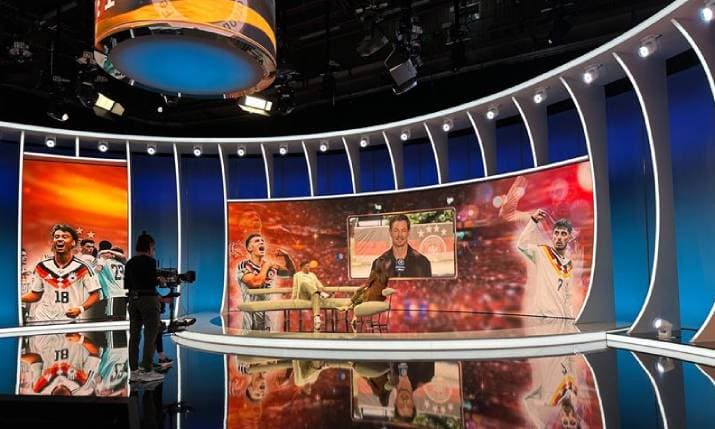
German public broadcaster ARD details its remote and on-site production workflows for the FIFA World Cup 2026, utilizing a centralized ARD SportHub in Cologne fed by signals from ZDF's NBC in Mainz via MTI Teleport München. ARD is deploying new flyaway venue kits using LiveU technology for bonded cellular transmission, and leveraging SRT for return feeds to on-air talent iPads. The broadcaster is also using Ross Video's Lama Automix for automated radio mixing for the first time.
ARD's World Cup setup demonstrates how far centralized remote production has matured for tier-one live sports. By eliminating on-site OB vans and IBC presence entirely, ARD has reduced its US footprint to four-person flyaway kits — a model that mirrors the broader industry shift documented at HBS's Dallas IBC, where replay, shading, and audio are similarly centralized. The debut of Lama Automix for radio commentary at this scale also signals growing confidence in AI-assisted audio mixing for live sports. Watch whether ARD extends this venue kit model to LA 2028, as ZDF has already confirmed centralized production plans for those Olympics.
ARD's remote-first approach aligns with the broader production architecture at FIFA World Cup 2026, where host broadcaster HBS has centralized replay, shading, audio mixing, and graphics at the IBC in Dallas rather than at individual stadiums. Per Sports Video Group (June 2026), HBS Project Director Stefan Wistuba described this as potentially the tournament's lasting legacy, stating: "It doesn't matter where you're sitting anymore to operate." HBS is running six galleries at the IBC to handle up to six simultaneous matches, with seven slow-motion replay teams organized by language, including a dedicated German team.
The scale of the 2026 tournament forced the centralization issue. Per Streaming Media (June 2026), FIFA president Gianni Infantino compared the undertaking to "104 Super Bowls," with 104 matches across 16 venues in three countries over 39 days. HBS built a fully converged ST-2110 network with 600 Gbps capacity per venue, using JPEG XS compression for non-main feeds. A separate post-production hub in London handles all non-live content, tapping UK editing talent to reduce travel costs.
Ross Video's Lama Automix, which ARD deployed for radio commentary for the first time, has a track record at major events. According to Ross Video, Eurosport used Lama Automix to produce 15,000 commentary sessions at the Paris 2024 Olympics — more than triple the volume from Beijing 2022. The software uses adaptive DSP for automatic speech leveling, EQ, and AI-based noise reduction, enabling a single operator to manage multiple simultaneous mixes.
ARD and ZDF's planning was further complicated by late rights acquisition. Per film-tv-video.de (June 2026), the German free-to-air rights were only secured on October 7, 2025, forcing both broadcasters to rely on existing infrastructure rather than build new facilities. ZDF has already confirmed that the same centralized production model will extend to the LA 2028 Olympics.
Add StreamingMeme as a preferred source on Google to see more of our streaming news at the top of your Search results.
Add as preferred source