

Antrica embeds Hailo-8 AI accelerators for low-latency UAV video encoding
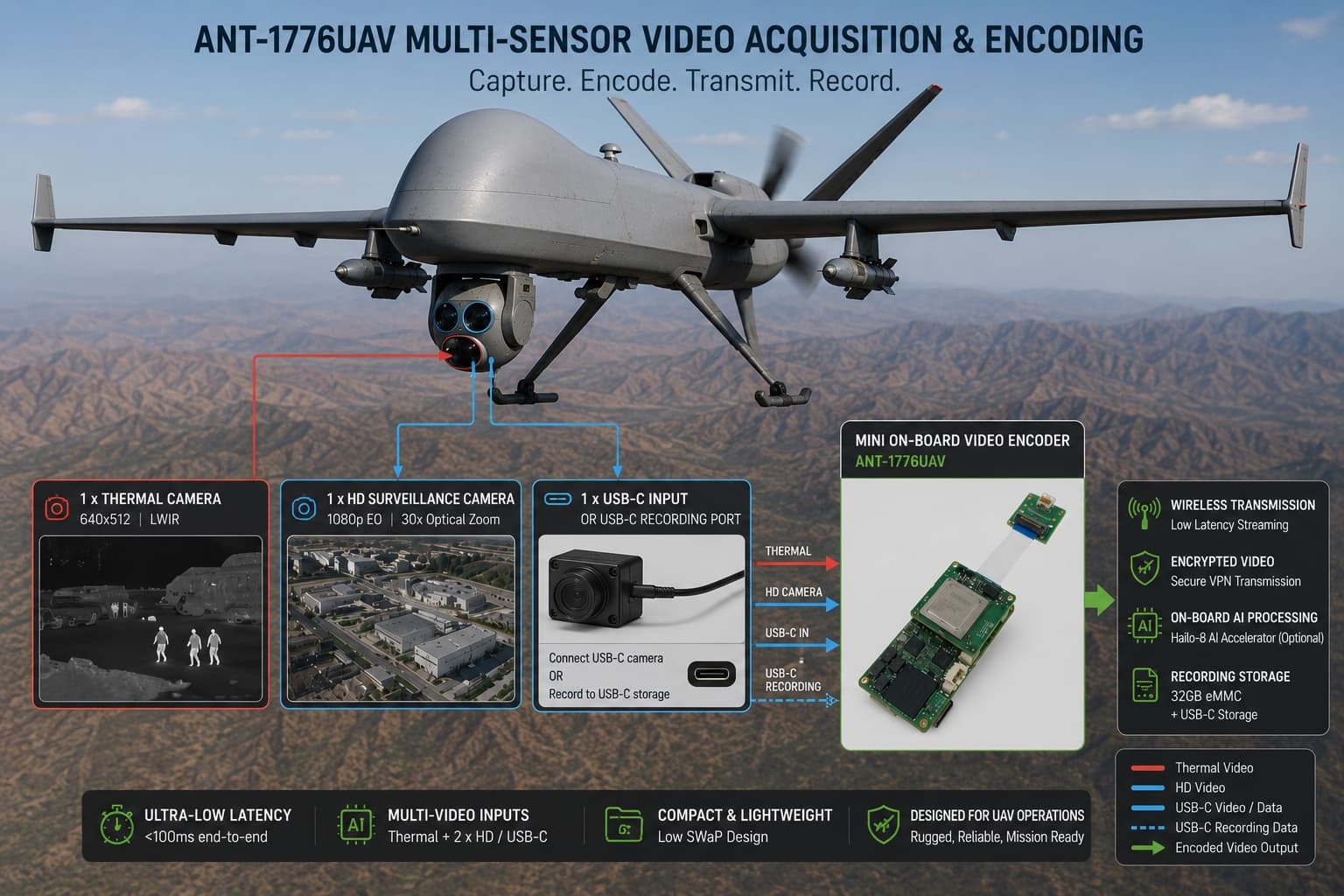
Antrica showcased integrated UAV video encoder boards featuring Hailo-8 AI accelerators for onboard object detection and edge processing at the Farnborough International Airshow. The hardware, designed for defense and aerospace applications, supports multiple simultaneous camera feeds, H.264/H.265 compression, and low-latency streaming.
Key Takeaways
- Hailo-8 integration enables onboard YOLOv5/v8 object detection without offloading processing to the ground or cloud.
- Hardware architecture supports simultaneous HDMI, composite, and USB-C inputs to reduce total payload weight.
- Units achieve ~100ms total system latency and include native support for OpenVPN and AES-encrypted local recording.
- New Maris-branded defense line includes Diamond (360-degree vehicle situational awareness) and Coral (tactical BLOS missions).
Why It Matters
The shift toward edge AI in uncrewed systems reflects a broader industry requirement to minimize glass-to-glass latency and bandwidth consumption in mission-critical environments. By integrating Hailo-8 silicon, Antrica addresses the 'power vs. compute' bottleneck, offering a low-power alternative to power-hungry GPU-based accelerators. This move positions Antrica within a growing B2B ecosystem prioritized by defense buyers requiring NDAA-compliant, non-Chinese hardware for secure Beyond Visual Line of Sight (BVLOS) operations. Watch for whether Antrica’s expansion into complete situational-awareness systems like 'Diamond' and 'Onyx' disrupts traditional partnerships with larger defense primes that previously utilized their standalone boards.
Additional Context
The integration of AI into edge encoding hardware arrives as the global video encoder market transitions from legacy fixed appliances to specialized, high-efficiency silicons. Per Mordor Intelligence (January 2026), hardware encoders maintained a 53.74% revenue share as of 2025, driven largely by mission-critical sectors like defense and live sports where deterministic performance is vital. However, the rise of uncrewed aerial vehicles (UAVs) has placed new pressure on size, weight, and power (SWaP) constraints, favoring specialized accelerators over general-purpose processors.
Similarly, the broader drone communication market is projected to reach $4.09 billion by 2030, growing at an 8.8% CAGR from 2025, according to MarketsandMarkets. This growth is increasingly tethered to National Defense Authorization Act (NDAA) compliance, as government entities phase out non-compliant hardware in favor of domestically or allied-sourced technology. For instance, ZenaTech recently configured manufacturing lines specifically for NDAA-compliant drone sensors (January 2026) to meet these shifting regulatory mandates.
Antrica’s strategic partner, Maris-Tech, has also emphasized the necessity for low-latency processing in the OODA (Observe-Orient-Decide-Act) loop. Per Maris-Tech (October 2025), miniaturized systems now allow for multi-stream AI inference—such as simultaneous infrared and thermal analysis—directly on helmet-mounted or micro-UAV systems. This shift reduces reliance on potentially compromised or low-bandwidth radio links, allowing intelligence to be processed at the point of capture rather than at a remote command center.
Read full article at aeroxplorer.com
Enjoy our coverage?
Add StreamingMeme as a preferred source on Google to see more of our streaming news at the top of your Search results.
Add as preferred source