

Amadeus Acoustics launches Downmix Engine to bridge immersive and broadcast audio
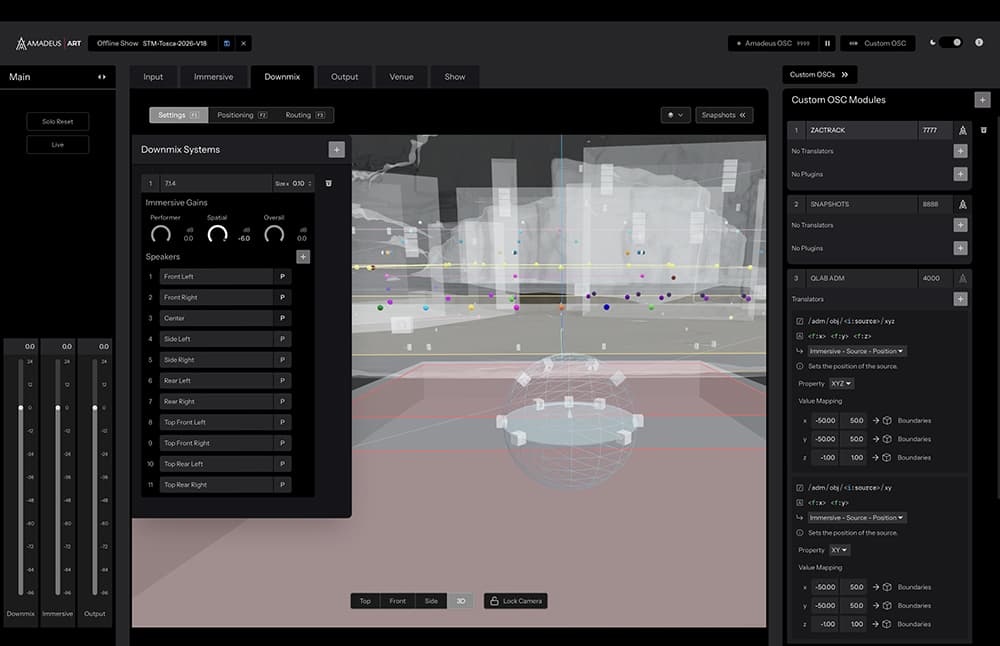
Amadeus Acoustics has launched ART::Director v1.3.1, a software update featuring a new Downmix Engine designed to translate complex, immersive venue audio into standardized formats for broadcast and production monitoring. The update also adds OSC automation, improved DSP connection stability, and new acoustic precision tools for sound designers.
Key Takeaways
- Integrated Downmix Engine supports standardized formats including 5.1, 7.1, Atmos, and bespoke loudspeaker layouts
- New OSC automation features provide pattern-based addresses and full compatibility with the ADM-OSC protocol
- Independent LFE dedicated outputs and size multipliers allow engineers to scale spatial fields for specific monitoring rooms
- Performer source gain offsets and support for negative loudspeaker delay improve acoustic precision for fill and subwoofer systems
Why It Matters
This update addresses a critical bottleneck in live media by decoupling immersive venue sound from the physical auditorium. By allowing sound designers to build spatial soundscapes in offline studio environments via downmix simulations, production timelines are significantly compressed. As immersive audio becomes a baseline requirement for major global broadcasts, tools that standardize the transition between high-channel-count arena systems and mobile broadcast units are essential for operational scalability. Watch for the upcoming implementation of these tools at the 2026 Eurovision Song Contest, where Amadeus serves as a technical supplier.
Additional Context
The release of ART::Director v1.3.1 aligns with an industry-wide pivot toward interoperable immersive audio metadata. Per SMPTE reporting in March 2026, the transition to immersive audio in media and entertainment research has moved beyond experimental phases into standardized delivery frameworks like ATSC 3.0 and DVB. These standards incorporate Next Generation Audio (NGA) frameworks that support object-based rendering via codecs such as Dolby AC-4 and MPEG-H, which are critical for the device-adaptive rendering that Amadeus’s new downmix engine facilitates.
Interoperability remains a central theme, as Amadeus Acoustics is a key stakeholder in the ADM-OSC workgroup. This initiative, which includes peers like d&b audiotechnik, L-Acoustics, and Meyer Sound, seeks to standardize the communication protocol between object editors and renderers across live and broadcast ecosystems. Per documentation from June 2026, ADM-OSC v1.0 has become the lightweight protocol of choice for ensuring that spatial metadata—such as gain and positioning—translates accurately between disparate hardware environments.
Amadeus's technological footprint in high-profile cultural venues provides a practical testing ground for these software updates. The historic Theater an der Wien in Vienna, which completed a major refurbishment in 2024, utilizes an Amadeus Core system managing 220 outputs and over 120 loudspeakers from CODA Audio. Use cases from such venues demonstrate how immersive processing is no longer confined to the main stage but must now extend to auxiliary zones and digital broadcast outputs to meet modern production demands.
Read full article at prosoundweb.com
Enjoy our coverage?
Add StreamingMeme as a preferred source on Google to see more of our streaming news at the top of your Search results.
Add as preferred source