

ClaimsEvidence maps codec patent risk across AVC, AV1 and VVC
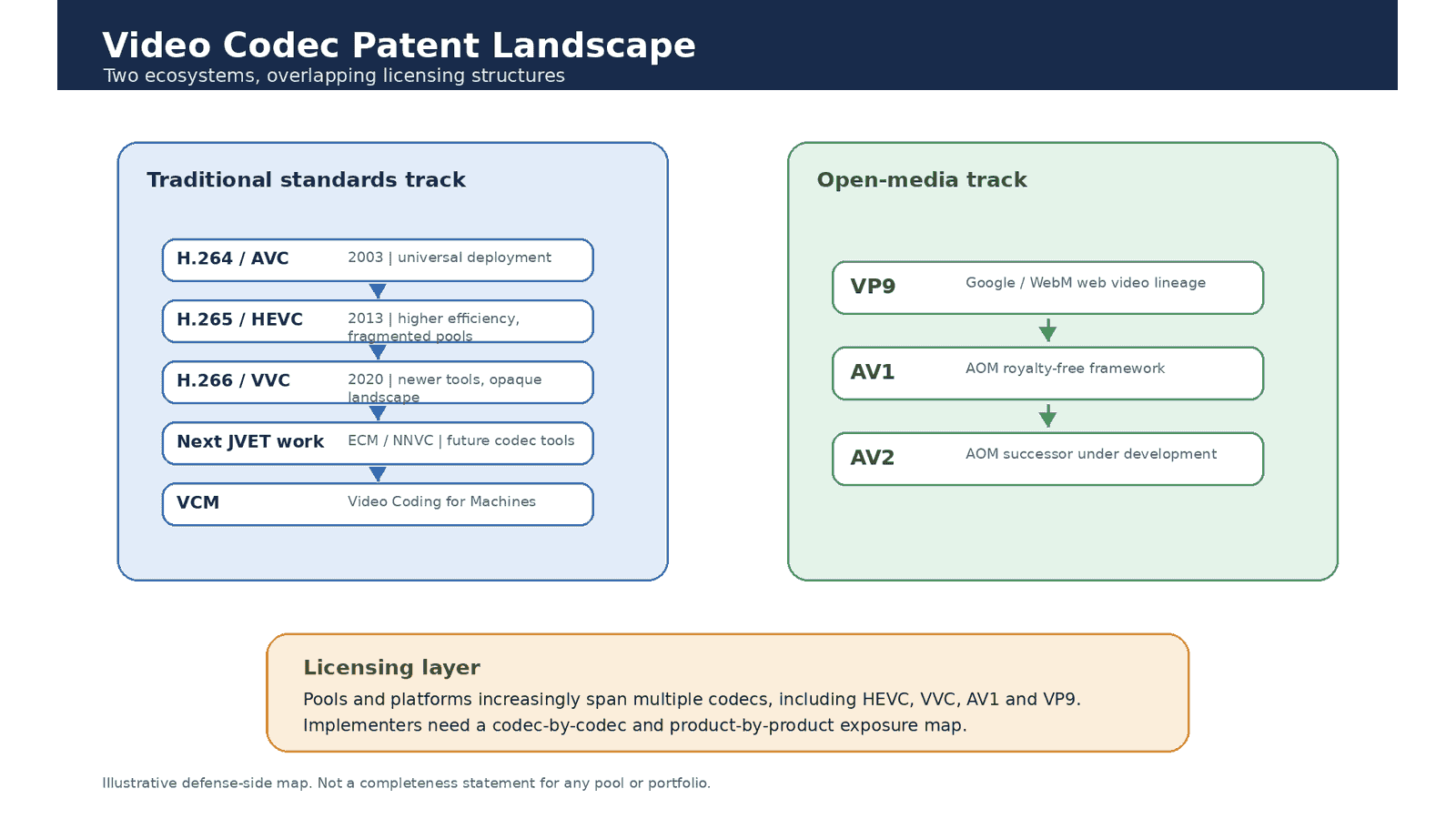
ClaimsEvidence has published a defense-side primer for implementers navigating the complex video codec patent landscape, covering traditional FRAND-licensed standards and royalty-free codecs. The article details how implementers can manage patent exposure for codecs like AVC, HEVC, VVC, VP9, AV1, and AV2, emphasizing the need for independent essentiality analysis due to evolving licensing models and transparency gaps. It also highlights emerging patent considerations for Video Coding for Machines (VCM) and AI-based video coding.
Key Takeaways
- The primer covers AVC, HEVC, VVC, VP9, AV1 and AV2, plus MPEG-DASH and emerging VCM work.
- Access Advance says its VCL Advance program now covers HEVC and VVC after acquiring Via LA’s program on December 15, 2025.
- Sisvel runs VP9 and AV1 licensing programs, while Avanci Video says its platform covers AV1, H.265/HEVC, H.266/VVC, MPEG-DASH and VP9.
- The article says many VVC SEP owners had not provided patent lists to the ITU as of early 2024.
- ISO/IEC 23888-2 is identified as “Artificial intelligence for multimedia - Part 2: Video coding for machines.”
Why It Matters
The immediate implication is that streaming, device and analytics companies cannot treat codec choice as a clean licensing decision: the article says AV1, HEVC, VVC, VP9 and even MPEG-DASH can sit inside overlapping pool, bilateral and non-pool exposure. That matters because the same stack may face different claims depending on codec profile, service model and territory. The broader ecosystem angle is that consolidation at Access Advance, plus programs at Sisvel and Avanci, has not removed transparency gaps in ITU/ISO declarations. Watch for product-specific essentiality analysis against exact codec tools and standards passages, especially around VVC and VCM.
Read full article at claimsevidence.com
Enjoy our coverage?
Add StreamingMeme as a preferred source on Google to see more of our streaming news at the top of your Search results.
Add as preferred source