

Vadzo Imaging launches multi-camera HDR system for 4K sports analytics
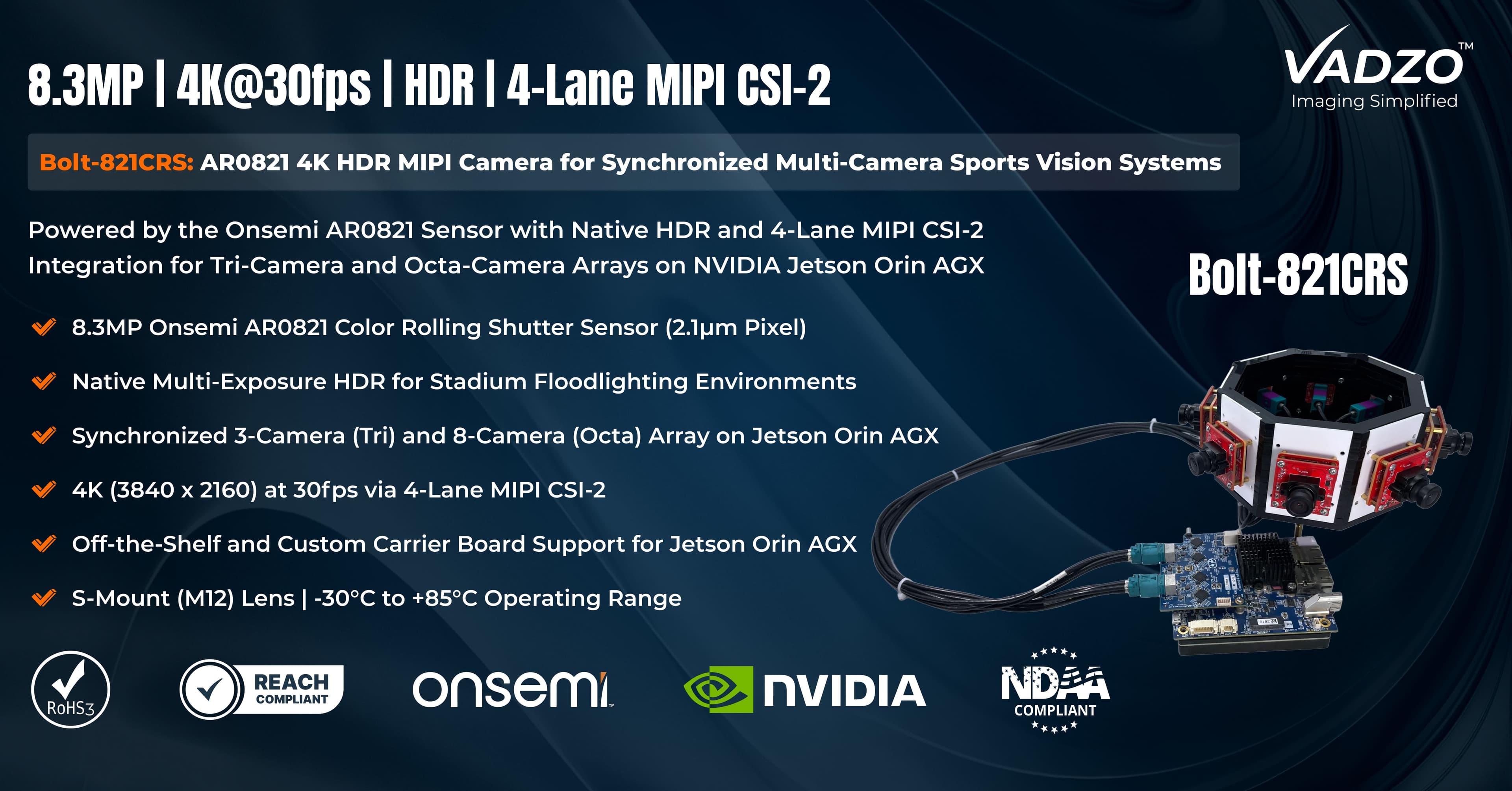
Vadzo Imaging has launched the Bolt-821CRS, a compact, 4K HDR MIPI camera module designed for synchronized multi-camera arrays on NVIDIA Jetson Orin AGX platforms. The solution targets sports broadcasting and AI-driven player tracking by offering hardware-level frame timing synchronization for up to eight cameras.
Key Takeaways
- Hardware-level frame synchronization supports array configurations of three to eight cameras via 4-lane MIPI CSI-2.
- Integrated Onsemi AR0821 sensor offers 8.3MP resolution and 140 dB native HDR to manage high-contrast stadium lighting.
- Eliminates USB and network stack latency by routing data directly to the NVIDIA Jetson Orin AGX hardware ISP.
- Supports off-the-shelf and custom carrier boards with a compact 38mm x 38mm footprint (convertible to 32mm x 32mm).
Why It Matters
Multi-camera synchronization is the primary bottleneck in high-fidelity sports analytics. By shifting synchronization from software to sensor-level hardware, Vadzo enables precise player trajectory reconstruction across overlapping zones without the jitter common in networked IP cameras. For the broader industry, this moves 4K HDR broadcasting and tracking onto compact, edge-compute platforms rather than centralized server racks. Expect a market push toward integrated MIPI arrays for real-time graphics and officiating tools, particularly as NVIDIA Jetson Orin hardware becomes the standard for venue-based AI inference. Watch for adoption rates in professional soccer and basketball, where seamless multi-view handoffs are critical for pose estimation.
Additional Context
The sports analytics market is undergoing a structural shift toward real-time optical tracking. Per Precedence Research, the global AI in sports market was valued at $10.82 billion in 2025 and is projected to reach approximately $13.10 billion by the end of 2026. This growth is driven by professional leagues like the NFL, NBA, and MLB integrating computer vision for officiating, tactical planning, and fan engagement. Data from Fact.MR in June 2026 suggests that computer vision specifically will grow at a 24% CAGR through 2036 as clubs prioritize repeatable tracking data from camera-based systems.
Technical infrastructure is a critical undercurrent of this growth. According to NVIDIA documentation from August 2025, while the Jetson AGX Orin platform has historically faced constraints regarding the number of concurrent image sensors, advancements in CSI bricks and virtual channel multiplexing now allow for more than six cameras to stream simultaneously. This architectural flexibility is essential for full-pitch coverage in soccer, where eight or more synchronized 4K feeds are required to map a 100-plus meter field at sub-centimeter accuracy.
Simultaneously, sensor-level innovation is catering to the unique lighting challenges of sports venues. Per Newswire reporting from May 2026, wide dynamic range (WDR) exceeding 120 dB is no longer a luxury but a requirement for outdoor stadium staging. Standard industrial sensors often clip highlights in artificial floodlighting, whereas newer 4K HDR modules like those using Onsemi's HyperLux architecture preserve detail in both direct sunlight and deep shadows. This capability is pivotal for automated match evaluations and scouting tools, which rely on consistent pixel information to feed large language models and pose estimation neural networks.
Read full article at digitaljournal.com
Enjoy our coverage?
Add StreamingMeme as a preferred source on Google to see more of our streaming news at the top of your Search results.
Add as preferred source