
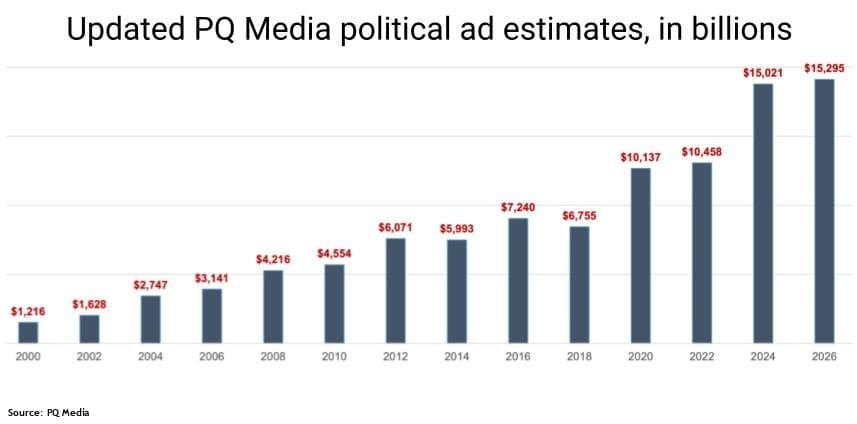
PQ Media projects that U.S. midterm political ad spending for 2026 will reach $15.3 billion, surpassing the 2024 presidential cycle expenditure of $15.0 billion. The research identifies a shift toward biennial growth in political media spend driven by increased party contentiousness and the removal of limitations on dark money funding.
The projection marks the second consecutive midterm to outpace the preceding presidential cycle, resetting the traditional quadrennial revenue model for broadcasters and streamers. For the streaming industry, the surge into Connected TV—driven by political buyers seeking precision targeting—will likely trigger severe inventory compression and CPM inflation in battleground markets through November. This biennial growth confirms that political advertising is no longer a periodic windfall but a permanent, high-volume segment of the annual ad market. Analysts should monitor Q3 2026 earnings for specific lift in local OTT and ad-supported tier revenue.
The 2026 spending surge is heavily influenced by the Supreme Court’s June 2026 decision in National Republican Senatorial Committee v. Federal Election Commission. As reported by MediaPost in June 2026, this 6-3 ruling struck down long-standing limits on coordinated spending between political parties and their candidates. This legal shift allows parties to function as direct conduits for large contributions, further accelerating the volume of "dark money" and hybrid ad buys that qualify for the lowest unit rates on linear stations, while simultaneously pushing vast sums into unregulated digital and streaming platforms.
Technological shifts are also reshaping the distribution of these funds. Per reporting from AdImpact in June 2026, Connected TV (CTV) has emerged as the critical battleground for 2026, with current spending pacing 46% ahead of the 2024 cycle. Early data from the Wesleyan University Media Project in March 2026 noted that for the first time in certain high-profile Senate races, early CTV political ad spending actually surpassed traditional broadcast buys. This reflects a broader industry migration where campaigns leverage programmatic voter targeting to reach cord-cutting voters who are no longer accessible via local news broadcasts.
Beyond domestic politics, the broader U.S. advertising market is expected to cross $320 billion in total revenue during 2026. According to GroupM and MAGNA Global forecasts from May 2026, the 2026 midterms—combined with the FIFA World Cup and Winter Olympics—will help push global ad spending past the $1 trillion mark for the first time. The convergence of these major events is expected to create unprecedented demand for premium video inventory, forcing non-political brand advertisers to compete for space during a year of intense supply constraints.
Add StreamingMeme as a preferred source on Google to see more of our streaming news at the top of your Search results.
Add as preferred source