
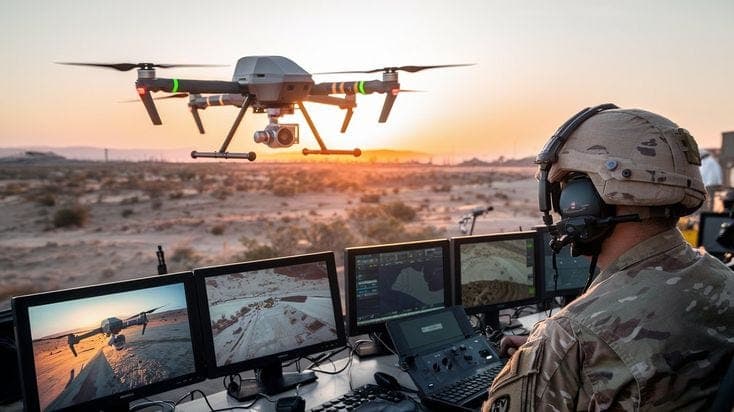
Telecommunications operators and infrastructure providers are increasingly positioning mobile network capabilities as critical assets for defense technology, specifically for autonomous drone detection. By leveraging existing connectivity and edge AI architectures, companies like AT&T, Verizon, Nokia, and Ericsson are securing defense contracts that utilize depreciated mobile network infrastructure for high-bandwidth, real-time sensing.
Add StreamingMeme as a preferred source on Google to see more of our streaming news at the top of your Search results.
Add as preferred sourceThe shift from hardware-centric defense to software-defined sensing turns national mobile networks into distributed radar systems. For the streaming and infrastructure ecosystem, this creates an secondary, high-margin revenue stream for edge compute and low-latency signal processing that is decoupled from consumer mobile churn. Telcos are essentially verticalizing their connectivity stacks to serve the 'ammunition' economy of expendable drones, where reliability and millisecond-level inference are non-negotiable. Expect specialized edge AI chipsets and private 5G architectures to prioritize these high-value defense workloads alongside civilian data. Watch for the 2029 NATO review of the Hague defense commitment as a primary signal for long-term infrastructure funding.
In February 2026, Ericsson Federal Technologies Group was awarded a prime seat on the Missile Defense Agency’s SHIELD contract, which carries a $151 billion ceiling. Per Ericsson, the initiative focuses on 'commercial first' innovations like Integrated Sensing and Communications (ISAC), which effectively turn civilian 5G and 6G networks into bat-like tracking systems for counter-UAV missions. This aligns with broader efforts to build a 'Golden Dome' defensive architecture that combines commercial hardware with proprietary AI to intercept complex aerial threats without the high cost of traditional standalone radar units.
While industrial leaders like Nokia and Ericsson are betting on the existing Orthogonal Frequency Division Multiplexing (OFDM) standard, the U.S. Department of Defense is exploring disruptive alternatives. Per Light Reading, the DoD's FutureG program awarded a $28 million contract in July 2026 to Cohere Technologies to test its Orthogonal Time Frequency Space (OTFS) waveform. The DoD indicates that OTFS may offer four times the accuracy of standard cellular tech for drone swarm detection. This competitive tension highlights a strategic pivot toward software-defined networking where the core value lies in signal precision rather than raw throughput.
In Europe, defense modernization is increasingly tied to technological sovereignty. Per Nokia, the company launched a collaboration with NestAI in July 2026, backed by a €100 million joint investment. The partnership develops AI-enabled command-and-control systems and mesh sensing capabilities designed for NATO operational requirements in contested environments. This surge in European activity follows the 2025 Hague Summit, where NATO allies (excluding Spain) committed to spending 5% of their GDP on defense by 2035, specifically earmarking the 'resilience' portion for the protection of digital data and critical networks.
