

T-Mobile scales private 5G for MLB All-Star video production workflows
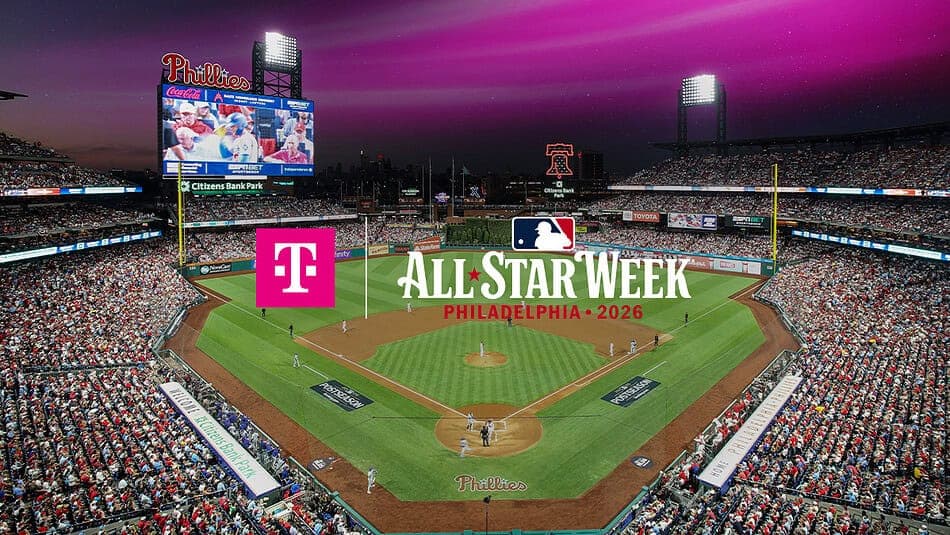
T-Mobile is deploying private 5G infrastructure, including network slicing and localized camera hardware, to support the MLB Automated Ball-Strike (ABS) challenge system and live remote production for All-Star Week in Philadelphia. The initiative highlights the application of 5G Advanced Network Solutions (ANS) for mission-critical professional sports broadcast operations and streaming.
Key Takeaways
- Private 5G network slices now power the ABS challenge system across all 29 U.S. ballparks, facilitating over 5,000 challenges so far this season.
- Hardware expansion includes pitcher's-eye 5G cameras mounted on L-screens and aerial drones for live batting practice coverage.
- The Home Run Derby moves to Netflix for the first time on July 13 as part of a three-year streaming rights agreement.
- Deployment uses dedicated mid-band n41 spectrum for mission-critical operations, including Go-Ahead biometrics and T-Priority first responder communications.
Why It Matters
The shift from experimental 5G trials to league-wide infrastructure for actual game decisions marks a mature turn for private network deployments. By integrating Hawk-Eye data with real-time remote production feeds, T-Mobile and MLB are demonstrating that 5G can replace traditional wired cabling for high-stakes broadcast and officiating workflows. This partnership also serves as a critical test for Netflix's live sports strategy; if the low-latency production enabled by T-Mobile yields a glitch-free, multi-angle stream, it validates the specialized networking required to move Tier 1 live sports from linear TV into the hyper-fragmented streaming ecosystem. Keep an eye on the latency metrics during challenges as a benchmark for automated officiating in other major leagues.
Additional Context
The 2026 season marks the full major league debut of the Automated Ball-Strike (ABS) Challenge System after years of testing in the Minor Leagues and Spring Training. According to reporting from Forbes in September 2025, the MLB Joint Competition Committee voted to adopt the challenge format over a fully automated 'robo-ump' system, a move largely driven by player preference for retaining the human element in pitch calling. MLB data from 2025 testing indicated that challenges were overturned 52.2% of the time, taking an average of roughly 14 seconds per review to avoid disrupting the pace of play. Per Sports Illustrated in February 2026, the system relies on 12 Hawk-Eye cameras per stadium to triangulate pitch locations within a margin of error of approximately one-sixth of an inch.
On the streaming front, the Home Run Derby's move to Netflix is part of a three-year deal worth an estimated $225 million to $250 million annually, according to The Athletic and MLB Trade Rumors. This package, which also includes a season-opening night game and the 'Field of Dreams' game, was carved out after ESPN and MLB opted out of their previous long-term agreement early. Front Office Sports reported in April 2026 that Netflix's first live MLB regular season game between the Yankees and Giants drew 3 million viewers, signaling the streamer's intent to focus on 'breakthrough' marquee events rather than full-season rights.
T-Mobile's infrastructure at Citizens Bank Park represents a broader push into 5G Advanced technology. As noted by RCR Wireless in May 2026, the carrier is increasingly using its 2.5 GHz mid-band spectrum and Ericsson hardware to create 'all-edge' private networks. These dedicated environments use unique Public Land Mobile Network (PLMN) identifiers to ensure the tens of thousands of consumer devices in a stadium do not interfere with mission-critical systems like biometric entry gates or real-time broadcast uploads.
Read full article at sportsvideo.org
Enjoy our coverage?
Add StreamingMeme as a preferred source on Google to see more of our streaming news at the top of your Search results.
Add as preferred source