
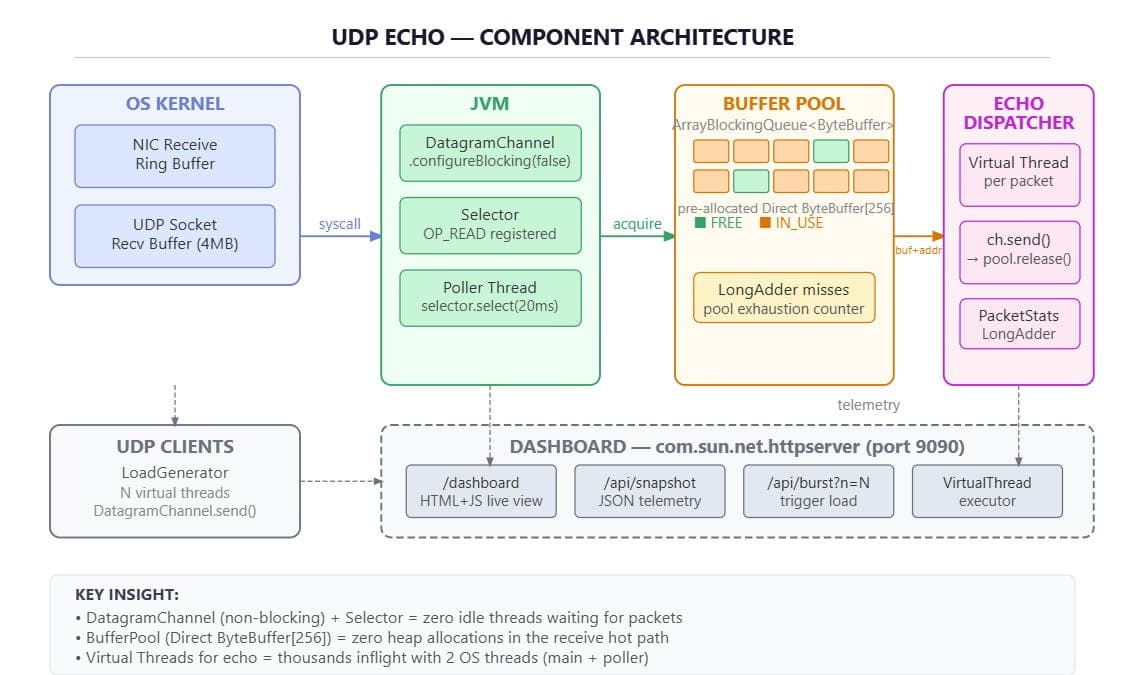
This article explains why high-concurrency real-time voice applications struggle with Spring Boot's default TCP-based WebSockets due to retransmission delays and JVM garbage collection overhead. It details the architectural necessity of switching to raw UDP and optimized buffer management to handle large-scale audio packet processing.
The shift toward raw UDP infrastructure highlights a fundamental conflict between enterprise Java abstractions and the sub-300ms latency requirements of modern streaming. For platform strategists, this reinforces that standard web frameworks often fail at high-concurrency media delivery due to inherent transport layer rigidities and JVM-induced jitter. As voice-first and interactive AI applications expand, infrastructure providers must move beyond high-level APIs toward custom transport layers that prioritize immediate packet delivery over absolute reliability. We expect to see more streaming platforms adopting memory-safe, non-GC languages or specialized low-latency JVM configurations to maintain audio consistency at scale.
The performance limitations identified in Java Spring Boot align with long-term infrastructure shifts by major streaming players. Per InfoQ in May 2026, Discord released a postmortem detailing how hidden architectural dependencies in its voice platform caused a cascading failure that affected millions of users. While Discord's specific outage involved Kubernetes termination cycles, the underlying issue remains the struggle to manage synchronous connection overhead in high-density environments. This follow-up reporting suggests that scaling real-time services requires moving away from traditional thread-per-connection models in favor of asynchronous, non-blocking architectures.
Furthermore, the streaming industry is increasingly moving away from Java-based systems for latency-critical workloads. Reports from Toptal in May 2026 highlight that while Java's JIT compilation has improved, manual memory management in C++ or Rust remains superior for real-time constraints. Discord previously documented this transition, moving its core messaging dataset from Java-based Cassandra to C++-based ScyllaDB to eliminate garbage collection (GC) pauses. According to engineering data from December 2025, this migration reduced p99 read latencies from over 40ms to roughly 15ms, illustrating the concrete gains available when bypassing the JVM's memory management.
Recent benchmarks from RTCLeague in April 2026 also emphasize that for AI-native voice infrastructure, WebRTC over UDP is the non-negotiable standard. Because humans perceive conversational delays starting at 250ms, TCP-based retransmissions are inherently unsuitable for voice-first sales or healthcare triage agents. Industry experts note that while Spring Boot simplifies early-stage development, B2B streaming services reaching 500,000 packets per second must eventually re-engineer their transport layers to avoid the "Spring Boot trap" of high-level abstractions that hide critical networking controls.
Add StreamingMeme as a preferred source on Google to see more of our streaming news at the top of your Search results.
Add as preferred source