
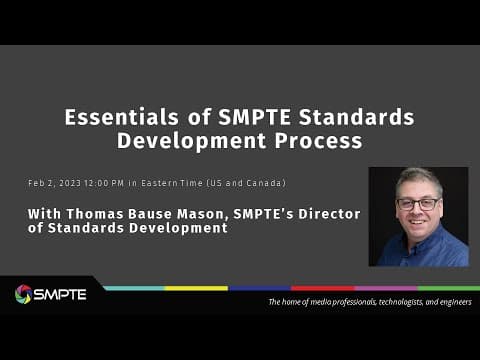
SMPTE has introduced a new Public Committee Draft (PCD) process designed to accelerate the development of media standards by enabling earlier, iterative industry feedback. The initiative leverages modern collaboration tools such as GitHub, Microsoft 365, and Jira to support software-centric projects and improve accessibility for global participants.
The transition from hardware-heavy to software-defined streaming infrastructure requires a more agile governance model. By opening drafts to the public and using collaborative platforms like GitHub, SMPTE is reducing the risk of 'standardization lag' where specifications become obsolete before publication. This move directly addresses industry complaints regarding the slow pace of consensus-building, enabling faster interoperability for IP-based workflows and cloud-native media processing. For strategists, this provides an earlier look at technical requirements for tent-pole standards like ST-2110. Watch for an increase in 'trial implementations' from non-member vendors as draft accessibility improves.
The introduction of the PCD process follows a landmark strategic shift for SMPTE in mid-2026. Per official SMPTE reports in June 2026, the organization made its entire standards catalog freely available to the global media technology community, removing a long-standing paywall for published Standards, Recommended Practices, and Engineering Guidelines. This open-access move was positioned as a way to bolster interoperability and reduce the proliferation of 'secondhand source' implementations in emerging markets. Related momentum in the IP media ecosystem has seen SMPTE ST-2110 evolve into a mature operational backbone. According to Imagine Communications executive John Mailhot in May 2026, the industry has transitioned from initial IP adoption to utilizing ST-2110 for complex workflows like vertical video and native immersive audio. In June 2026, SMPTE also launched its 110th Anniversary Campaign, a fundraising and strategic initiative designed to modernize its standards development and educational programs, specifically targeting talent development for software-defined media environments. Competitive and adjacent standardization bodies are similarly adapting. Per Witbe, August 2026—note: specific external competitive news limited to Intinor demonstrating ST-2110 advancements at IBC2026—the focus has moved toward 'gateway' technologies that bridge compressed public internet feeds with uncompressed professional facilities. This highlights why SMPTE is prioritizing faster feedback loops; hardware vendors are increasingly relying on software-defined gateways that require real-time specification updates to maintain connectivity standards.
Add StreamingMeme as a preferred source on Google to see more of our streaming news at the top of your Search results.
Add as preferred source