
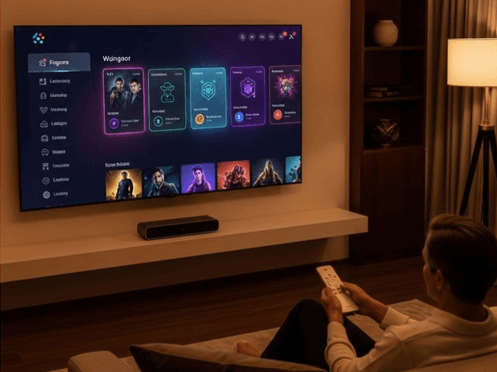
The streaming industry is transitioning toward big-screen optimized interactive content, leveraging 5G and native OS integration on Smart TVs to deliver low-latency gaming and gamified SVoD experiences. Platforms are shifting away from external hardware dongles in favor of native applications on platforms like Tizen and webOS to improve UX and engagement.
The transition to native OS environments represents a strategic move to own the 'living room real estate' and reduce churn through multidimensional engagement. By bypassing external hardware, streaming providers can offer lower-latency interactive features that were previously restricted to high-end consoles. This shift allows broadcasters to transform passive viewers into active participants, creating a unified ecosystem where video, gaming, and real-time data coexist. For the competitive landscape, this means the battle for subscribers will increasingly hinge on technical OS sovereignty and the ability to provide a frictionless, integrated entertainment hub. Watch for the expansion of native cloud-gaming library partnerships within major TV manufacturer app stores.
The global smart TV market is reaching a critical inflection point, with valuations projected to hit approximately $271 billion in 2026 per Future Market Insights (February 2026). This growth is increasingly driven by 'platform convergence,' according to BCG’s Video Gaming Report 2026 (May 2026), which notes that the traditional divide between console, PC, and mobile ecosystems is rapidly dissolving. As display manufacturers standardize high-performance features, 120Hz refresh rates and HDMI 2.1 compliance are becoming common in mid-tier models, effectively turning standard displays into viable gaming monitors.
Industry leaders are responding by embedding cloud gaming services directly into the hardware. For instance, Samsung’s 2026 Tizen OS upgrades and LG’s webOS ‘Gaming Portal’ certifications are designed to remove the friction of console ownership. Per TechRadar (February 2026), these manufacturers are now marketing cloud gaming as a core feature rather than a secondary app, with LG’s 2026 OLED range being among the first to offer 4K 120Hz cloud gaming via Nvidia GeForce NOW. This mirrors a broader trend where 60% of players have already trialed cloud-based platforms, signaling a behavioral shift toward hardware-agnostic play.
Connectivity remains the essential backbone for this interactive pivot. According to reports from nmscommunications (February 2026), standalone 5G networks can now reduce latency to as low as 1 millisecond, a significant improvement over 4G’s 30-50 millisecond range. This ultra-low-latency infrastructure is crucial for real-time synchronization in sports betting and live-dealer environments. Furthermore, MainStreaming (December 2025) suggests that such interactive offerings can increase total viewing minutes by 25% to 50%, making these technological upgrades vital for retention as the SVoD market faces increasing fragmentation and subscriber fatigue.
Add StreamingMeme as a preferred source on Google to see more of our streaming news at the top of your Search results.
Add as preferred source