

Samsung begins mass production of PCIe 6.0 eSSD for AI infrastructure
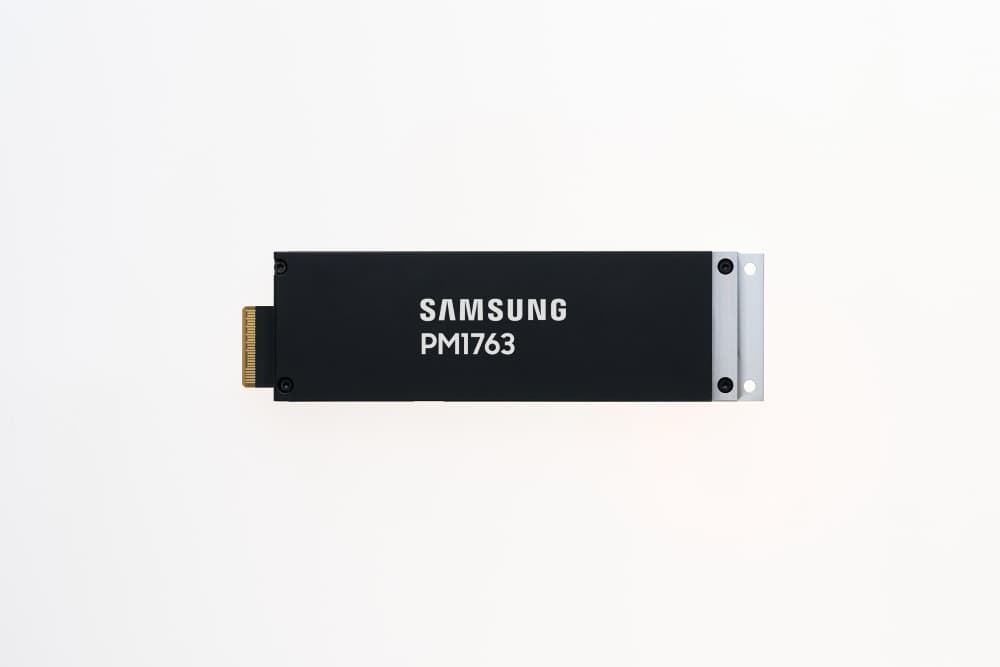
Samsung has officially moved its PM1763 enterprise PCIe 6.0 SSD into mass production. Optimized for AI and high-performance computing, the drive features 16TB of capacity and sequential read speeds reaching 28,400 MB/s to address data-loading bottlenecks in GPU-intensive server environments.
Key Takeaways
- Sequential read speeds reach 28,400 MB/s, more than doubling performance over previous PCIe 5.0 models.
- Integrated 4nm controller and ninth-generation V-NAND improve power efficiency by 1.8x compared to the PM1753.
- Supports direct-to-chip liquid cooling to manage thermal loads in high-density rack environments.
- 16TB model can transfer a 40GB large language model in roughly 1.4 seconds.
- Adopts PAM4 signaling and supports post-quantum cryptography to secure AI data pathways.
Why It Matters
The immediate impact is the removal of I/O wait times that currently throttle GPU utilization during model checkpointing and weight loading. For the ecosystem, this move signals that storage bandwidth is finally catching up to the massive memory speeds of Blackwell-class accelerators. This infrastructure shift forces a broader move toward liquid cooling at the component level to maintain performance. What to watch next is how quickly PCIe 6.0 ecosystems migrate from lab testing to mass deployment in hyper-scale datacenters.
Additional Context
The mass production of the PM1763 aligns with Samsung's dominance in the enterprise SSD market, where it held a 35.1% share in Q1 2026, per The Elec. This launch specifically targets NVIDIA's next-generation Vera Rubin AI platform, following Samsung's unveiling of memory solutions like SOCAMM and HBM4 at GTC earlier in the year. The surge in generative AI has radically shifted the storage market; per Omdia, July 2026, the global enterprise SSD market is projected to reach $154 billion by year-end, a sixfold increase from 2025 values.
While hardware competitors like Micron have previously sampled PCIe 6.0 designs, Samsung's vertical integration provides a cost advantage in the ‘layer stacking’ race. Per The Korea Times, April 2024, Samsung’s ninth-generation V-NAND uses a double-stack structure to maintain spec parity while reducing fabrication complexity. This architectural efficiency is critical as the industry faces ongoing NAND shortages. According to Ipc2U reporting from early 2026, enterprise SSD prices surged 60% in one year, leading hyperscalers to prioritize supply security through long-term contracts for high-capacity, durable drives like the PM1763.
Looking forward, the roadmap for AI storage is scaling toward even higher densities. Samsung confirmed at the 2025 Global Memory Innovation Forum that it plans to ship 256TB PCIe 5.0 drives later this year, with a 512TB PCIe 6.0 flagship scheduled for 2027, per TechPowerUp. These increments are essential as model sizes exceed the VRAM capacity of individual GPUs, requiring frequent data transfers from high-speed storage arrays. The transition to PCIe 6.0 and the adoption of its L0p power state for dynamic bandwidth scaling are now seen by analysts at Fab Economics as the definitive standard for AI inference infrastructure through the end of the decade.
Read full article at letsdatascience.com
Enjoy our coverage?
Add StreamingMeme as a preferred source on Google to see more of our streaming news at the top of your Search results.
Add as preferred source