

Samsung Ads reports 76% of viewers start journey on home screen
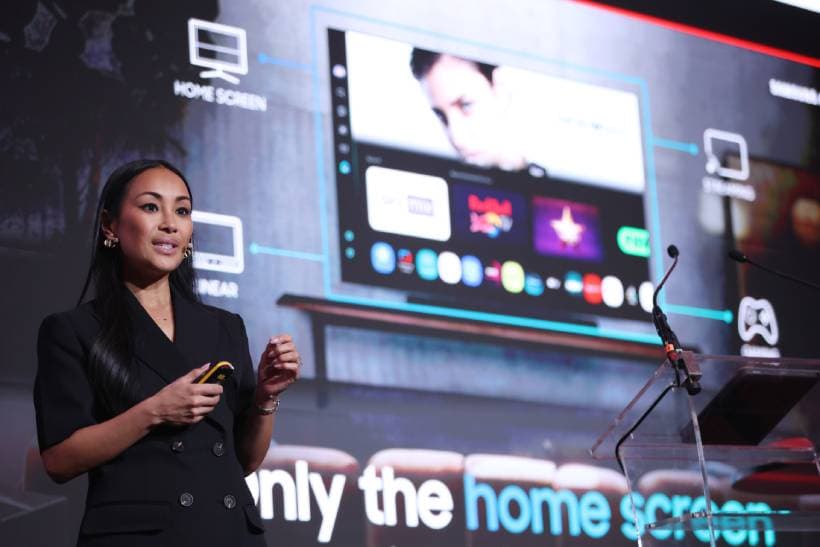
Samsung Ads reports that 76% of viewers are undecided on content, spending an average of 10.5 minutes on the home screen, indicating a significant opportunity for advertisers to reach audiences before they choose what to watch. The company's research shows that home screen ad placements increase brand advocacy by 11% and purchase likelihood by 10%. Samsung Ads also launched TotalView, a solution to measure ad exposure and audience reach across both linear and streaming environments, aiming to bridge data gaps for brands.
Key Takeaways
- Viewers switch between an average of five apps before selecting content, highlighting a fragmented decision-making process.
- Premium home screen ad placements increased brand advocacy by 11% and purchase likelihood by 10% in recent MTM Research trials.
- TotalView proprietary measurement tool provides a unified view of ad exposure across both traditional broadcast and streaming silos.
- UK Samsung TVs recorded 25 billion home screen visits in 2025, serving as a primary gateway for content discovery.
- Combining TV and mobile app data late last year allowed Samsung to track cross-device engagement patterns for harder-to-reach younger demographics.
Why It Matters
The rise of the 'undecided viewer' shifts the high-value advertising battleground from mid-roll slots to the hardware's operating system level. By leveraging first-party ACR data from millions of sets, Samsung is positioning the home screen as a critical discovery portal rather than just a utility menu. For the broader ecosystem, this signals a move toward hardware manufacturers acting as the new gatekeepers of intent, challenging traditional media planners to treat the TV OS as a performance marketing channel. Watch for whether rival OEMs like Vizio or Roku release similar 10-minute 'dwell time' benchmarks to compete for premium top-of-funnel budgets.
Additional Context
Samsung’s push into unified measurement matches a broader industry pivot toward cross-platform accountability. Per TV Technology (June 2025), Nielsen recently expanded its agreement with Vizio to integrate Inscape’s ACR data from millions of smart TVs into both local and national audience measurement. This mirrors the industry-wide struggle to solve for 'deduplicated reach,' where brands risk over-serving ads to the same households across fragmented cable and streaming buys. Inscape itself reported that campaigns merging linear and streaming strategies saw a 130% lift in tune-in effectiveness compared to single-channel approaches.
The hardware-as-advertising model is also showing significant financial maturity. Per Finimize (April 2026), Roku’s platform revenue—driven largely by home screen ads and revenue sharing—now generates nearly ten times the revenue of its hardware division. This shift has led major players to battle for control over the TV operating system. Vizio, now part of Walmart following a 2024 acquisition, reported in January 2026 that users spend roughly 30 minutes browsing its home screen daily. This 'dwell time' is being directly monetized through retail media integrations that connect viewing habits to in-store purchase data.
Technologically, the gap between mobile and TV is closing via data-as-a-service partnerships. Per Advanced Television (May 2025), Samsung Ads integrated opted-in mobile app usage data across Europe to track 'second-screening' behavior. This allows advertisers to see which mobile apps are used during specific broadcasts, such as travel apps during sports. Such deterministic datasets are becoming the 'table stakes' of 2026, as agencies move away from using simple dashboards toward clean-room integrations with providers like Snowflake to prove ROAS in a privacy-compliant manner.
Read full article at campaignlive.co.uk
Enjoy our coverage?
Add StreamingMeme as a preferred source on Google to see more of our streaming news at the top of your Search results.
Add as preferred source