

Red Hat semantic router and multi-tier caching land in vLLM update
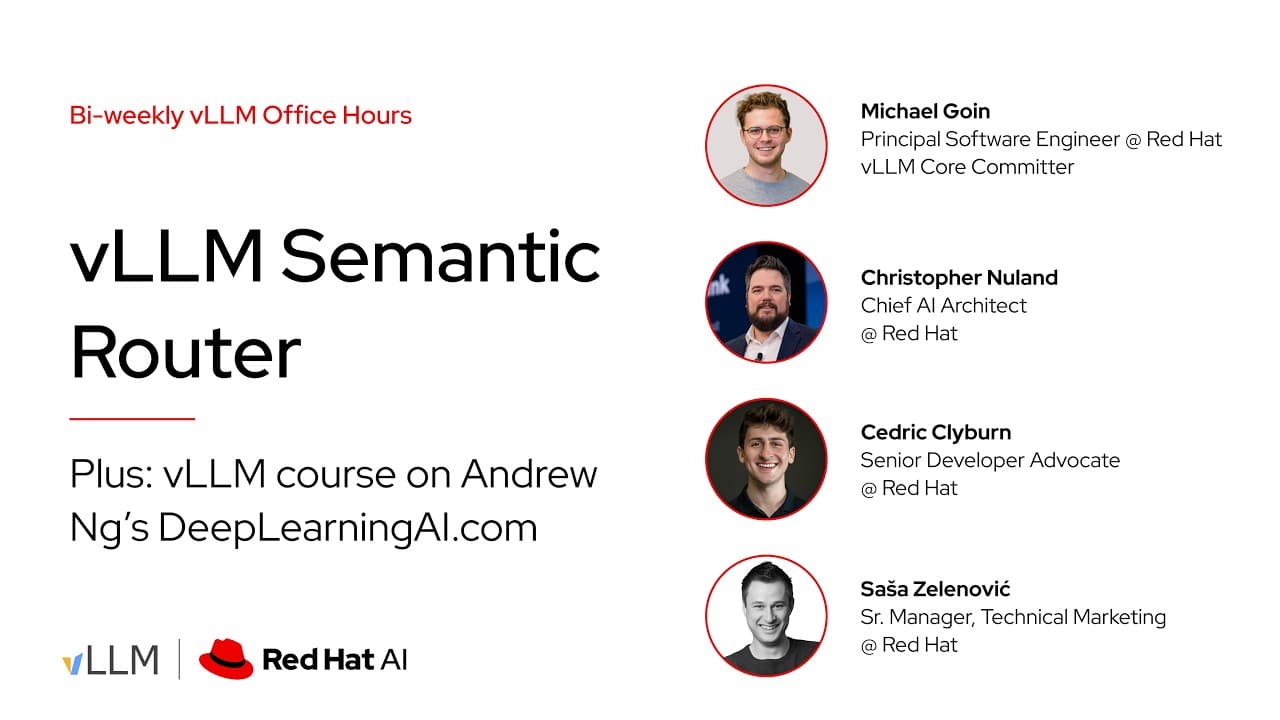
vLLM version 0.23 introduces multi-tier KV cache offloading, hardware-specific quantization improvements, and model support additions. Red Hat also detailed its development of a Semantic Router designed to optimize multi-model inference routing based on cost, latency, and privacy criteria.
Key Takeaways
- Red Hat’s Semantic Router enables signal-driven routing based on cost, latency, and privacy with PII redaction and guardrails.
- vLLM v0.23 adds multi-tier KV cache offloading support for disk and remote storage to extend effective memory capacity.
- The release hardens DeepSeek V4 support using TRT-LLM-gen attention kernels and enables async EPLB by default for MoE models.
- Hardware-specific updates include new AMD RDNA3 quantization kernels and pipeline parallelism optimizations for distributed inference.
- DeepLearning.AI launched a free vLLM course with Cedric Clyburn focused on the optimize-deploy-benchmark lifecycle.
Why It Matters
The introduction of semantic routing and multi-tier offloading shifts the focus of open-source inference from raw throughput to systemic efficiency. By allowing engineers to offload KV caches to persistent storage and route simple queries to smaller, cheaper local models, the vLLM ecosystem is addressing the high cost of memory in large-context streaming operations. For the broader ecosystem, this signals a maturation of the AI stack, moving beyond NVIDIA-dependency with improved AMD RDNA3 support and robust multi-model management. Infrastructure teams should monitor the adoption of the Agent Gateway integration, which standardizes how these routers are deployed within cloud-native environments and Kubernetes clusters.
Additional Context
The vLLM v0.23 release arrives as the project solidifies its status as a primary open-source contender for enterprise-grade inference. Per AI Weekly in May 2026, the transition of AMD hardware to a "first-class" inference target was accelerated by the integration of native HIP W4A16 quantization kernels, which eliminated the performance tax previously imposed by slower Triton emulation. This hardware parity is critical for organizations seeking to diversify their compute stacks beyond NVIDIA. Further reporting by yutori.com in July 2026 notes that the v0.23 branch also debuted Model Runner V2 for Llama and Mistral models, which integrates Heterogeneous Memory Access (HMA) by default to better manage the growing memory footprint of frontier models like DeepSeek V4.
On the orchestration side, the Semantic Router project, developed primarily by Red Hat, has moved toward tighter integration with Envoy-based networking. Per vllm-semantic-router.com in June 2026, the router now operates as an Envoy ExtProc sidecar within the Agent Gateway data plane. This architecture allows Kubernetes users to mutate request headers (e.g., x-selected-model) in the request lifecycle without adding extra proxy hops or Python-based overhead. By using Matryoshka embedding models to classify intent, the system can achieve cost reductions exceeding 80% specifically by shifting commoditized queries away from expensive cloud APIs to local endpoints.
Educationally, the push for production readiness is supported by new training resources. DeepLearning.AI’s June 2026 course launch, "Fast & Efficient LLM Inference with vLLM," highlights how memory management through PagedAttention and prefix caching remains the dominant bottleneck in scaling. The course teaches practitioners to use LLM Compressor and GuideLLM to profile latency-versus-throughput curves, signaling an industry-wide shift toward empirical benchmarking rather than theoretical performance claims.
Read full article at youtube.com
Enjoy our coverage?
Add StreamingMeme as a preferred source on Google to see more of our streaming news at the top of your Search results.
Add as preferred source