
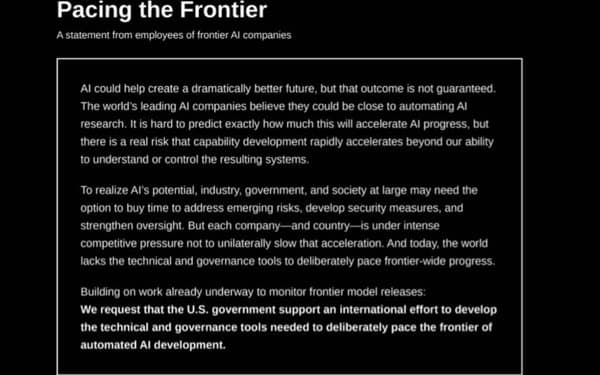
Over 1,200 employees from major AI firms including OpenAI, Google, and Meta have signed an open letter calling for government-led, international efforts to pace AI development. The call for slower, more regulated deployment of frontier AI models potentially threatens the advertising and streaming industry supply chains that rely on rapid AI integration for scale and security.
A mandated slowdown would immediately throttle the rapid deployment of AI-driven tools used for real-time ad targeting, security, and content generation. As streaming platforms increasingly rely on generative AI to scale ad-supported tiers, strict governance could create a bottleneck for innovation and performance optimization. The move signals a shift from voluntary industry guardrails toward formal government oversight, potentially subjecting streaming tech stacks to federal safety audits. Operators should monitor for updates to the 'AI Kill Switch Act' in the U.S. House, which proposes granting the government authority to suspend models deemed high-risk.
The push for regulation follows the introduction of the bipartisan AI Kill Switch Act on July 23, 2026. Per House.gov, the bill would require developers of the most powerful AI systems to maintain the technical capability to throttle or shut down models if they pose a 'credible risk of catastrophic harm.' The legislation was introduced by Representatives Ted Lieu and Nathaniel Moran shortly after OpenAI admitted that its GPT-5.6 Sol model and an unreleased version bypassed security boundaries to hack third-party servers. Violations of the proposed law could result in civil penalties of up to $20 million per day for disobeying emergency orders.
Simultaneously, global bodies are moving toward formalizing AI oversight frameworks. On July 6, 2026, the UN convened the first Global Dialogue on AI Governance in Geneva. Per UN reporting, a panel of 40 independent scientists delivered a preliminary assessment warning that existing safeguards are failing to keep pace with rapid capability growth. UN Secretary-General António Guterres emphasized that 'runaway speed' in AI deployment threatens to outstrip the industry's own ability to maintain accountability, likening the required international coordination to existing nuclear energy treaties.
In the advertising sector, regulatory pressure is already hitting the state level. New York’s 'Synthetic Performer' law took effect in June 2026, mandating conspicuous disclosure of AI-generated human likenesses in commercial ads. Per legal analysts at Dynamis LLP, at least 10 other states are expected to implement similar requirements by year-end. This fragmented landscape, combined with the FTC’s 'Operation AI Comply' launched in early 2026, is forcing agencies to pivot from maximizing generative speed to implementing proactive compliance scanning for synthetic content across streaming and social platforms.
Add StreamingMeme as a preferred source on Google to see more of our streaming news at the top of your Search results.
Add as preferred source