

OTT and FAST hybrid models redefine digital news delivery and monetization
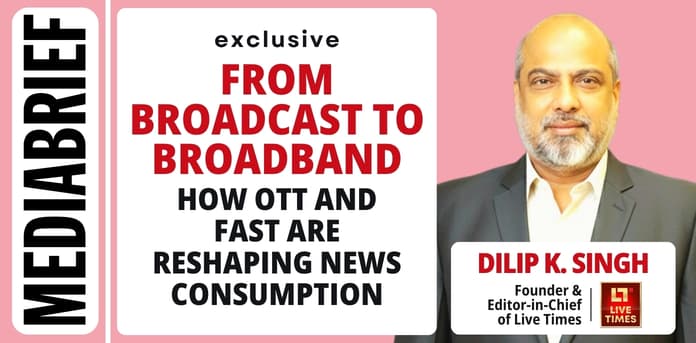
Dilip Kumar Singh, Founder of Live Times, discusses how OTT and FAST services are fundamentally reshaping news consumption, moving from broadcast to multi-platform, on-demand ecosystems. This transformation requires news organizations to adopt data-driven storytelling, programmatic advertising, and cross-platform distribution strategies. Singh emphasizes that future success for news lies in leveraging both OTT for depth and FAST for scale, together forming a hybrid, comprehensive distribution model.
Key Takeaways
- OTT platforms enable newsrooms to capture first-party viewer analytics, including real-time data on story completion and topic loyalty.
- The hybrid strategy leverages OTT for high-value long-form journalism and FAST for continuous updates and mass-reach live events.
- Programmatic and addressable advertising systems are replacing traditional broadcast models to monetize fragmented audience segments across Connected TVs.
- Content personalization is now a core operational requirement, uses viewing patterns to recommend relevant stories to streaming audiences.
Why It Matters
The migration of news to OTT and FAST represents the end of the scheduled broadcast era. For news organizations, this shift is critical because it replaces opaque broadcast ratings with granular first-party audience intelligence, enabling more efficient programmatic monetization and data-driven storytelling. In hyper-competitive markets like India, these formats are no longer experimental but have become the primary 'operating system' for news delivery. Success now depends on technical distribution agility and the ability to convert viewer data into actionable content strategies. Watch for a surge in dedicated FAST news channels on manufacturer platforms like Samsung TV Plus as legacy broadcasters seek to recapture declining cable audiences.
Additional Context
The transition to FAST and OTT news is accelerating globally as hardware manufacturers become dominant gatekeepers. Per Samsung, February 2026, the Samsung TV Plus platform surpassed 100 million monthly active users, offering over 4,300 channels across 30 countries. This reach is a major driver for news expansion; in India, major networks like India TV and TV Today Network (including Aaj Tak HD) launched exclusive FAST channels on Samsung's ecosystem in late 2024 to capture the growing Connected TV (CTV) audience. LG Electronics is following a similar path, projecting that content services will account for one-third of its TV segment operating profits by 2027 as it invests nearly $709 million to secure premium content for its webOS platform.
Market data underscores the urgency for this shift. Per Ormax Media, September 2025, India’s CTV audience grew 85% in a single year to reach 129.2 million users. This surge in large-screen streaming is reshaping monetization; while India was traditionally a smartphone-first market, the 2025 Digital News Report from the Reuters Institute notes that 'watching' has officially overtaken reading as the preferred news consumption method in the region. Furthermore, IMARC Group reported in April 2025 that the total Indian OTT market reached $4.5 billion in 2024, with a projected CAGR of 19.7% through 2033. This growth is increasingly fueled by ad-supported (AVOD) models, which are expanding faster than subscription-based video as publishers look to scale across price-sensitive demographics.
Read full article at mediabrief.com
Enjoy our coverage?
Add StreamingMeme as a preferred source on Google to see more of our streaming news at the top of your Search results.
Add as preferred source