

NVIDIA DeepStream 9.1 launches with automated 3D tracking and JetPack 7.2
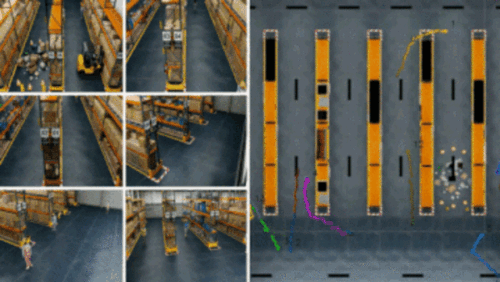
NVIDIA has released DeepStream 9.1, featuring new Multi-View 3D Tracking and AutoMagicCalib tools designed to unify object tracking across network-connected camera arrays. The update, which supports the JetPack 7.2 edge computing platform, aims to simplify the development of vision AI pipelines for large-scale environments like retail or industrial spaces.
Key Takeaways
- Multi-View 3D Tracking (MV3DT) fuses data from multiple cameras into a shared 3D coordinate system using MQTT messaging.
- AutoMagicCalib (AMC) automates 3x4 projection matrix generation, removing the need for manual camera calibration in large-scale environments.
- Support for JetPack 7.2 extends hardware compatibility to the Blackwell-based Jetson Thor and high-performance Orin edge platforms.
- The release includes 13 agentic skills designed for use with natural language coding assistants like Claude Code and Codex to accelerate development.
Why It Matters
This release shifts vision AI from single-feed monitoring to holistic spatial intelligence. By automating camera calibration—a historic bottleneck—NVIDIA significantly lowers the technical barrier for retail and industrial tracking at scale. Integrating these capabilities into the JetPack 7.2 ecosystem ensures that heavy-duty multi-view inference can move from centralized servers to the edge, reducing latency and bandwidth costs. Moving forward, the introduction of agentic skills suggests a transition toward natural language-driven pipeline configuration, which could drastically compress the typical vision AI development cycle. Watch for early performance benchmarks of MV3DT on Jetson Thor hardware to gauge the feasibility of real-time 3D tracking in massive complex environments.
Additional Context
The DeepStream 9.1 launch coincides with NVIDIA's broader strategy to expand its edge computing portfolio under the Metropolis platform. On July 15, 2026, per Wccftech and NVIDIA, the company introduced the Jetson Thor T3000 and T2000 modules. These Blackwell-powered units deliver up to 865 TFLOPs of AI compute, specifically targeting humanoid robotics and advanced visual AI. This hardware expansion provides the necessary processing headroom for the compute-intensive 3D coordinate fusion and multi-camera association algorithms introduced in DeepStream 9.1.
Market data underscores the commercial pressure driving these technical advances. According to reports from Fortune Business Insights and stalawartresearchinsights.com in February 2026, the computer vision market is projected to reach approximately $24.14 billion this year. Recent trends indicate a decisive shift toward edge deployment, with Gartner forecasting that 75% of enterprise data will be processed outside traditional data centers by the late 2020s. Within this landscape, the 3D camera and machine vision segment is growing at roughly 17% annually, fueled by the demand for precise spatial mapping in logistics and autonomous systems.
Competition in the 3D vision space has intensified throughout early 2026. Per industry reporting from June 2026, providers like Orbbec have recently launched specialized stereo 3D cameras compatible with the Jetson Thor platform to support robotics and industrial automation. To remain the dominant standard, NVIDIA is increasingly focused on the "agentic" development model. By packaging 80 total skills across the Metropolis ecosystem as of July 2026, the company claims it can reduce development time by up to 6x compared to traditional coding methods.
Read full article at developer.nvidia.com
Enjoy our coverage?
Add StreamingMeme as a preferred source on Google to see more of our streaming news at the top of your Search results.
Add as preferred source