

NVIDIA DeepStream 9.1 adds agentic AI for automated multi-camera tracking
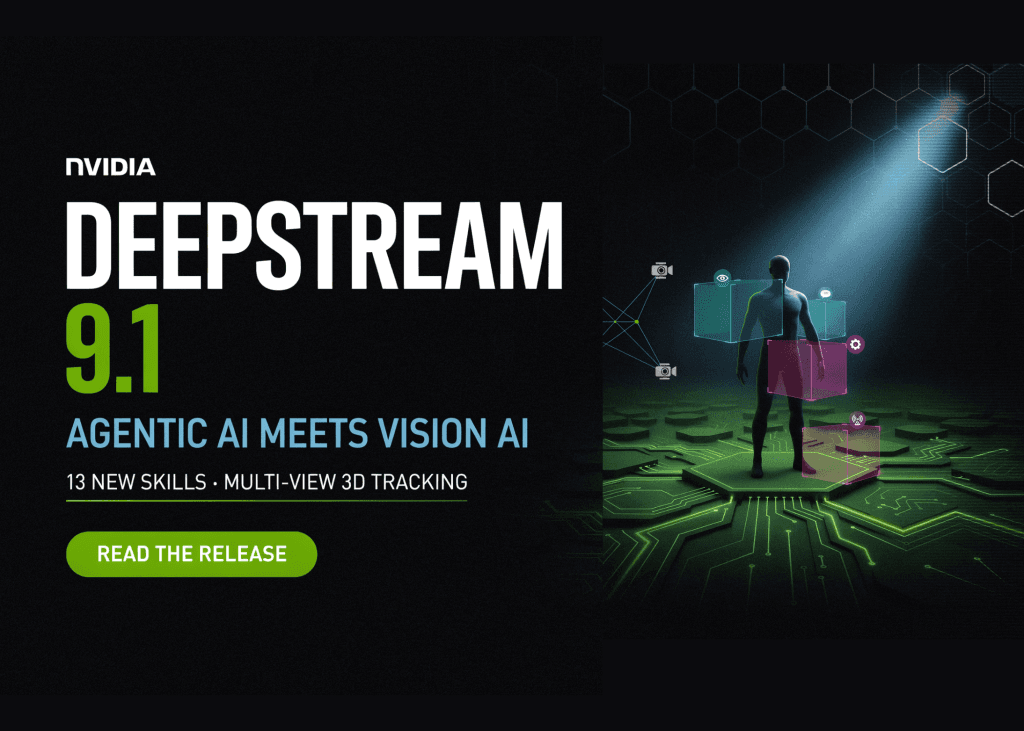
NVIDIA has released DeepStream 9.1, which introduces Multi-View 3D Tracking and AutoMagicCalib capabilities alongside 13 new agentic AI skills for coding agents. The update enhances the toolkit's support for cross-camera object tracking and automated camera calibration within video analytics pipelines.
Key Takeaways
- 13 new agentic AI skills allow developers to build and deploy vision pipelines using Claude Code, Codex, or Cursor prompts.
- Multi-View 3D Tracking (MV3DT) assigns a single global ID to objects by fusing 2D detections into a shared 3D coordinate system.
- AutoMagicCalib (AMC) removes the need for manual checkerboard calibration by analyzing tracked objects and estimating camera parameters from raw video.
- The SDK adds official support for JetPack 7.2, extending capabilities to Jetson Orin and Jetson Thor edge hardware.
- NVIDIA has consolidated DeepStream into a unified open-source GitHub monorepo under CC-BY-4.0 and Apache-2.0 licenses.
Why It Matters
This release shifts video analytics from manual, labor-intensive configuration to an intent-based architecture. By integrating agentic AI, NVIDIA reduces the barrier to deploying cross-camera tracking, which is essential for large-scale retail and industrial monitoring. For the streaming infrastructure market, this signals a move toward self-configuring edge-to-cloud pipelines where the software automatically handles spatial calibration and object persistence across fragmented sensor layouts. Watch for the performance impact of the PeopleNetTransformer and RT-DETR 2D models in complex, high-density environments like active warehouses.
Additional Context
DeepStream 9.1 arrives shortly after the June 2026 release of NVIDIA JetPack 7.2, which unified the software foundation for the Jetson Orin and Jetson Thor families. Per NVIDIA (June 2026), JetPack 7.2 introduced Multi-Instance GPU (MIG) support for Jetson Thor, allowing its Blackwell-based architecture to be partitioned into isolated compute instances for predictable multi-workload execution. This deterministic performance is critical for the 'physical AI' applications DeepStream 9.1 targets, such as humanoid robotics and autonomous industrial machines.
Furthermore, NVIDIA’s move toward open-sourcing the SDK via a GitHub monorepo aligns with recent ecosystem expansions. Per NVIDIA Developer (July 2026), the company also recently launched official Yocto Project support for JetPack 7.2, enabling distribution partners like Balena and WindRiver to offer customized embedded Linux solutions. This broader push towards open and automated development environments—including the NemoClaw framework for agent orchestration—indicates NVIDIA is positioning its edge AI stack as a standard for heterogeneous sensor fusion in smart cities and automated retail sectors.
Read full article at marktechpost.com
Enjoy our coverage?
Add StreamingMeme as a preferred source on Google to see more of our streaming news at the top of your Search results.
Add as preferred source