StreamingMemeStreamingMemeBuyers Guide
LeaderboardsEventsSubmit News
Subscribe

Daily Brief

The streaming industry in your inbox every morning.

Daily Brief

The streaming industry in your inbox every morning.

StreamingMemeStreamingMeme

The independent buyers guide and news aggregator for the streaming technology industry.

Explore

Buyers GuideLeaderboardsEventsSubmit News

Stay updated

Weekly digest of new companies and streaming news.

Categories

Encoding & SoftwareVideo Delivery & CDNStreaming PlatformsAI for VideoProduction HardwareBusiness NewsMonetization & Ad TechRegulatory & Policy

© 2026 StreamingMeme. All rights reserved.

AboutPrivacy PolicyTermsContact
EncodingCDNPlatformsAI & VideoHardwareBusinessAd TechPolicy
← AI for Video
AI & VideoTechnical DevelopmentJuly 12, 2026

New contrastive learning framework HGCL-MAW solves data scarcity in recommendation engines
New contrastive learning framework HGCL-MAW solves data scarcity in recommendation engines
Springer Nature

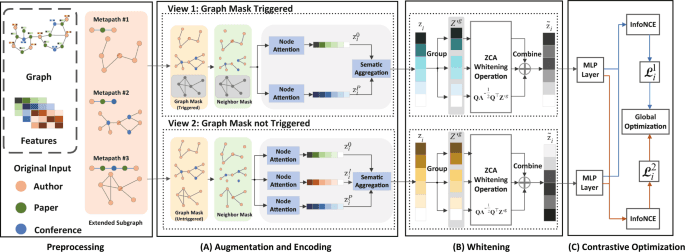
Researchers have introduced a new framework called Heterogeneous Graph Contrastive Learning with Meta-path Augmentation and Whitening (HGCL-MAW) to enhance node representation in label-scarce environments. The model utilizes graph attention encoders and a unique whitening technique to minimize dimensional correlation, offering potential improvements for recommendation engines used in streaming and social media platforms.

Key Takeaways

  • HGCL-MAW uses meta-path and neighbor augmentation strategies to generate robust node representations without relying on heavy data labeling.
  • A graph attention-based encoder performs both intra-graph and inter-graph aggregation to capture local structural and global semantic features.
  • A new whitening technique minimizes dimensional correlation in embeddings, preventing the 'dimensional collapse' often seen in batch-normalized models.
  • Experimental validation across four public datasets confirms superior performance in node classification and clustering downstream tasks.

Why It Matters

Personalization is the primary driver of retention in streaming, but platforms often struggle with cold-start problems and the high cost of manual data annotation. HGCL-MAW provides a self-supervised path to maintain recommendation quality even when explicit user engagement signals are sparse. By mitigating dimensional collapse, the framework ensures that AI models utilize the full capacity of their feature sets, potentially reducing the compute overhead required for high-accuracy personalizations. For the broader ecosystem, this signals a shift toward more resilient architectures that can handle the structural complexity of heterogeneous data without extensive human oversight. Watch for adoption of whitening techniques as a replacement for standard batch normalization in B2B recommendation APIs.

Additional Context

The development of HGCL-MAW coincides with a broader transition in recommendation engineering toward dynamic and temporal graph neural networks (GNNs). According to reports from PatSnap in April 2026, the current 'Frontier Period' of streaming optimization is characterized by the convergence of generative models and multi-modal feature fusion to enhance real-time distributed inference. While traditional systems relied on simple profile-matching, modern architectures are increasingly using GNNs to model explicit collaborative signals and user-item interactions as complex, evolving topologies. Dimensional collapse has emerged as a critical technical hurdle for these advanced models. Recent research published in January 2025 by the National Institutes of Health highlights that implicit regularization in graph convolutions often forces node embeddings into restricted low-dimensional subspaces, a phenomenon that limits the model's expressiveness. Techniques like the whitening used in HGCL-MAW are increasingly viewed as essential plug-and-play components to ensure embedding uniformity and alignment. Furthermore, the integration of GNNs with Large Language Models (LLMs) is becoming standard for enterprise-scale recommender systems in 2026. Per KDnuggets in January 2026, this shift allows platforms to process datasets that combine structural graph relationships with natural language context. Industry leaders like Netflix have moved toward industrial deployment maturity with in-session adaptive recommendation models, underscoring the necessity for frameworks that can maintain high performance in label-scarce scenarios while managing multi-order information aggregation.


Read full article at link.springer.com

Enjoy our coverage?

Add StreamingMeme as a preferred source on Google to see more of our streaming news at the top of your Search results.

Add as preferred source

Related Articles

The Broadcast Bridge: Broadcasters transition to NATS messaging for scalable cloud-native microservice orchestration
Preprints.org: LF-MAE framework uses self-supervised learning to reconstruct 4D light-field data
AI Engineering Insider: Reference architecture for streaming recommenders adds layered LLM guardrails

Newest

in 4 months
The Broadcast Bridge: Broadcasters transition to NATS messaging for scalable cloud-native microservice orchestration
about 18 hours ago
Kavout: Nvidia posts $81.6B Q1 revenue as institutional caution slows momentum
about 19 hours ago
POLITICO: U.S. AI Export Program underwhelms with only 78 corporate applications
about 21 hours ago
PRIP Strategy: TCL challenges InterDigital's AV1 patent as litigation targets hardware manufacturers
about 21 hours ago
AVIXA: Corporate media demand doubles as enterprise and broadcast standards converge
about 21 hours ago
Portada: Omnicom and NBCUniversal launch AI-driven dynamic contextual advertising for CTV
about 21 hours ago
APNIC: IPv4 routing table hits 1.06M prefixes as Amazon expands footprint
about 21 hours ago
Fora Soft: Streaming operators pivot to three-layer AI stack for viewer retention
about 21 hours ago
Newsshooter: Magewell launches $2,099 Director Plus for 4K60 mobile production bonding
about 21 hours ago
Preprints.org: LF-MAE framework uses self-supervised learning to reconstruct 4D light-field data
about 21 hours ago
AI Engineering Insider: Reference architecture for streaming recommenders adds layered LLM guardrails
about 21 hours ago
Artificial Code by Jacopo Perfetti: Optimization focus shifts to AI harness as model weights reach parity
1 day ago
IBC: Banijay and All3Media complete $8 billion merger to form production giant
1 day ago
IndexBox: Hyperscale expansion to drive 4.8% relay rack market growth through 2035
1 day ago
MarketBeat: Veritone taps Oracle Cloud for 20% savings amid deep restructuring
1 day ago
The Tech Buzz: Apple Neural Engine development traced back to failed self-driving car program
1 day ago
I-Programmer: SIGGRAPH 2026 debuts Games Summit and neural rendering pipeline breakthroughs
1 day ago
Substack: OpenAI, Meta, and SpaceXAI launch frontier models in major agentic shift
1 day ago
IndexBox: POL module market to hit 7.5% CAGR as data centers densify
1 day ago
IndexBox: AI infrastructure surge to drive 7.2% annual growth for network and server market through 2035

Upcoming Events

Jul
16
ADWEEK House Sports SummitNYC
Jul
29–30
Buffer-Free VideoSeattle
Aug
17–20
SET EXPOSao Paulo
Sep
11–14
IBCAmsterdam
Sep
13
SportsPro Streamtime Sports LiveAmsterdam
View all events →

Top Sources

  1. 1.BoxxTech79
  2. 2.Sports Video Group68
  3. 3.AdExchanger68
  4. 4.SiliconANGLE65
  5. 5.PPC Land42
  6. 6.YouTube36
  7. 7.TechCrunch27
  8. 8.Variety27
Full leaderboards →

Newest

in 4 months
The Broadcast Bridge: Broadcasters transition to NATS messaging for scalable cloud-native microservice orchestration
about 18 hours ago
Kavout: Nvidia posts $81.6B Q1 revenue as institutional caution slows momentum
about 19 hours ago
POLITICO: U.S. AI Export Program underwhelms with only 78 corporate applications
about 21 hours ago
PRIP Strategy: TCL challenges InterDigital's AV1 patent as litigation targets hardware manufacturers
about 21 hours ago
AVIXA: Corporate media demand doubles as enterprise and broadcast standards converge
about 21 hours ago
Portada: Omnicom and NBCUniversal launch AI-driven dynamic contextual advertising for CTV
about 21 hours ago
APNIC: IPv4 routing table hits 1.06M prefixes as Amazon expands footprint
about 21 hours ago
Fora Soft: Streaming operators pivot to three-layer AI stack for viewer retention
about 21 hours ago
Newsshooter: Magewell launches $2,099 Director Plus for 4K60 mobile production bonding
about 21 hours ago
Preprints.org: LF-MAE framework uses self-supervised learning to reconstruct 4D light-field data
about 21 hours ago
AI Engineering Insider: Reference architecture for streaming recommenders adds layered LLM guardrails
about 21 hours ago
Artificial Code by Jacopo Perfetti: Optimization focus shifts to AI harness as model weights reach parity
1 day ago
IBC: Banijay and All3Media complete $8 billion merger to form production giant
1 day ago
IndexBox: Hyperscale expansion to drive 4.8% relay rack market growth through 2035
1 day ago
MarketBeat: Veritone taps Oracle Cloud for 20% savings amid deep restructuring
1 day ago
The Tech Buzz: Apple Neural Engine development traced back to failed self-driving car program
1 day ago
I-Programmer: SIGGRAPH 2026 debuts Games Summit and neural rendering pipeline breakthroughs
1 day ago
Substack: OpenAI, Meta, and SpaceXAI launch frontier models in major agentic shift
1 day ago
IndexBox: POL module market to hit 7.5% CAGR as data centers densify
1 day ago
IndexBox: AI infrastructure surge to drive 7.2% annual growth for network and server market through 2035

Upcoming Events

Jul
16
ADWEEK House Sports SummitNYC
Jul
29–30
Buffer-Free VideoSeattle
Aug
17–20
SET EXPOSao Paulo
Sep
11–14
IBCAmsterdam
Sep
13
SportsPro Streamtime Sports LiveAmsterdam
View all events →

Top Sources

  1. 1.BoxxTech79
  2. 2.Sports Video Group68
  3. 3.AdExchanger68
  4. 4.SiliconANGLE65
  5. 5.PPC Land42
  6. 6.YouTube36
  7. 7.TechCrunch27
  8. 8.Variety27
Full leaderboards →