

Miri Technologies ships V410 hardware with built-in Wi-Fi 7
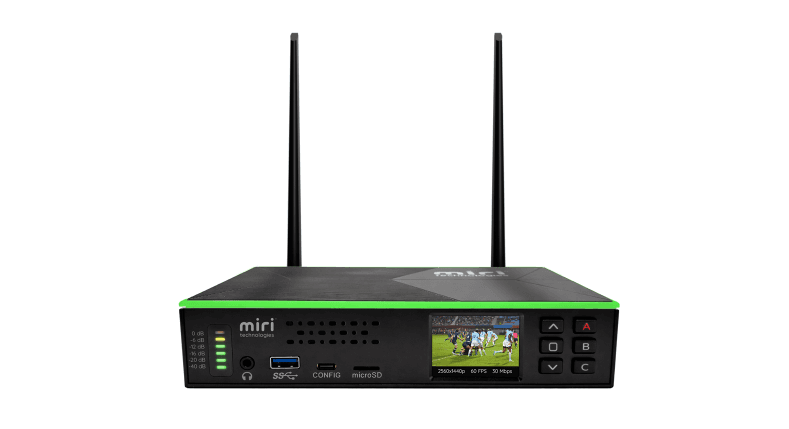
Miri Technologies has launched the V410, an encoder/decoder appliance that supports 4K live streaming, NDI HX3, SRT, and Open Media Transport. The unit features built-in Wi-Fi 7, dual Gigabit Ethernet ports, and is compatible with the company's X510 bonding router for resilient IP-based production workflows.
Key Takeaways
- Supports encoding of one 4K UHD stream at 60fps or two simultaneous 2K QHD (2560x1440) channels.
- Dual-mode hardware is user-configurable as either an encoder or a decoder with support for H.264 and H.265.
- Integrates Wi-Fi 7 connectivity and dual Gigabit Ethernet ports, with one port offering Power over Ethernet (PoE).
- Protocol support includes NDI HX3, SRT, and OMT, alongside transcoding capabilities from NDI High Bandwidth to streaming formats.
Why It Matters
The V410 addresses the critical need for deterministic wireless performance in congested environments by adopting Wi-Fi 7, which minimizes latency jitter for high-bitrate 4K streams. By including Open Media Transport (OMT) and two-factor authentication, Miri is positioning its hardware for the hybrid production era, where security and protocol interoperability are as vital as raw throughput. This move pressures legacy encoder manufacturers to upgrade internal wireless modules to 802.11be standards to remain viable in the professional field-contribution market. Watch for uptake in the corporate and educational sectors, where simplified web interfaces and front-panel VU meters target non-technical operators.
Additional Context
The V410 launch follows a broader industry push toward Wi-Fi 7 as a replacement for wired Ethernet in high-density production. Per Cisco (January 2026), 2026 is a turning point for the standard as device availability removes earlier adoption barriers. Wi-Fi 7 features such as Multi-Link Operation (MLO) are particularly relevant for video, as they allow devices to use multiple frequency bands simultaneously to ensure a stable connection even if one band experiences interference.
In the professional streaming hardware segment, the inclusion of NDI HX3 and the emerging OMT protocol reflects a larger shift toward efficient, low-bandwidth video-over-IP. Per Unified Streaming (February 2026), the industry is moving away from purely cloud-native workflows back toward hybrid hardware architectures to gain better control over latency and costs. This repatriation to the edge is driving demand for multi-protocol appliances that can bridge high-bandwidth local NDI sources with compressed SRT or HLS distribution streams.
Miri’s strategy also emphasizes security, marking a departure from traditional 'open' broadcast hardware. According to Miri CTO Ryan Brenneman at NAB 2026, the inclusion of two-factor authentication addresses increasing cyber threats against media infrastructure. This focus on device-level security alongside resilient network bonding—often used in conjunction with Miri's X510 dual-cellular router—is becoming a standard requirement for live event production where disruption of a master feed carries high financial and reputational risks.
Read full article at thebroadcastbridge.com
Enjoy our coverage?
Add StreamingMeme as a preferred source on Google to see more of our streaming news at the top of your Search results.
Add as preferred source