

Marketers lose 27% of annual ad spend to AI-driven fraud
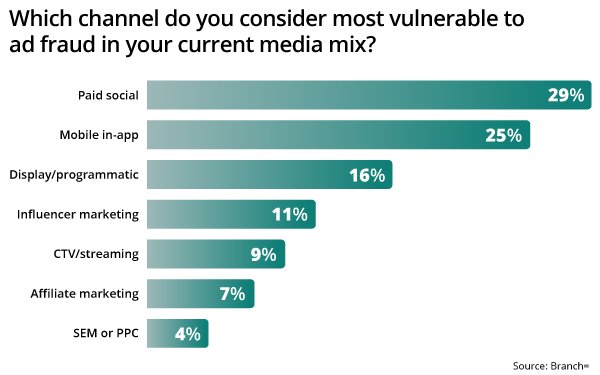
A survey of 455 marketing executives by fraud-protection firm Branch indicates that marketers estimate 27% of annual ad spend is lost to fraud. The report identifies AI's role in creating sophisticated fake conversions and highlights that advertising leaders see paid social and connected TV as significant areas of concern despite varied defense strategies.
Key Takeaways
- Marketers estimate 27% of annual advertising budgets are lost to fraudulent activity.
- Only 16% of executives believe AI is helping them fight fraud, while 83% say it makes detection more difficult.
- 98% of respondents have reallocated media budgets in the last 12 months due to rising fraud concerns.
- Connected TV remains a vulnerable sector, with invalid traffic rates higher than desktop and mobile web.
Why It Matters
The rising volume of AI-driven fake conversions threatens the integrity of performance-based buying. As fraudsters use synthetic agents to mimic clicks and installs at lower costs, advertisers are forced to move away from proxy metrics and toward bottom-line revenue measurement. In the streaming ecosystem, this shift increases the pressure on CTV platforms to provide transparent, log-level data to prove real audience engagement. Expect a broader industry transition toward 'end-quality' verification as standard detection tools struggle to keep pace with generative fraud. Watch for more buyers to mandate direct, authenticated supply paths to bypass the increasingly opaque programmatic open exchange.
Additional Context
The findings from Branch align with broader industry data showing a surge in high-tech exploitation of streaming budgets. Per DoubleVerify in May 2026, CTV fraud schemes and variants jumped 140% in Q1 2026 compared to the previous year. The spike is driven by the rise of fraudulent streaming apps and persistent bot attacks that can cost unprotected campaigns approximately $1.8 million per billion impressions. This has severely impacted buyer trust; a July 2026 IAB report found that 43% of CTV buyers now doubt inventory quality even when purchasing through supposedly safe direct deals or private marketplaces. Exacerbating the issue is the explosion of 'Made-for-Advertising' (MFA) inventory. According to Jounce Media data from early 2026, generative AI has lowered content production costs significantly, leading to a 38% year-over-year increase in active MFA domains. These sites use AI to mimic quality publisher signals while stuffing pages with high-load ad units that deliver zero editorial value. Research from the ANA in January 2025 indicated that while some marketers have successfully reduced MFA spend from 15% to 6.2%, more than half of all programmatic spend still fails to reach the intended consumer, highlighting a persistent 'blind spot' in automated ad delivery.
Read full article at mediapost.com
Get this in your inbox → Subscribe
Enjoy our coverage?
Add StreamingMeme as a preferred source on Google to see more of our streaming news at the top of your Search results.
Add as preferred source