
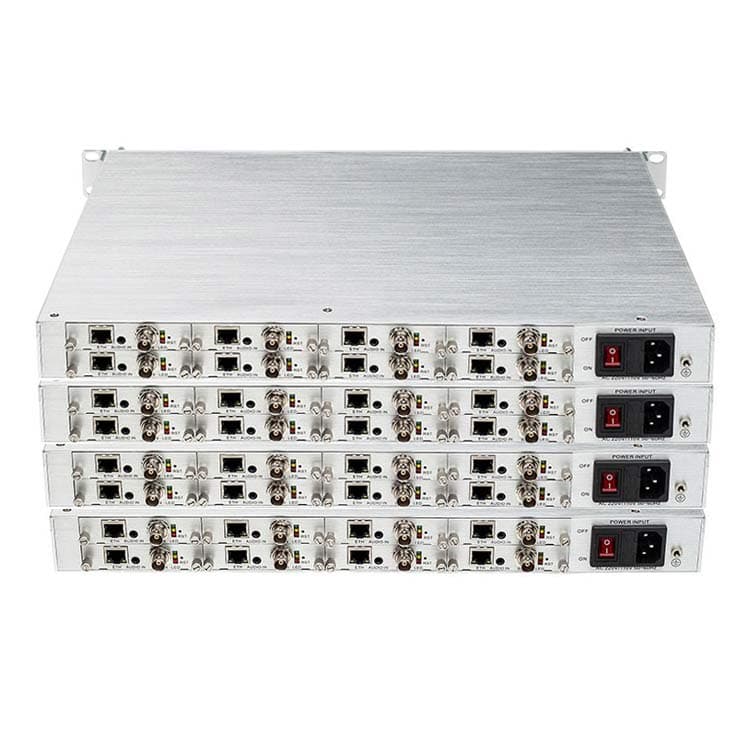
JLONvision has developed the EC8 SDI Video Encoder, an 8-channel hardware encoder supporting 1080P 60fps H.265 and H.264 video encoding. This device offers 30-50% bandwidth savings compared to H.264 and supports various streaming protocols including RTMP, HTTP, HLS, RTSP, and UDP. It is designed for broadcast, telecom operators, and IPTV systems, with embedded OS for 24/7 operation.
The EC8 addresses the growing demand for high-density, power-efficient contribution hardware in a market shifting toward HEVC for 1080p and 4K production. By consolidating eight SDI inputs into a single 2U chassis, it provides a high-density alternative to single-channel appliances for telcos and IPTV operators. This release underscores the industry-wide push to lower OpEx by reducing rack space and bandwidth costs while maintaining the low-latency reliability of dedicated hardware. Watch for whether JLONvision adds SRT support in upcoming firmware updates, as the protocol is increasingly required for reliable contribution over unpredictable public networks.
The hardware-based HEVC encoder market is seeing robust growth as legacy H.264 infrastructure reaches a replacement cycle. Per DataIntelo (April 2026), the global HEVC H.265 encoder market was valued at $3.8 billion in 2025 and is projected to reach $9.6 billion by 2034, with hardware appliances holding a dominant 57.4% share of revenue. This demand is driven by the necessity of dedicated Silicon (ASIC/FPGA) to manage high-density workloads, such as 16+ channels per rack unit, with the sub-50ms latency required for live sports and broadcast contribution.
Technological shifts are also focusing on the integration of AI-driven rate control. Per Data Insights Market (May 2026), AI algorithms are being integrated into encoding pipelines for noise reduction and dynamic bit-rate adjustments, potentially improving efficiency by another 5-10%. While emerging codecs like VVC (H.266) offer higher savings, most independent publishers are prioritizing HEVC due to its mature hardware playback ecosystem on mobile and CTV devices. This makes high-density SDI-to-HEVC bridges like the EC8 critical for current IPTV and OTT infrastructure upgrades.
Competitively, the market remains bifurcated between high-end systems from providers like Haivision and Harmonic—which prioritize high-fidelity 4:2:2 chroma and modular blade designs—and cost-effective standalone units. Recent reporting from Callaba (August 2025) suggests that rackmount reliability and protocol versatility, including the ability to push to multiple social platforms simultaneously, are the primary selection criteria for modern broadcast and corporate studio environments.
Add StreamingMeme as a preferred source on Google to see more of our streaming news at the top of your Search results.
Add as preferred source