

ITV Sport blends Brooklyn rooftop views with AE Live tracking for World Cup
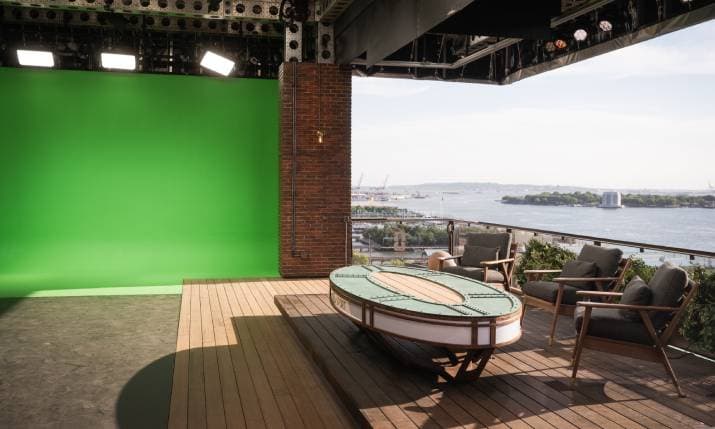
ITV Sport is producing its FIFA World Cup 2026 coverage from a hybrid virtual studio in Brooklyn that blends real-world Manhattan skyline views with augmented reality elements. The production utilizes AE Live engines and StypeGrip tracking to synchronize physical and virtual sets for a 360-degree broadcast environment.
Key Takeaways
- The rooftop studio sits on a three-meter-high truss structure to clear foreground obstructions and optimize views of the Brooklyn Bridge and Manhattan skyline.
- Technical workflow utilizes five AE Live VR engines combined with StypeGrip tracking and spider arrays to transition between physical interiors and virtual backgrounds.
- A semi-remote production model connects the Brooklyn site to ITV’s Gravity Westworks hub in London via dual 10-gigabit fiber links to handle vision mixing and EVS.
- The 'unreal' set layers include fixed virtual screens within real-world buildings, allowing directors to overlay match highlights or fan reactions onto the skyscraper backdrops.
- Production audio incorporates a live stereo landscape of city sounds, including local traffic and sirens, mixed to maintain broadcast clarity while preserving location atmosphere.
Why It Matters
This deployment marks a shift in major tournament broadcasting where physical location is no longer just a backdrop but a data-integrated component of the virtual set. By blending real optics with five VR engines, ITV is addressing the 'clinical' feel of total virtual production while maintaining the flexibility of digital assets. For the broader ecosystem, this hybrid approach sets a benchmark for high-stakes remote production, proving that lean on-site technical teams can execute complex AR-enhanced broadcasts via high-bandwidth fiber. Industry observers should watch if this 'location-plus-augmentation' model becomes the standard for reducing on-site footprints without sacrificing the high-value 'big event' aesthetic that viewers expect from terrestrial rights holders.
Additional Context
The 2026 FIFA World Cup has become a testing ground for contrasting production philosophies among major UK and US broadcasters. While ITV Sport established its physical presence in Brooklyn, the BBC opted for a remote-first strategy, broadcasting from its Salford hub to reduce carbon emissions by a reported 19%, per TalkTV in June 2026. This tactical divergence highlights a growing industry debate over the necessity of on-location anchoring versus the efficiency of centralized virtual studios. Simultaneously, Fox Sports has deployed what it describes as the world’s largest live multi-camera LED volume at its Los Angeles lot, using over 54 million individual LEDs to simulate tournament environments for its North American rights, according to NewscastStudio reporting in June 2026.
Technological partnerships have also deepened to solve latency and resolution issues inherent in such large-scale remote workflows. AE Live, which extended its 25-year partnership with ITV Sport in July 2024, is now providing remote graphics playout from hubs in both London and Connecticut to support volume-heavy schedules across Apple/MLS and FIFA broadcasts. On the distribution side, Sky launched 'Real Time' channels in June 2026 to combat the streaming lag often associated with 4K UHD broadcasts on platforms like BBC iPlayer, offering a low-latency alternative for viewers concerned about social media spoilers. These developments collectively signal a move toward highly decentralized production where the physical studio serves as a boutique aesthetic choice rather than a technical requirement.
Read full article at svgeurope.org
Enjoy our coverage?
Add StreamingMeme as a preferred source on Google to see more of our streaming news at the top of your Search results.
Add as preferred source