

Interactive Entertainment Blurs Lines: Streaming, Gaming, Real-Time Converge
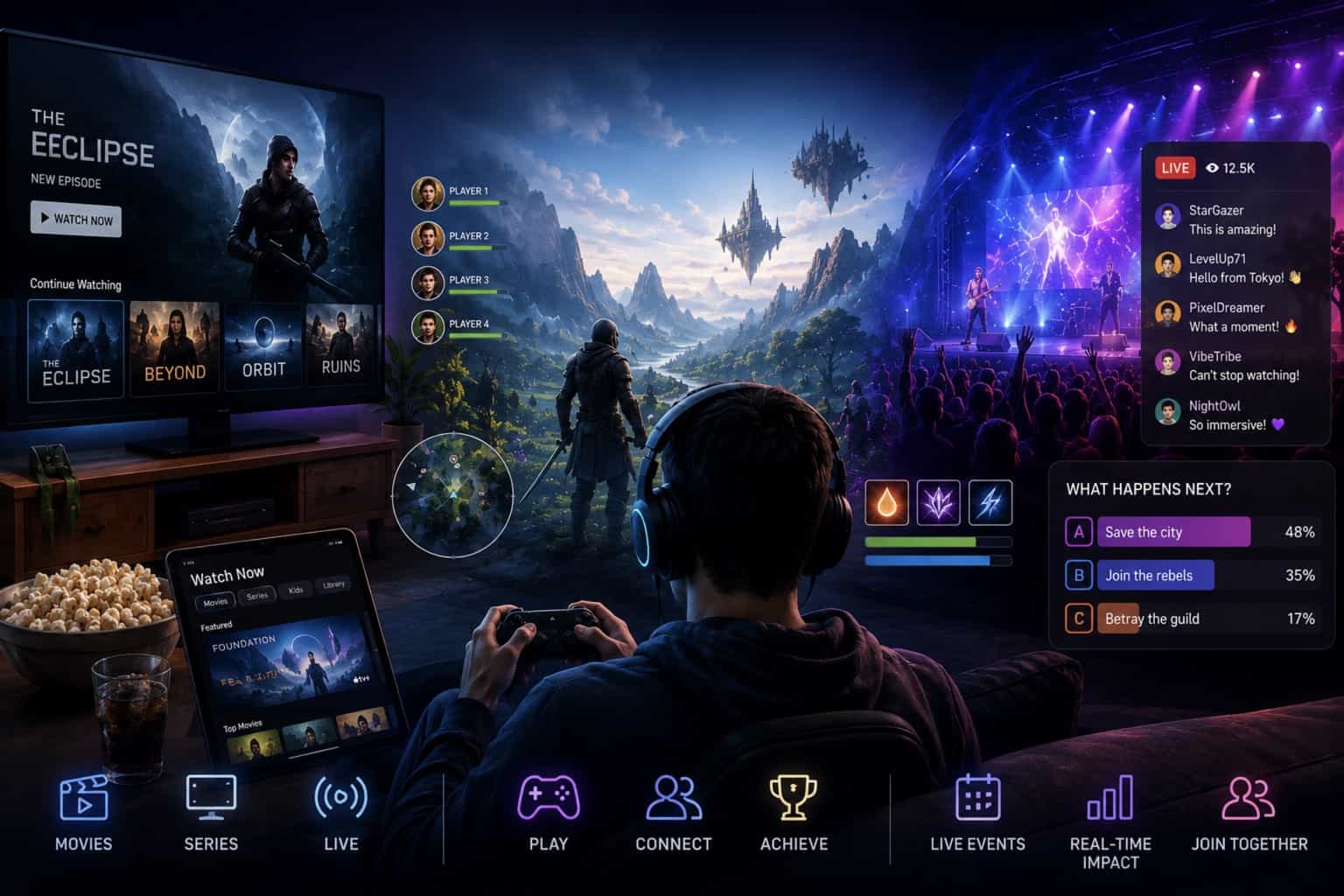
The article discusses the growing convergence of streaming, gaming, and real-time interactive experiences, leading to a structural shift in content creation and consumption. This trend is driven by technological advancements like low-latency streaming and the increasing demand for participatory media from audiences. Platforms and regulators are responding to these changes, with the UK undertaking an inquiry into immersive technologies.
Key Takeaways
- Audience demand for interactive, short-form content drives a structural shift in content creation and consumption.
- Platforms like Netflix experiment with branching narratives, while Twitch normalizes audience influence on live broadcasts via chat and real-time voting.
- Low-latency streaming and connected devices remove key barriers to convergence between streaming and gaming experiences.
- The UK Parliament is conducting an immersive technologies inquiry into regulating hybrid interactive products and platforms.
Why It Matters
The convergence of streaming, gaming, and real-time experiences is redefining how content is produced and monetized, forcing platforms to adapt their infrastructure and design. This shift moves beyond traditional linear models, emphasizing real-time interaction and user participation as central to audience engagement. Companies should monitor regulatory responses, particularly in regions like the UK, and track investment trends in live and hybrid format productions to understand emerging competitive landscapes.
Additional Context
The trend towards interactive entertainment blurring the lines between streaming and gaming continues to manifest in various developments. Nexon and Naver are launching linked content for "FC Online" and the Chzzk streaming platform, allowing users to move between watching broadcasts and playing games on a single screen (DigitalToday, June 2026). This collaboration integrates mini-games directly into Chzzk streams, with rewards for "FC Online" players, emphasizing data synergies and personalized content delivery based on user interests. This initiative aims to connect users' daily lives and games more seamlessly.
Cloud gaming services are also expanding and enhancing their offerings. Amazon launched Prime in South Africa, including Amazon Luna cloud gaming (NAG, June 2026). Luna provides access to a rotating selection of games like "Hogwarts Legacy" and "Fortnite" without requiring high-end hardware, marking a significant step toward accessibility in the region. Meanwhile, Nvidia added 18 new games to its GeForce NOW cloud gaming service in June 2026, including "Neverness to Everness" and "Gothic 1 Remake" (AI Chat Daily, June 2026). This continuous expansion of content libraries, often featuring graphically demanding titles, highlights the growing viability and competitive nature of cloud streaming as a distribution channel for interactive experiences.
Further demonstrating the push for immersive, interactive content, X-Plane and iRacing landed on Apple Vision Pro, streaming from gaming PCs to the headset (VR.org, June 2026). These applications utilize foveated streaming and passthrough technology to blend physical cockpits with virtual environments, enhancing realism and addressing long-standing VR simming challenges. This positions the Vision Pro as a premium display peripheral for content rendered elsewhere, indicating a focus on high-fidelity user experience for dedicated enthusiasts.
Read full article at seat42f.com
Enjoy our coverage?
Add StreamingMeme as a preferred source on Google to see more of our streaming news at the top of your Search results.
Add as preferred source