

indie Semiconductor debuts iND881 SoC for automotive and robotic edge AI
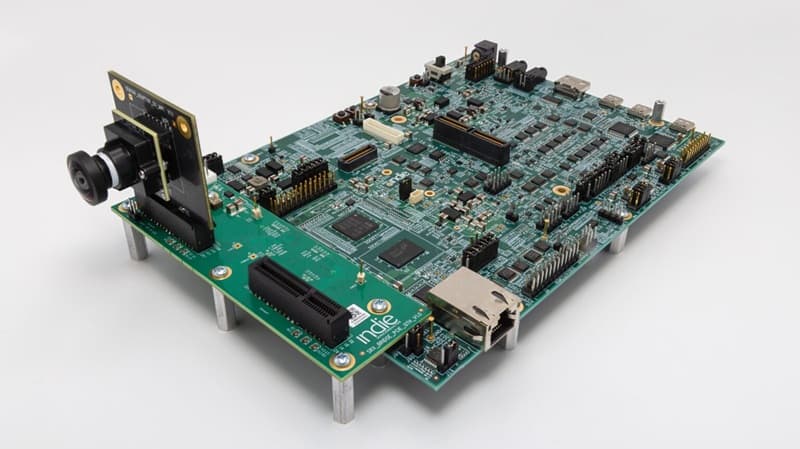
indie Semiconductor has announced the iND881, a new system-on-chip that combines AI compute, image signal processing, and integrated H.264 video encoding. The hardware is designed for automotive and robotic camera applications, supporting multi-modal sensor fusion and high-resolution video streams.
Key Takeaways
- Delivers 2 TOPS of AI compute at 1 GHz alongside a 500 GOPS VLIW SIMD DSP
- Supports up to 8MP video at 60 fps via an integrated H.264 encoder
- Includes a 144 dB HDR 24-bit pipeline and a hardware security module for secure boot
- Qualified for AEC-Q100 Grade 2 and meets ISO 26262 ASIL-B requirements
Why It Matters
The iND881 reflects a shift toward decentralized perception, moving heavy inference tasks directly into the camera module to bypass central bus latency. By integrating the emotion3D software stack acquired in 2025, indie provides a pre-validated solution for the mandated driver and occupant monitoring (DMS/OMS) market. This positioning allows indie to compete in the mid-tier automotive segment against larger rivals by focusing on low-power, high-integration silicon for specific safety-critical vision tasks. Watch for volume production timelines following the AutoSens and InCabin USA 2026 demonstrations to gauge Tier 1 adoption.
Additional Context
The launch of the iND881 follows indie Semiconductor’s August 2025 acquisition of Vienna-based emotion3D for $20 million in cash plus performance-based earnouts. Per indie’s 2025 disclosures, the transaction was designed to pair indie's mixed-signal SoCs with emotion3D's AI-based perception algorithms, specifically targeting the $83 billion automotive software market projected for 2030 by McKinsey. This strategy addresses the growing regulatory pressure for in-cabin safety, as global assessment programs increasingly require sophisticated driver and occupant monitoring systems (DMS/OMS).
In the broader semiconductor landscape, indie's iND881 enters a market where edge AI is becoming the standard for autonomous mobile robots and humanoid platforms. According to May 2026 reporting from MarketsandMarkets, the humanoid robot market is entering a commercialization phase, expected to grow to $15.26 billion by 2030. This expansion is driven by the convergence of multimodal perception systems and AI hardware that allow robots to interpret unstructured environments in real-time, a capability indie is targeting with its support for IR, thermal, and LiDAR fusion.
Recent competitive activity at the June 2026 Qualcomm Automotive Technology Summit highlights a parallel trend toward cockpit-driving integration. While Qualcomm is focusing on 2,000 TOPS-class central compute for high-tier vehicles, per Counterpoint Research, smaller innovators like indie are finding traction by providing efficient, specialized edge processors. This bifurcated market allows OEMs to balance high-power central intelligence with cost-effective, low-latency edge sensors that handle dedicated safety functions like blind-spot detection and lane-keeping assistance.
Read full article at electronics-lab.com
Enjoy our coverage?
Add StreamingMeme as a preferred source on Google to see more of our streaming news at the top of your Search results.
Add as preferred source