

India's Creator Economy Professionalizes Into $250 Billion Global Sector
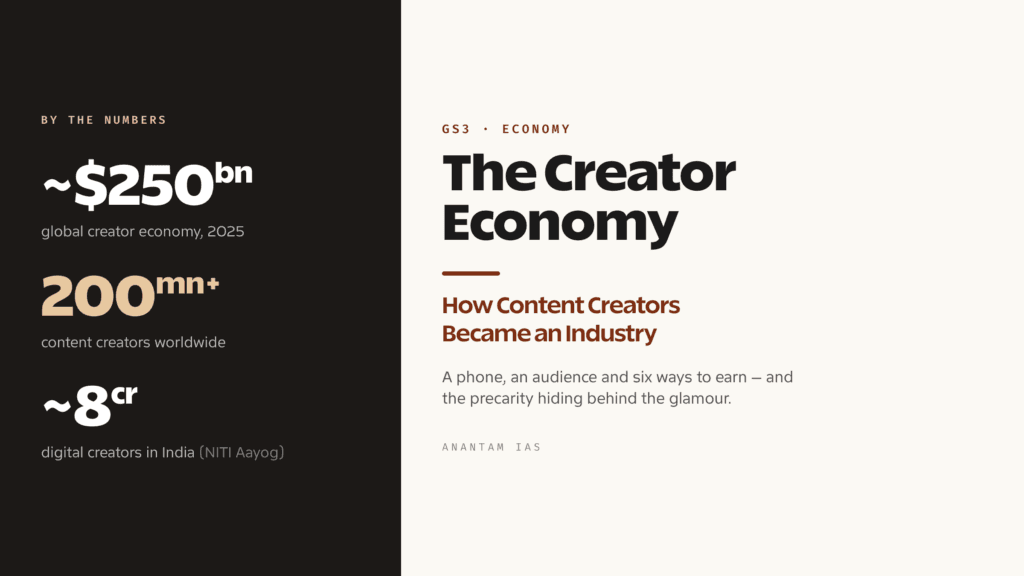
The article discusses the rapid growth and professionalization of the global creator economy, projected to reach $250 billion by 2025, with a significant focus on India's role. It details how creators monetize their content, the precarity of platform dependence, and India's regulatory efforts including ASCI guidelines for ad disclosure and SEBI's rules for finfluencers. The Indian government has embraced the 'Orange Economy' strategy, backing it with a $1 billion fund and initiatives to foster the sector.
Key Takeaways
- Global creator industry size estimated at $250 billion in 2025 with 20% annual growth.
- India counts 80 million digital creators, through only 4.5 million are classified as professionally active.
- YouTube Partner Programme pays a 55% revenue share on standard videos, though Indian RPMs remain low.
- SEBI January 2025 rules now bar regulated entities from associating with unregistered financial influencers.
- The Indian government launched a $1 billion Creative Economy fund to support the sector.
Why It Matters
The professionalization of creators signals a shift from gig-work fragmentation to a mature, regulated media category. For streaming platforms, this validates the high-value nature of user-generated content (UGC) but introduces significant compliance overhead as regulators like ASCI mandate transparent ad disclosure. The Indian government's strategic backing of the Orange Economy positions content as a formal export, mirroring the country's IT services boom. Watch for how platforms balance stricter 'inauthentic content' policies with the need to retain a mass volume of creators as traditional media spend continues to move toward individual-led channels.
Additional Context
The professionalization of the Indian creator sector aligns with a broader shift in the digital advertising landscape. According to a Dentsu report from February 2025, India's digital ad market is expected to grow by 20.2% to reach ₹59,200 crore by year-end, with social media spend accounting for nearly 30% of that total. This surge in capital has attracted tighter platform-level governance; per the Economic Times in July 2025, YouTube enforced new monetization guidelines to demonetize 'inauthentic' or mass-produced AI content, requiring creators to prove 'original value' through commentary or unique context to remain in the YouTube Partner Program (YPP).
Regulatory enforcement is also becoming more data-driven. A 2025 study by the Advertising Standards Council of India (ASCI) found that 69% of top digital creators were in violation of disclosure norms, leading to a visible shift from voluntary compliance to enforceable accountability. By early 2025, SEBI had already directed over 70,000 misleading financial posts to be removed, emphasizing that influence carrying financial risk now requires formal registration. Parallel to this, BCG reporting in May 2025 indicated that while only 10% of India's 2.5 million monetized creators currently earn a full-time living, the ecosystem is already influencing over $350 billion in annual consumer spending.
Globally, the sector is moving toward a multi-revenue model to hedge against platform volatility. Goldman Sachs projections from March 2025 suggest the number of global creators will hit 67 million this year, with professional creators looking to 'creator enablement tools' to diversify away from pure ad-share. As major platforms like Meta launch paid subscription tiers (e.g., Facebook Plus) to offset AI infrastructure costs as of June 2026, the creator economy is increasingly blending with the subscription economy, forcing creators to transform from viral celebrities into diversified small business entities.
Read full article at anantamias.com
Enjoy our coverage?
Add StreamingMeme as a preferred source on Google to see more of our streaming news at the top of your Search results.
Add as preferred source