

IETF standardizes HTTP QUERY method to optimize data-heavy streaming metadata
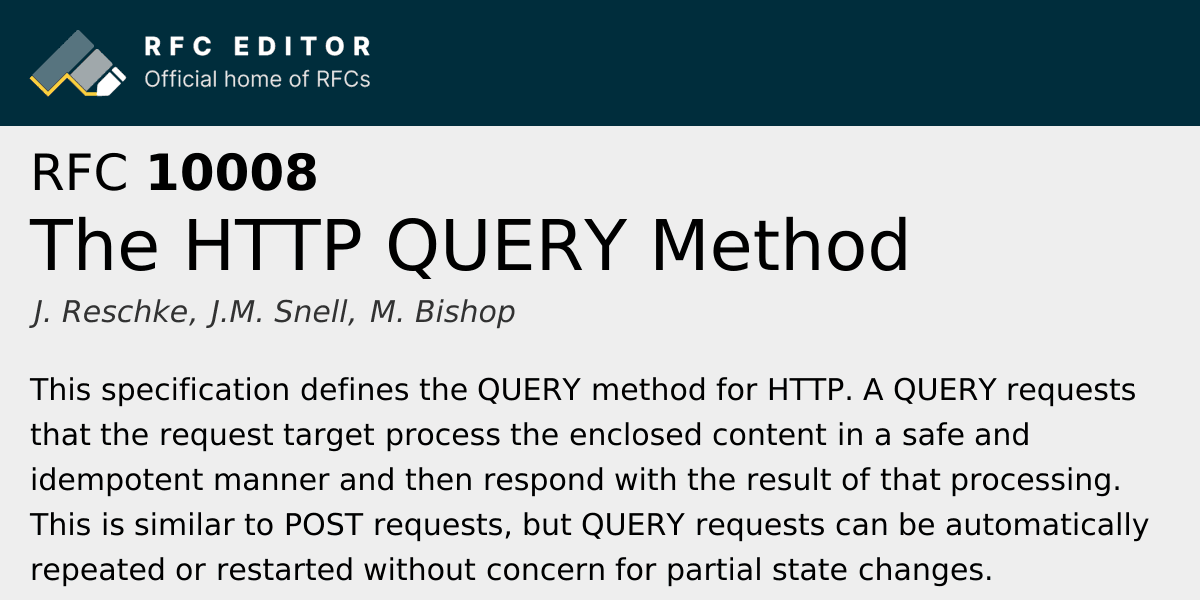
The IETF has finalized RFC 10008, standardizing the HTTP QUERY method to bridge the gaps between GET and POST for safe and idempotent requests. The method allows systems to submit complex query parameters within the request body rather than the URI, mitigating size restrictions and logging risks while enabling automatic retries and native caching. This standard is highly relevant for streaming platforms and CDNs managing heavy payload metadata queries, analytics, and content routing.
Key Takeaways
- QUERY replaces the common 'GET with body' hack, enabling safe, idempotent requests that include a payload.
- The method mitigates URI length constraints, which often truncate complex analytics and metadata queries at approximately 8,000 octets.
- Standardized caching for QUERY requests allows CDNs to store and reuse responses without the cache invalidation risks typical of POST requests.
- RFC 10008 was co-authored by engineers from Akamai and Cloudflare, signaling strong alignment with edge delivery and CDN infrastructure.
Why It Matters
The standardization of QUERY directly addresses a major bottleneck in streaming analytics and personalization: URI size limits often break complex recommendation engine requests. By moving query logic into the request body while preserving idempotency, platforms can finally leverage native CDN caching for deep-catalog searches and high-volume metadata calls. This reduces origin load and improves responsiveness for UI-heavy applications. As streaming architectures shift toward object-native delivery and edge-resident control logic, standardized QUERY support will be essential for managing the sheer volume of per-session telemetry. Watch for major CDN vendors to roll out native QUERY-keying support in their caching rules throughout late 2026.
Additional Context
The finalization of RFC 10008 follows years of collaborative development within the IETF HTTP Working Group, with contributors from cloud leaders Akamai and Cloudflare highlighting the method's critical role in modern web infrastructure. Prior to this standard, developers often navigated a 'GET-POST-GET' cycle to handle voluminous data queries—a process that Nordic APIs noted in 2022 as inefficient and prone to security risks, such as sensitive query parameters appearing in server logs or browser histories. By formalizing QUERY, the industry gains a semantic tool specifically built for data-intensive API calls that are both safe to repeat and cacheable.
In the broader streaming ecosystem, this technical shift aligns with the maturation of other delivery standards such as LL-HLS and Media over QUIC (MoQ). Per Eltrovemo in March 2026, the industry has progressively refined the HTTP delivery paradigm toward object-level granularity and lower latency. While HLS remains the baseline for compatibility, the addition of QUERY provides a missing piece for the management of the 'data behind the data'—metadata. Efficient metadata handling is vital, as Hygraph reported in early 2026 that bad data management can cost streaming companies between 15% and 25% of their potential revenue.
Implementation is already reaching major development environments. For example, Node.js introduced experimental support as early as June 2024, providing a foundation for backend services to adopt the method ahead of widespread browser support. As of June 2026, analysts expect the next phase of adoption to focus on middle-box and intermediary compatibility. Because QUERY responses are explicitly cacheable, they avoid the semantic 'oddities' of caching POST requests, which many security-focused proxies and gateways are traditionally configured to reject or bypass.
Read full article at rfc-editor.org
Enjoy our coverage?
Add StreamingMeme as a preferred source on Google to see more of our streaming news at the top of your Search results.
Add as preferred source