

Graphic Processor Market to Double by 2033, Driven by AI Infrastructure
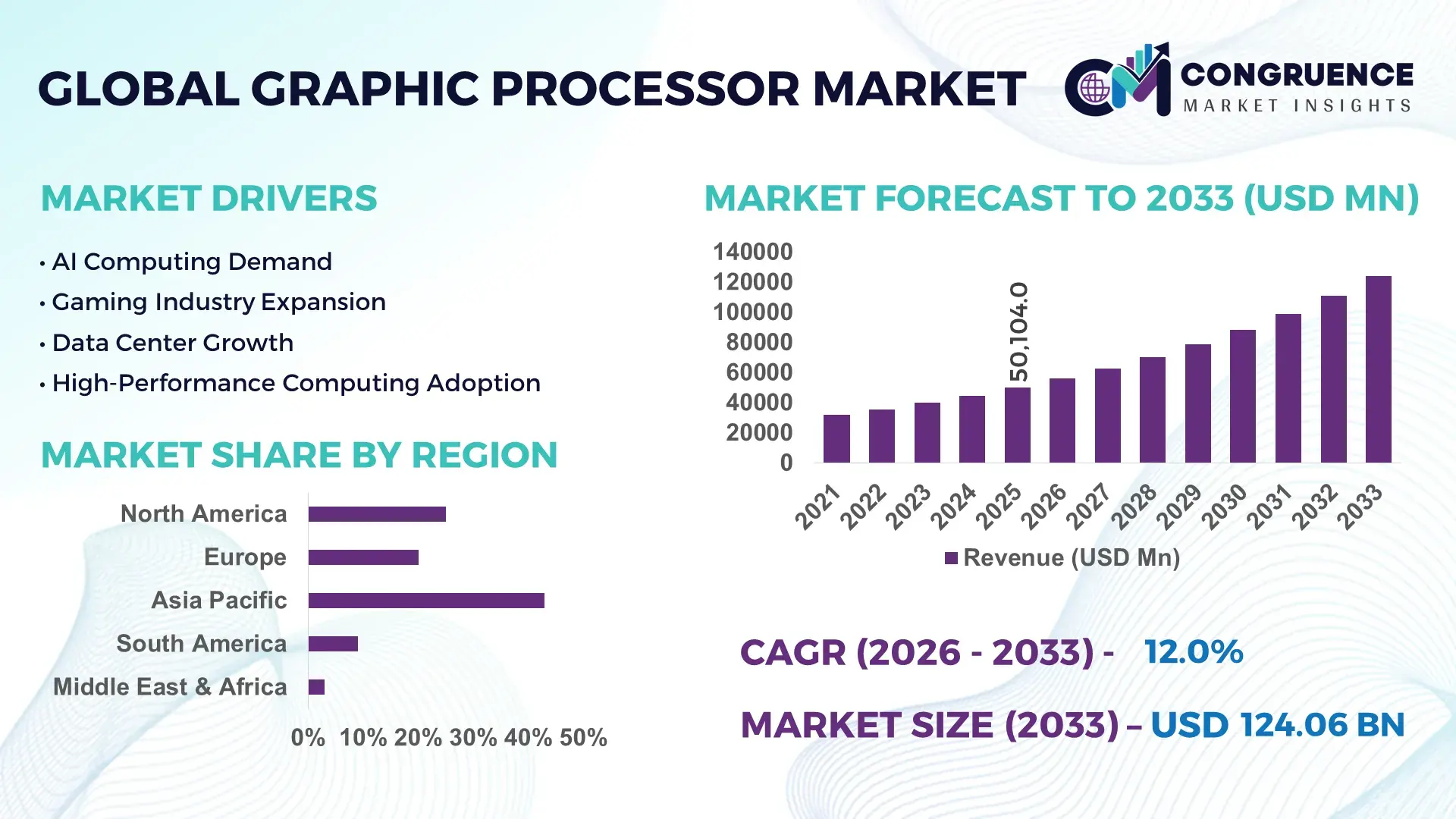
The global graphic processor market, valued at $50.1 billion in 2025, is projected to reach $124 billion by 2033, driven largely by AI infrastructure and gaming demand. The report highlights the increasing role of GPUs in cloud rendering, content creation, and data center efficiency, with implications for AI-accelerated video workflows and streaming platforms. Key players like NVIDIA, AMD, and Intel are expanding their focus on AI-centric GPU architectures to improve efficiency and reduce latency in demanding workloads.
Key Takeaways
- Market size expected to grow from $50.1 billion in 2025 to $124 billion by 2033, a 12% CAGR.
- AI server deployments surged 38%, cloud gaming traffic increased 27%, and automotive visualization workloads expanded 22%.
- North America leads high-end AI graphic processing demand with over 45% market share, while China holds 32% manufacturing-linked supply participation.
- Over 64% of enterprise AI workloads use GPU acceleration; premium gaming GPU upgrades increased 31% globally.
- NVIDIA, AMD, and Intel are key players, with one leading GPU vendor controlling nearly 70% of AI accelerator shipments.
Additional Context
The graphic processor market's expansion is significantly influenced by hardware innovations aimed at enhancing AI capabilities. NVIDIA, for instance, unveiled its RTX Spark superchip in June 2026 at COMPUTEX, integrating a Blackwell RTX GPU with a 20-core NVIDIA Grace CPU. This chip, designed for Windows PCs, delivers up to 1 petaflop of AI compute and 128GB of unified memory, supporting local AI agents and 12K video editing (per Videomaker, June 2026). Microsoft is partnering with NVIDIA to develop a secure Windows platform for these on-device AI agents (per SiliconANGLE, June 2026). NVIDIA's consistent focus on AI-centric GPUs was further demonstrated in March 2024 with the launch of the Blackwell GPU platform, which aims to reduce large language model inference costs and energy consumption significantly. OpenAI and NVIDIA have already deployed GPT-5.5 Codex on Blackwell GB200 NVL72 systems, achieving 50x higher token efficiency per megawatt and a 35x reduction in inference costs (per TechRadar, May 2026). This trend underscores a broader industry shift where GPU design prioritizes AI processing over traditional gaming, leading to potential supply constraints for consumer gaming GPUs as data center demand takes precedence (per Verodate, October 2026). The competition in this space is intense, with Intel's Arc Battlemage B770, manufactured on its own 18A process, emerging as a notable competitor that sidesteps TSMC capacity issues (per Verodate, October 2026).
Read full article at congruencemarketinsights.com
Enjoy our coverage?
Add StreamingMeme as a preferred source on Google to see more of our streaming news at the top of your Search results.
Add as preferred source