

FOX Sports cuts World Cup latency to 30ms via AES67 workflows
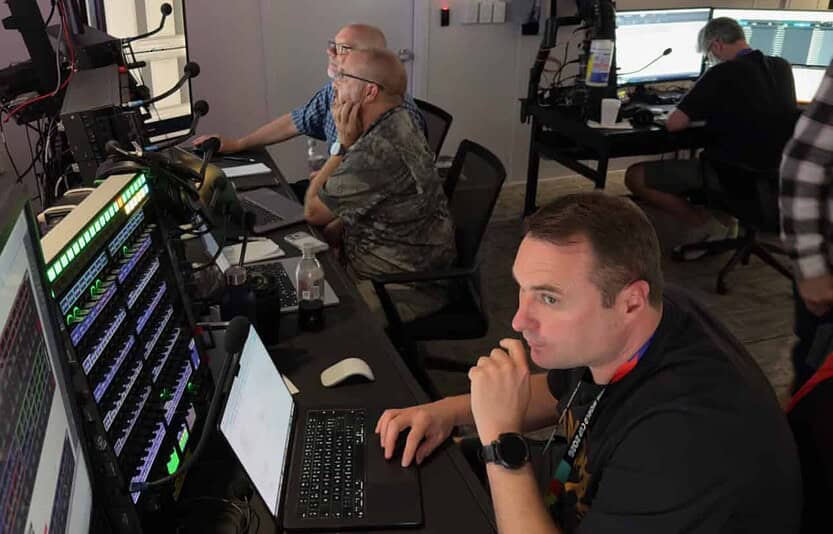
FOX Sports is using AES67 trunk lines and BRISK IP studio kits to manage intercom and commentary workflows across 104 World Cup matches in three countries, connecting its Pico broadcast center, Dallas IBC, and up to six venues at a time. The article says the move from VoIP to AES67 has cut round-trip latency to about 30 milliseconds and details the production chain involving Riedel, Calrec, Dante, Cisco, and other live-production systems.
Key Takeaways
- Modular BRISK 'remote truck in a box' systems enable rapid onsite assembly in under two hours using JPEG XS encoding.
- Dual workflow tracks connect match venues simultaneously to the Dallas International Broadcast Center and the Pico facility in Los Angeles.
- Technical stack includes Riedel 1024 frames, Calrec audio equipment, and EVS Cerebrum control for ST 2110-redundant operations.
- Commentary integration uses MADI streams from Host Broadcast Services to link play-by-play teams directly to Pico control rooms.
Why It Matters
This architectural shift demonstrates the physical limits of traditional remote production when scaled across a three-country, 104-match tournament. By replacing legacy VoIP with AES67 trunking, FOX is prioritizing synchronization and low latency—critical for maintaining natural dialogue between onsite commentators and studio analysts thousands of miles apart. As sports streaming increasingly shifts toward centralized production models (REMI), this deployment proves that high-fidelity, visually lossless content can be managed at a massive scale without replicating heavy truck infrastructure at every venue. Watch for whether this IP-centric approach becomes the blueprint for future geographically dispersed mega-events like the 2028 Olympics.
Additional Context
The 2026 FIFA World Cup represents the largest production in FOX Sports history, requiring 340 hours of first-run programming to cover an expanded 48-team field across 16 host cities. Per TV Technology (June 2026), the network’s Home Run Productions (HRP) REMI infrastructure has been upgraded to support both JPEG XS and low-latency HEVC via Appear’s X platform. This enables the network to produce and distribute all match and studio content natively in 1080p HDR, a technical milestone for the tournament's broadcast consistency across North American markets.
While FOX manages its specific broadcast rights, the broader infrastructure at the International Broadcast Center (IBC) in Dallas is powered by Lenovo, FIFA’s official technology partner. According to FIFA (June 2026), Lenovo is deploying over 17,000 devices and ThinkSystem SR635 V3 servers to manage live video data and AI-driven innovations, such as semi-automated offside technology using 3D player avatars. The IBC facility itself spans 45,000 square meters, serving as the nerve center for nearly 200 global broadcasters.
Beyond technical delivery, FOX is leveraging this IP backbone to support a highly distributed talent roster. Per Front Office Sports (May 2026), the network's production involves more than 1,200 crew members and nine traveling commentary teams. This decentralized on-air presence relies entirely on the low-latency kits to ensure that high-profile additions, such as Thierry Henry and Zlatan Ibrahimović, can interact with match feeds with minimal delay. This setup also supports simultaneous streaming delivery across the new Fox One platform and Tubi, marking a significant test for the network's direct-to-consumer and FAST strategies.
Read full article at sportsvideo.org
Enjoy our coverage?
Add StreamingMeme as a preferred source on Google to see more of our streaming news at the top of your Search results.
Add as preferred source