
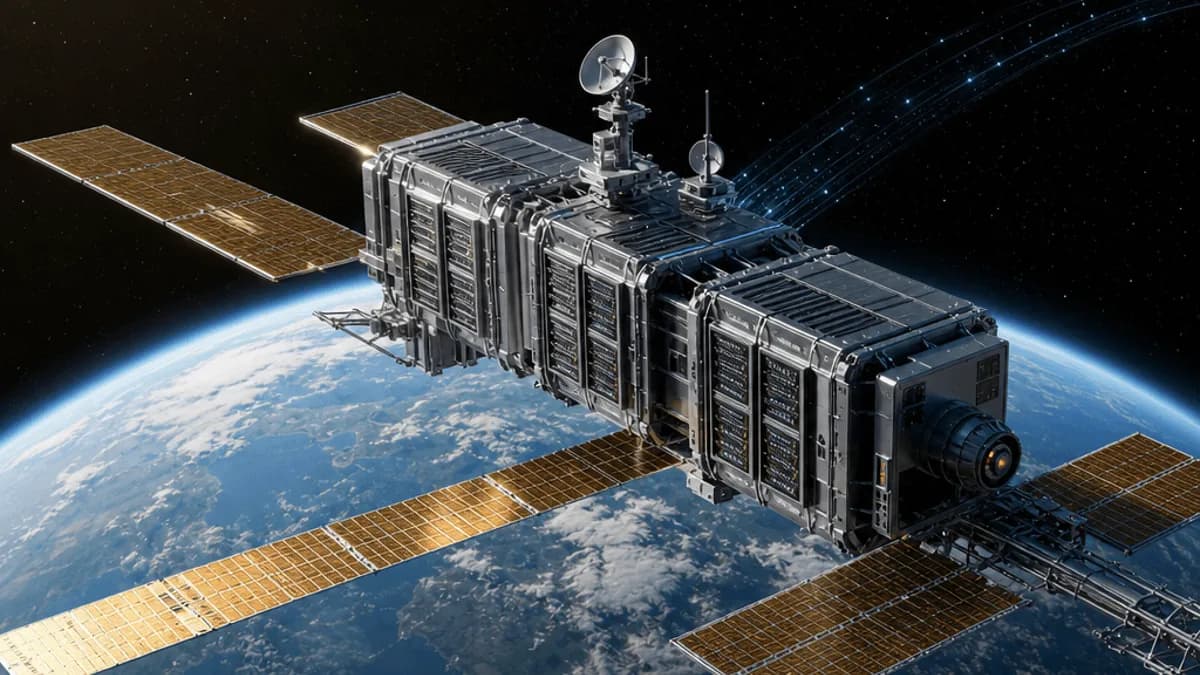
Euwyn Poon, founder of Spin, has raised $5 million in seed funding for Orbital, a new startup aiming to build 10,000 orbital data centers. This initiative seeks to address the escalating energy and cooling requirements of AI computation by relocating infrastructure to space. The project envisions using space for batch processing tasks like training large language models or rendering video.
The venture signals a shift toward off-planet infrastructure as terrestrial grid capacity and cooling water become critical bottlenecks for AI expansion. While latencies currently restrict orbital compute to batch tasks like video rendering and model training, high-density solar power and radiative cooling offer a long-term escape from urban zoning moratoriums and utility limits. For the streaming and video industry, successful deployment could fundamentally relocate high-compute backend tasks from crowded ground centers to more scalable orbital arrays. Watch for the 2027 Pathfinder demo to validate if off-the-shelf GPUs can survive radiation levels and meet the thermal dissipation requirements necessary for sustained production workloads.
The space-based compute sector has accelerated rapidly in early 2026 as mounting energy crises on Earth drive hyperscalers and startups toward Low Earth Orbit (LEO). Per market reporting from June 2026, SpaceX recently filed an S-1 for a highly anticipated IPO, which outlined plans for a "Gigasat" factory in Bastrop, Texas. This facility is designed to manufacture "AI satellites" capable of providing 100 gigawatts of orbital compute annually. This move aligns with a broader trend of vertical integration, where launch providers like SpaceX and Blue Origin are positioning themselves to handle both the transport and the computing for AI workloads to solve what they describe as the "power and cooling wall."
Beyond specialized startups like Orbital, legacy tech giants are also testing the atmosphere. Per internal reporting from May 2026, Google is developing "Project Suncatcher," an initiative specifically exploring high-bandwidth optical links and solar-powered Tensor Processing Units (TPUs) in orbit. Meanwhile, startups such as Starcloud have already reported hosting Nvidia H100 GPUs in space to demonstrate system-level AI training in an unpressurized environment. These projects are primarily targeting the same infrastructure gap: the International Energy Agency projected in mid-2026 that global data center energy consumption will more than double by 2030, matching the total power draw of a nation like Japan.
The technical hurdle remains the transition from conduction-based cooling used on Earth to radiative cooling in space. Per detailed technical analysis from June 2026, SpaceX's AI1 satellite concept uses 110-square-meter deployable liquid radiators to shed heat as infrared light. While proponents argue that space is a "free refrigerator," the Stefan-Boltzmann law dictates that heat dissipation in a vacuum is significantly slower than water-based systems on the ground. Consequently, the industry is closely tracking the development of modular computing fleets and specialized thermal materials as prerequisites for reaching cost parity with Earth-bound facilities by the mid-2030s.
Add StreamingMeme as a preferred source on Google to see more of our streaming news at the top of your Search results.
Add as preferred source