

Deezer reports 50% of daily music uploads are now AI-generated
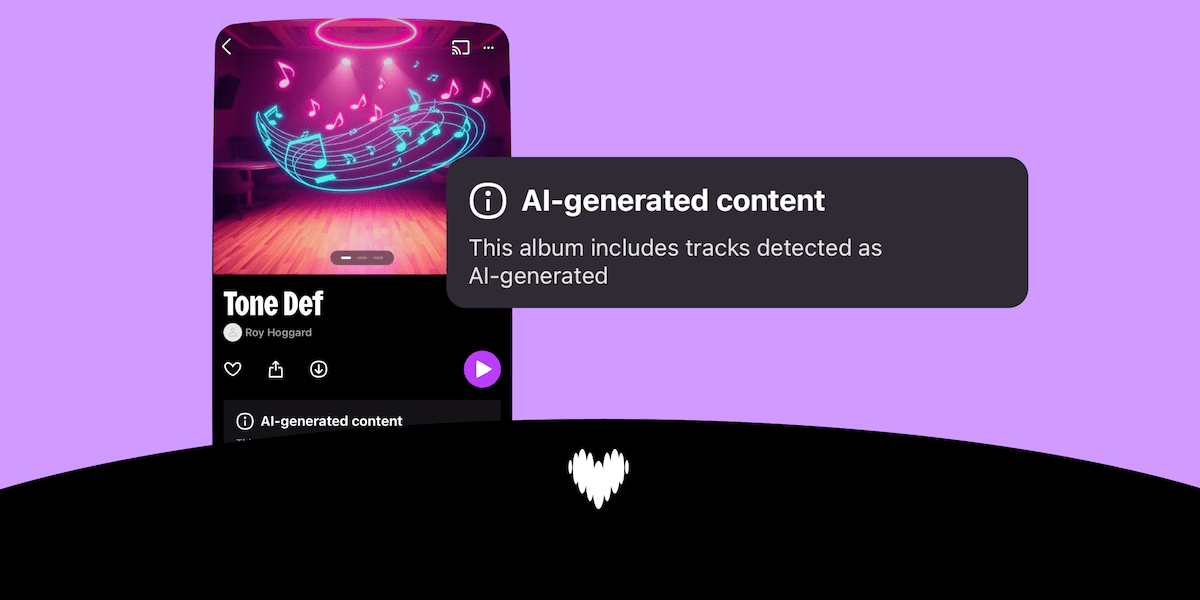
Streaming service Deezer reported that AI-generated content now makes up over 50% of its daily uploads, with volumes reaching 90,000 tracks per day during peak periods. In response to these trends, the company is implementing a policy to remove AI-generated tracks that lack engagement or are associated with fraudulent activity, and is offering its internally developed AI detection technology to other platforms.
Key Takeaways
- AI upload volume on Deezer surged from 10,000 tracks daily in January 2025 to 90,000 in June 2026.
- Internal detection technology can identify audio generated by Suno and Udio models with reported 99.8% accuracy.
- Purge policy targets AI tracks with zero streams over six months to protect artist royalty pools from dilution.
- Statutory labels for AI-generated music are now visible to listeners on the platform to ensure content transparency.
Why It Matters
The vertical surge in AI-generated supply indicates that synthetic content is no longer a niche phenomenon but a dominant portion of the global ingest pipeline. For the streaming ecosystem, this creates a high-stakes filtering problem; while Deezer uses aggressive purges and auto-detection, competitors like Apple and Spotify rely more on voluntary metadata disclosures. This divergence in policy—ranging from Bandcamp's total ban to Spotify's conditional acceptance—fragmentizes how artists monetize AI-assisted works. The immediate pressure now shifts to distributors, who must verify provenance to avoid mass takedowns. Watch for whether other major DSPs adopt Deezer’s detection tools to standardize synthetic content identification across the industry.
Additional Context
The surge in synthetic content arrives as the recording industry's legal stance on AI training data reaches a critical juncture. Per Music Business Worldwide and Law Commentary (July 2026), Sony Music recently intensified its litigation by filing a new $4.5 billion copyright lawsuit against Udio, asserting that over 30,000 recordings were used for unauthorized training. This follows a period of consolidation where Universal Music Group and Warner Music Group settled their respective disputes with Udio and Suno in late 2025 to establish licensed AI music frameworks. Sony remains the final major label holdout in U.S. federal courts, pursuing discovery to identify the scale of catalog scraping. While supply has exploded, consumption of fully synthetic music lags significantly behind human-authored works. Per Apple Music industry briefings (May 2026), while AI-generated tracks comprise over 33% of new uploads to its catalog, they account for less than 0.5% of total listening time. This disparity has led to the implementation of "Transparency Tags" on Apple Music and a similar "verified" badge system on Spotify to distinguish human artistry from automated uploads. These measures align with the EU AI Act's Article 50, which becomes enforceable in August 2026 and mandates machine-readable labels for AI-generated audio. Industrial-scale streaming fraud remains a primary driver for these platform crackdowns. According to IFPI's Global Music Report 2026, global recorded music revenues reached $31.7 billion in 2025, but the report explicitly highlighted streaming fraud as a threat to royalty distribution. Deezer reported that as much as 85% of streams on certain AI-generated tracks in 2025 were fraudulent, siphoning revenue from legitimate creators. Consequently, DSPs are increasingly coupling AI detection with stricter per-track stream thresholds to prevent low-engagement synthetic content from qualifying for royalty payouts.
Read full article at techcrunch.com
Get this in your inbox → Subscribe
Enjoy our coverage?
Add StreamingMeme as a preferred source on Google to see more of our streaming news at the top of your Search results.
Add as preferred source