

Cloud gaming dominates Chromebooks as NVIDIA passes 30 million registered users
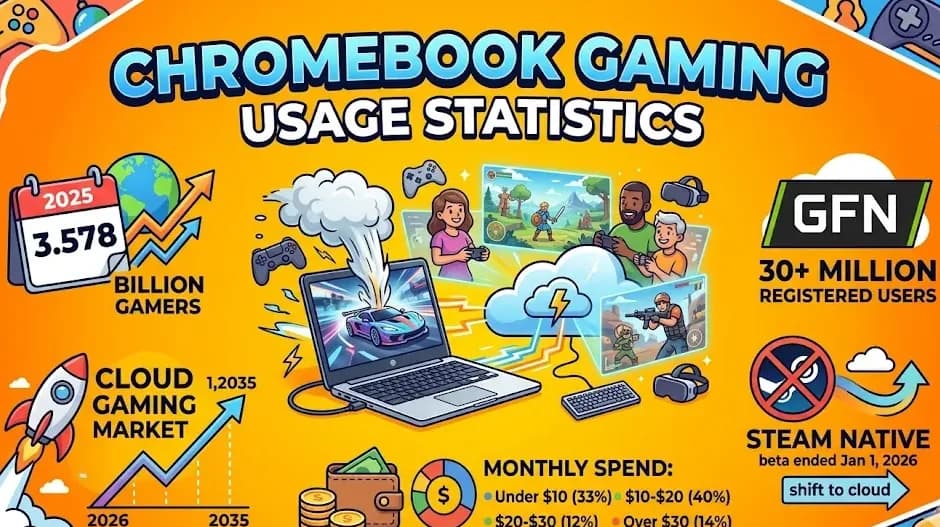
Following the shutdown of native Steam support on ChromeOS in January 2026, Chromebook-based gaming has transitioned almost entirely to cloud video streaming. NVIDIA's GeForce NOW has emerged as the dominant platform service in this space, surpassing 30 million registered users globally, highlighting the shift toward ultra-low latency infrastructure over local device hardware.
Key Takeaways
- GeForce NOW surpassed 30 million registered users across 100+ countries in early 2026
- Steam for Chromebook officially ended on January 1, 2026, after four years in beta
- Average revenue per cloud gaming user rose to $30.35 in 2026, up from $22.97 in 2025
- Cloud streaming requirements for 1080p/60fps play now focus on 25 Mbps bandwidth over local CPU power
- Hardware shipments for ChromeOS devices are projected at 22.11 million units for 2026
Why It Matters
The shift from local execution to cloud delivery on Chromebooks validates a hardware-agnostic future for AAA gaming. By bundling GeForce NOW with new hardware, Google is outsourcing its gaming strategy to NVIDIA's infrastructure rather than competing through native software like the failed Stadia project. This move highlights a broader industry trend where connectivity and low-latency CDNs replace local silicon as the primary bottleneck for high-fidelity content. For competitors, the 45% growth in Xbox Game Pass cloud hours suggests a rapidly fragmenting but expanding market. Watch for whether NVIDIA’s 100-hour monthly cap, which currently affects only 6% of users, becomes a standard monetization hurdle for heavy streamers as server costs scale.
Additional Context
The transition to cloud-first gaming on ChromeOS comes alongside significant infrastructure shifts at NVIDIA. Per Club386 and TechPowerUp in December 2025, NVIDIA implemented a 100-hour monthly playtime cap for almost all GeForce NOW subscribers starting January 1, 2026. This policy was designed to manage server demand and avoid general fee increases, as global data centers face rising power and hardware costs. While the limit excludes legacy 'Founders' members, new 'Performance' and 'Ultimate' subscribers must now pay for 15-hour extensions once they hit the cap, reflecting a move toward usage-based monetization in the streaming sector.
Simultaneously, Microsoft has expanded the competitive landscape. According to reports from SQ Magazine in February 2026, Xbox Cloud Gaming hours surged 45% year-over-year to 1.7 billion hours in 2025. Microsoft’s 'Stream Your Own Games' feature has further incentivized Game Pass Ultimate subscribers to use browsers and low-power devices like Chromebooks for titles they already own, rather than relying on a fixed library. This growth is part of a larger market trend where the global cloud gaming audience is expected to reach 482.3 million users by the end of 2026.
Google’s decision to end Steam support aligns with a broader consolidation of its ChromeOS strategy. Per PCWorld and PCMag in August 2025, the shutdown effectively ended a four-year experiment to bridge the gap between web-centric OS design and heavy local PC gaming hardware. With ChromeOS holding roughly 1.86% of the global desktop market in early 2026, Google has prioritized 10-year update guarantees and cloud-native workflows. This pivot suggests that for the 22.11 million Chromebooks shipped in 2026, the local 'silicon gap' will be permanently filled by ultra-low latency video streaming services rather than native porting efforts.
Read full article at aboutchromebooks.com
Enjoy our coverage?
Add StreamingMeme as a preferred source on Google to see more of our streaming news at the top of your Search results.
Add as preferred source