
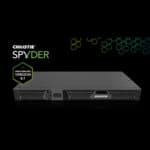
Christie has released Spyder-S 6.1, an update to its video processing platform, enhancing connectivity with new DisplayPort 1.4 and SFP Frames. This expansion aims to support more complex productions for rental, staging, live events, and fixed installations. The platform offers increased flexibility, scalability, and performance for demanding live environments.
The upgrade addresses the growing requirement for massive, high-bitrate visual canvases in the immersive entertainment market. By expanding modular connectivity, Christie lowers the total cost of ownership for rental and staging firms that previously relied on monolithic, fixed-input hardware. This shift toward FPGA-based, distributed processing reflects a broader industry move to bridge the gap between high-end broadcast standards and flexible live event infrastructure. Strategists should monitor adoption rates among major sports venues and broadcast sets, where the 200-million-pixel threshold is becoming a baseline for immersive fan experiences. Watch for whether competitors like Barco respond with similar high-bandwidth modular expansions in the 8K processing segment.
Christie's Spyder-S platform represents the fifth generation of its Spyder windowing video processor lineage, built on FPGA technology and purpose-built hardware rather than general-purpose computing. The platform's modular distributed architecture uses QSFP28 link cables delivering 200 Gbps bidirectional connectivity between frames, allowing the system to behave as one cohesive processor regardless of scale. Christie's official release notes confirm that Spyder-S 6.0.0 shipped as the initial product release on September 17, 2025, with the 6.1.0 feature release arriving on May 14, 2026, introducing the DisplayPort 1.4 and SFP frames that form the basis of this announcement. The platform has already progressed through maintenance releases 6.1.1, 6.1.2, and 6.1.3 as of August 18, 2026, indicating active field deployment and iterative refinement.
The Spyder-S 6.1 launch positions Christie against established competitors in the high-end video processing segment for rental, staging, and fixed installations. Inavate APAC reported that the release introduces expanded connectivity, simplified management, and greater creative power for teams delivering more complex productions, noting that backgrounds render without consuming layers and source mixing uses a single layer instead of two, freeing capacity for more content and larger canvases. This layer-efficiency improvement is significant for rental houses managing tight frame budgets across touring productions where every available layer translates to additional creative flexibility on show day.
From a technical standpoint, Christie's approach of scaling from a single 1RU frame to 16 linked frames supporting more than 200 million pixels on a single canvas without changing software or workflow differentiates the Spyder-S from monolithic chassis designs that dominate the market. Joel Daly, director of product management at Christie, stated that release 6.1 gives customers flexible connectivity for any show or installation, a platform that is faster to set up and manage, and the power of backgrounds and mix effects to deliver larger, more immersive visual experiences. The SFP frame's support for 12G-SDI and HDMI 2.0 with fiber for long-distance runs addresses a practical pain point for large-venue installations where copper cable length limitations have historically constrained system design.
Add StreamingMeme as a preferred source on Google to see more of our streaming news at the top of your Search results.
Add as preferred source