

China breaks fiber transmission record with 51.3 Tb/s unrepeatered trial
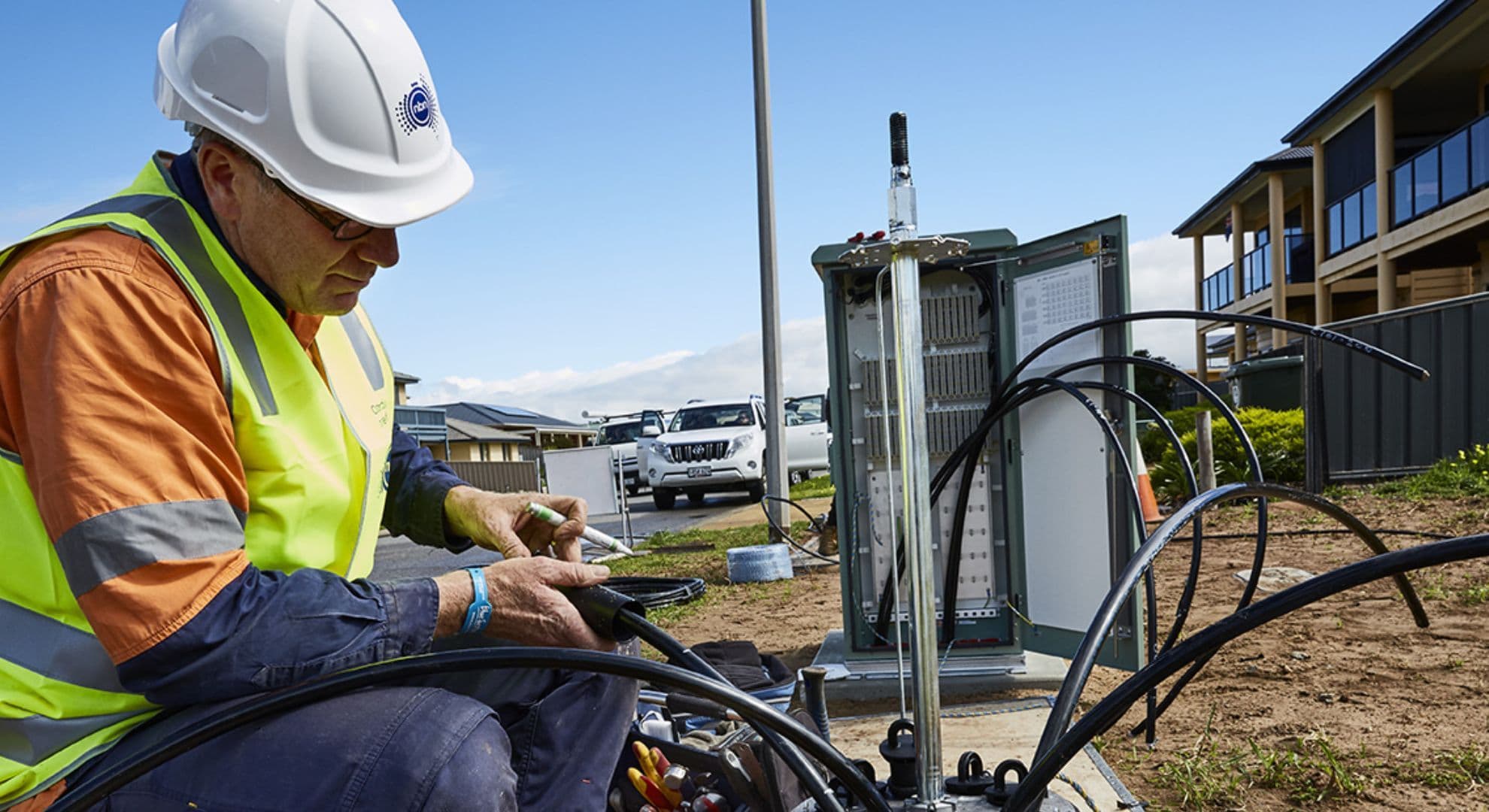
Researchers from CICT and China Mobile have achieved a fiber-optic transmission record of 51.3 Tb/s over 206 kilometers without signal regeneration. This development leverages advanced digital signal processing and modulation to reduce the physical infrastructure requirements, latency, and power consumption for high-capacity data center connectivity.
Key Takeaways
- Transmission reached 51.3 Tb/s over a 206 km (128-mile) span without intermediate signal regeneration.
- Per-wavelength throughput hit 1.2 Tb/s, a record for unrepeatered wavelength-division multiplexing in field conditions.
- Hollow-core fiber technology allowed signals to travel roughly 47% faster than through traditional solid glass cores.
- Adaptive channel control dynamically redistributed power and data rates to overcome signal decay during the long-distance run.
Why It Matters
Eliminating signal regeneration points over 200-kilometer spans significantly simplifies the physical layer for distributed data center clusters. For the streaming industry, this technology paves a path toward ultra-low-latency 8K delivery and the massive synchronization requirements of real-time AI inference at the edge. By reducing the number of active components between server sites, operators can lower both maintenance costs and power consumption while increasing aggregate throughput. Industry participants should monitor the transition of hollow-core fiber from research trials to commercial deployment phases in China's national computing network as a signal of maturing and scalable AI-ready networking.
Additional Context
The breakthrough by CICT and China Mobile on July 4, 2026, aligns with a broader push for 'dual-ten-gigabit' infrastructure across China. Per Xinhua (June 2026), the nation is transitioning from 5G to 5G-Advanced and 6G, targeting infrastructure that serves as the backbone for AI-driven transformation. China Mobile previously activated an S+C+L three-band multi-core fiber in Qingdao (June 2026), which increased single-fiber capacity by five times through space-division multiplexing. These technical milestones are essential to support the projected growth of video traffic, which is expected to account for 82% of global internet traffic by late 2026, according to recent analysis by Servers.com.
While China leads in unrepeatered distance records, Western firms are also scaling hollow-core fiber. Per industry reporting in July 2026, Microsoft has already deployed 1,280 kilometers of hollow-core fiber within its Azure infrastructure, with plans to reach 15,000 kilometers through partnerships with Corning. Simultaneously, high-speed records continue to be shattered globally; University College London and NICT demonstrated 450 Tb/s over a 39 km metropolitan link in the UK in June 2026. The competition centers on whether the industry will rely on wider spectrum bands in existing fiber or the lower-latency physics of hollow-core air channels to meet AI-era bandwidth demands.
Read full article at techradar.com
Enjoy our coverage?
Add StreamingMeme as a preferred source on Google to see more of our streaming news at the top of your Search results.
Add as preferred source