
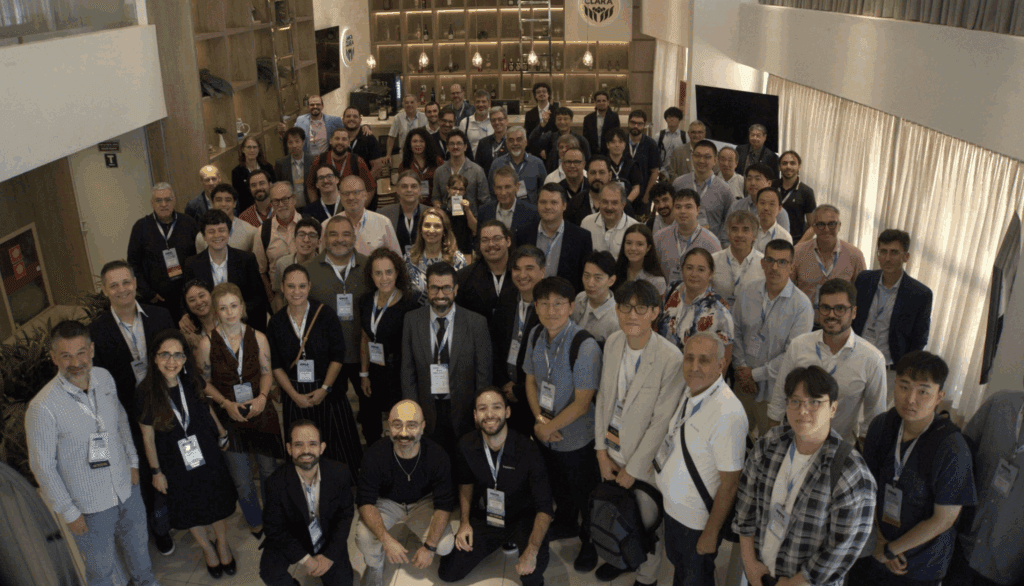
The IEEE International Symposium on Broadband Multimedia Systems and Broadcasting (BMSB 2026) brought together international experts in João Pessoa, Brazil, to discuss the evolution of digital television and the development of the TV 3.0 standard. Key topics included the integration of 5G networking, immersive media applications, and next-generation broadcasting architectures.
Brazil’s TV 3.0 initiative represents one of the world's most aggressive over-the-air (OTA) modernization projects, leveraging the ATSC 3.0 physical layer as its core. For the global streaming stack, this transition signals a move toward hybrid architectures where broadcast and broadband are treated as a unified delivery mechanism. By formalizing these standards now, Brazil sets a template for other Latin American markets to follow, potentially driving down hardware costs through regional scale. Watch for the performance data from early TV 3.0 pilot transmissions as broadcasters prepare for large-scale deployments slated for the 2026 FIFA World Cup.
The TV 3.0 project, commercially branded as DTV+, gained significant regulatory momentum following a landmark Presidential Decree in August 2025. Per ATSC reporting from August 2025, this decree officially codified the ATSC 3.0-based system as Brazil’s future television format, selecting it over competing standards like 5G Broadcast and Advanced ISDB-T due to superior spectral efficiency in the 6 MHz band. While commercial services are targeted to begin by mid-2026, the Ministry of Communications recently extended the full implementation timeline through late 2027 to ensure ecosystem maturity, per CSI Magazine reporting in March 2026.
Simultaneous trials are exploring complementary technologies to enhance mobile reach. In January 2026, a consortium including Qualcomm, Motorola, and Rohde & Schwarz successfully demonstrated a 5G Broadcast proof-of-concept in São Paulo. According to RCR Wireless, the trial delivered live television directly to Motorola Razr 50 handsets using duplex gap broadcasting without interfering with existing cellular traffic. These tests, along with separate Ministry of Communications trials in Curitiba reported in March 2026, suggest that Brazil may utilize 5G Broadcast as a secondary layer to provide free-to-air content to mobile devices without requiring data plans.
On the hardware and infrastructure front, vendors are already positioning for the rollout. Per TV Technology in June 2026, Rede Legislativa began using Appear’s X5 IP contribution platform to transport signals from Brasília to São Paulo to support experimental TV 3.0 transmissions. Additionally, the ATSC recently updated its A/300 standard suite to include specific operating configurations for the Brazilian market, ensuring that international hardware manufacturers have clear guidance for producing compatible receivers at scale.
Add StreamingMeme as a preferred source on Google to see more of our streaming news at the top of your Search results.
Add as preferred source