
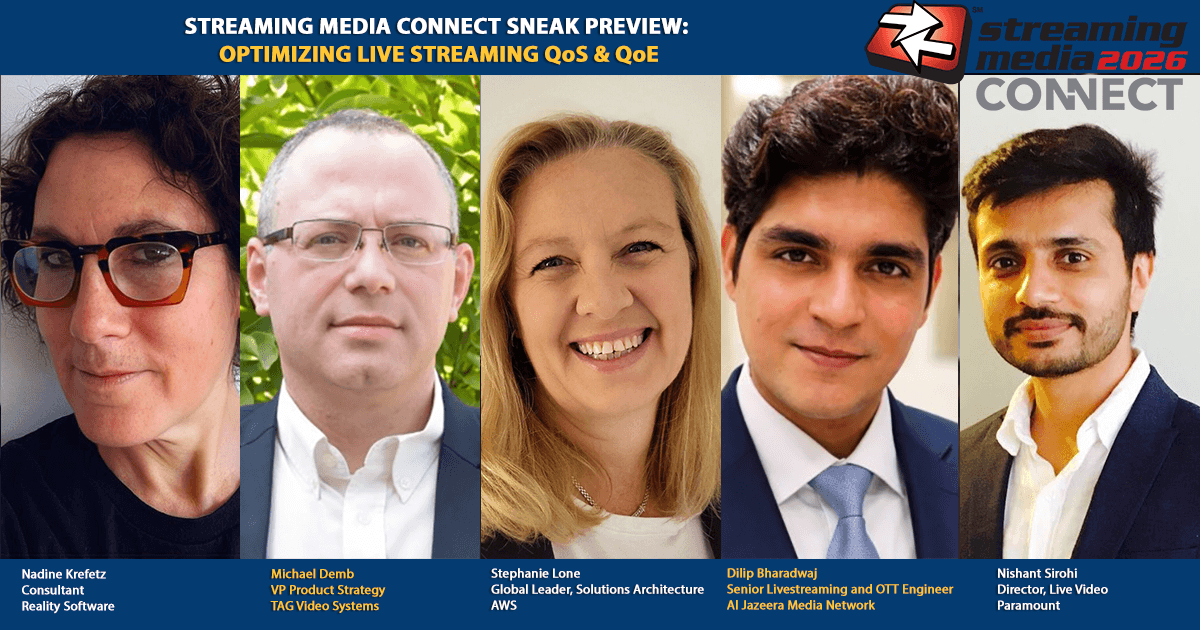
Executives from AWS, Paramount, Al Jazeera, and TAG Video Systems will participate in a panel at Streaming Media Connect on August 12 to discuss live streaming QoS and QoE. The session explores utilizing real-time analytics and AI-driven observability to bridge the gap between technical infrastructure metrics and viewer retention.
The industry is moving from reactive troubleshooting to intelligent, automated operations as live events reach unprecedented scale. By integrating AI-driven observability directly into the ingest and delivery pipeline, providers can mitigate common failures like rebuffering and bitrate drops that lead to immediate churn. For architects and engineers, the immediate implication is a shift toward 'observability at the edge,' where predictive analytics identify infrastructure bottlenecks before they manifest as player errors. Tracking the adoption of these closed-loop monitoring systems will be the primary signal for determining which platforms can reliably maintain high-concurrency live streams without sacrificing margins.
The push for AI-driven observability coincides with a massive investment in cloud-native infrastructure among major broadcasters. Per Amazon Web Services reports from April 2026, Fox Corporation recently designated AWS as its preferred AI cloud provider to power the FOX One platform. This partnership specifically uses machine learning for sub-second latency and automated highlight generation, aiming to serve over 300 million monthly active users. Such scale requires the 'predictive intelligence' mentioned by session panelists to manage the technical volatility seen in major live broadcasts.
Streaming performance during peak events remains a critical benchmark for these technologies. During February 2024's Super Bowl LVIII, Paramount+ achieved a record-setting audience of roughly 123 million to 126 million viewers across all platforms, according to Nielsen and iSpot data. Despite the briefest lag time among streamers—clocking in at 42.73 seconds behind the live feed—the service still faced public reports of buffering and 'video unavailable' errors. Industry analysts from Phenix and TV Tech noted at the time that while latency was low, the stability of the stream varied significantly by device and bitrate.
To address these delivery inconsistencies, vendors like TAG Video Systems have expanded their functional reach. Per company releases from July 2024, TAG introduced new 'Heatmap' and 'QC Elements' tools designed to consolidate thousands of sources into a single screen for faster root-cause analysis. These advancements, combined with partnerships like the 2023 Caton Cloud Alliance, suggest an ecosystem-wide pivot toward monitoring every hop in the transmission path rather than relying solely on end-user player logs.
Add StreamingMeme as a preferred source on Google to see more of our streaming news at the top of your Search results.
Add as preferred source