
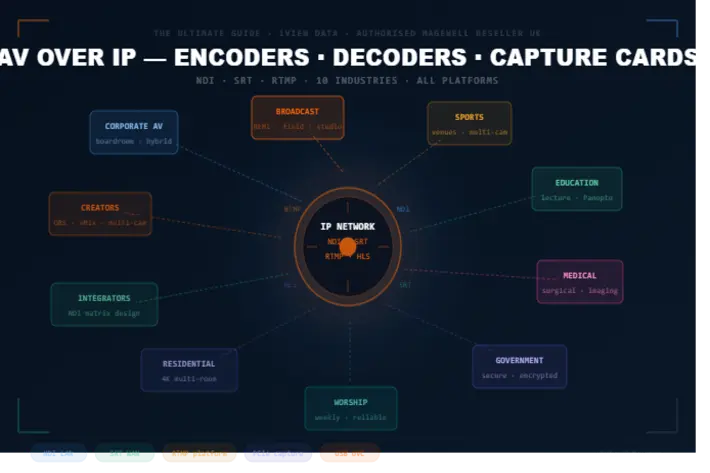
iView Data published a comprehensive guide on AV over IP hardware, including encoders, decoders, and PCIe capture cards, emphasizing its role in replacing traditional SDI infrastructure. The guide details how these technologies power professional video networks across various industries and helps users choose the right hardware for specific deployments. This resource addresses the industry-wide shift towards IP-centric AV operations.
The transition from SDI baseband routing to IP-centric networks has moved from theoretical to operational reality for high-stakes video environments. For engineers and strategists, this shift demands a move away from rigid physical cross-points toward software-defined orchestration that utilizes existing enterprise IT infrastructure. As hardware manufacturers consolidate their positions, the selection of specific encoder and decoder brands now dictates long-term interoperability and technical debt. Investors should monitor this space as the global AV over IP market is projected to grow significantly through 2026, driven by higher demand for 4K distribution and hybrid production models.
The transition from Serial Digital Interface (SDI) to Internet Protocol (IP) continues to redefine broadcast and professional AV economics. Per RGB Broadcasting in January 2026, operating margins for broadcasters have compressed from 18% in 2022 to approximately 12% by 2025, forcing a disciplined shift toward IP infrastructure to achieve quantifiable ROI through scalability. Analysts project that while 85% of tier-1 broadcasters will complete their IP core migrations by the end of 2027, tier-2 and tier-3 organizations are moving more slowly due to the significant re-skilling required for traditional broadcast engineers navigating IT networking concepts.
Sector-specific data from Cognitive Market Research in May 2026 values the global AV over IP market at over $8.2 billion, with hardware components representing a 52.4% share. This growth is underpinned by the refinement of transport protocols like SRT (Secure Reliable Transport) and NDI. According to industry reports from June 2026, more than 85% of newly installed enterprise AV systems in large commercial facilities now include IP-based management layers, moving away from legacy matrix switchers. This saturation is particularly evident in North America, which maintains a 37.8% global market share in adoption as of early 2026.
Interoperability remains a critical friction point as the industry balances competing standards like SMPTE ST 2110, NDI, and IPMX. Per TVBEurope in May 2026, the industry is entering a phase of 'stabilization and refinement' where hybrid workflows dominate. Rather than a total immediate replacement of legacy gear, 2026 deployments frequently utilize SDI for core physical switching while leveraging NDI and SRT for flexible studio routing and remote contribution. This hybridity allows organizations to manage technical debt while scaling for high-bandwidth 4K and 8K content demands.
Add StreamingMeme as a preferred source on Google to see more of our streaming news at the top of your Search results.
Add as preferred source