

AMD ships Helios AI racks to challenge Nvidia data center dominance
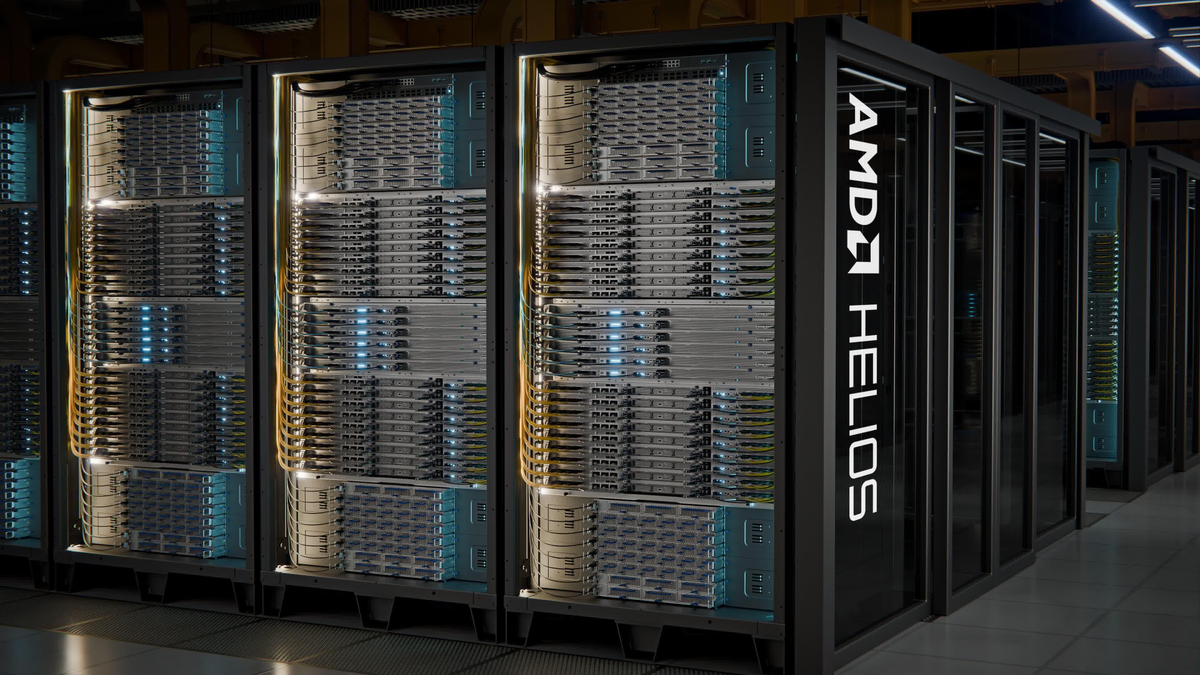
AMD has launched its Helios rack-scale AI system, featuring Instinct MI455X GPUs and the ROCm.ai software stack, to challenge Nvidia's data center dominance. Major AI providers OpenAI and Anthropic have committed to significant deployment volumes of this infrastructure starting in late 2026.
Key Takeaways
- Instinct MI455X GPU features 320 billion transistors on TSMC 2nm/3nm nodes with 432 GB of HBM4 memory.
- OpenAI committed to 6 GW of AMD infrastructure, with the first 1 GW deploying in H2 2026.
- Anthropic signed a deal for 2 GW of Helios capacity and will use Claude models to optimize AMD software.
- Helios integrates Pensando networking and ROCm.ai software, targeting a 60% shift toward inference compute by 2026.
- New Gorgon Halo deskside device uses Ryzen AI Max APUs to support local AI agent development.
Why It Matters
AMD is evolving from a component supplier to a full-stack systems rival, directly targeting Nvidia's data center ecosystem. By securing massive commitments from frontier model leaders like OpenAI and Anthropic, AMD validates its hardware as a viable alternative for the looming shift toward high-scale inference and sovereign AI agents. This diversification of the supply chain is critical for streaming platforms and cloud providers seeking to manage spiraling AI compute costs. Watch for the first 1 GW of OpenAI deployment in H2 2026 as a litmus test for ROCm.ai's production stability compared to the entrenched CUDA standard.
Additional Context
The launch of Helios follows a period of intense roadmap acceleration for AMD. In June 2024, AMD shifted to an annual release cadence for its Instinct accelerators to match Nvidia's rapid development cycle. This strategy aimed to bridge the performance gap between its MI300 series and Nvidia's Blackwell architecture. Per Tom's Hardware, July 2026, AMD’s deal with Anthropic includes a strategic equity investment of up to $5 billion, mirroring earlier warrant-based agreements with OpenAI and Meta that could grant those companies significant stakes in AMD based on deployment milestones. Market competition has intensified as model providers seek to reduce dependency on a single hardware vendor. According to Reuters and Fierce Network, July 2026, Meta has also committed to up to six gigawatts of GPU capacity from AMD, signaling a industry-wide pivot toward diversified compute clusters. While Nvidia maintained an 80% gross margin through 2024, analysts from SemiAnalysis and TrendForce noted that AMD's higher memory capacity (432 GB HBM4 on MI455X) offers a physical advantage for long-context LLM inference where memory bandwidth is the primary bottleneck. Software remains the critical front in this conflict. While Nvidia's CUDA has a 15-year head start, AMD's ROCm 6 stack has reached production-ready status for PyTorch and vLLM workloads. Per Spheron Network, April 2026, recent benchmarks showed AMD hardware narrowing the inference throughput gap to single-digit percentages compared to Nvidia's B200 when running standardized MLPerf workloads. The engineering collaboration with Anthropic, which uses AI agents to autonomously tune silicon performance, represents a new tactical approach to overcoming the historical software maturity gap.
Read full article at finance.biggo.com
Get this in your inbox → Subscribe
Enjoy our coverage?
Add StreamingMeme as a preferred source on Google to see more of our streaming news at the top of your Search results.
Add as preferred source