

Alibaba launches Qwen-RobotSuite to bridge the gap between AI and robotics
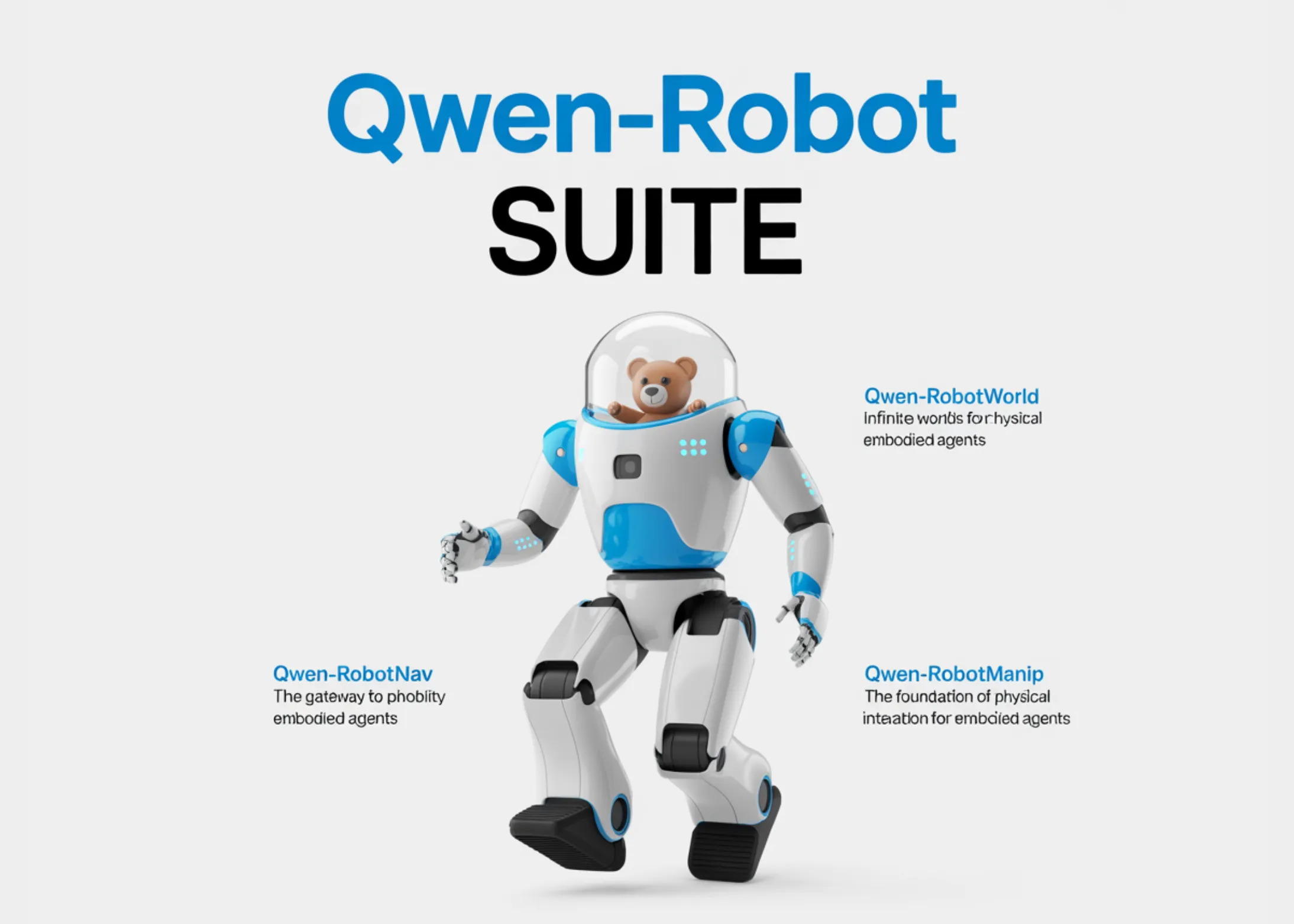
Qwen has released Qwen-RobotSuite, a collection of three embodied AI models (RobotManip, RobotWorld, RobotNav) designed for robotics applications. These models address challenges in manipulation, video world modeling, and navigation, built on Qwen vision-language backbones and demonstrating strong benchmark results. The suite aims to overcome the fragmentation of robotics data and provides a framework for scaling manipulation data, using language as a universal action interface, and offering a controllable interface for navigation.
Key Takeaways
- Qwen-RobotManip uses an 80-dimensional canonical action vector to enable data scaling across heterogeneous robot hardware.
- Qwen-RobotWorld achieved 1st place on the EWMBench motion fidelity benchmark with a 33% gain over the runner-up.
- Qwen-RobotNav handles waypoint trajectory prediction and performs with 76.5% success on the VLN-CE RxR navigation benchmark.
- The suite utilizes Alibaba's modular infrastructure to separate spatial navigation, world modeling, and physical manipulation layers.
Why It Matters
Alibaba's move marks a major pivot from conversational AI toward physical world intelligence, shifting the competition from language tokens to spatial reasoning and motor control. By anchoring these models to the Qwen3.5-4B backbone, Alibaba ensures every improvement in its core Large Vision Models (LVMs) compounds directly into industrial robotics capability. This modular approach allows enterprise developers to choose specialized components for navigation or manipulation without rebuilding the entire stack. For stakeholders, this signals a future where cloud providers act as the primary integration layer for industrial automation, potentially leading to new forms of platform lock-in within the physical economy.
Additional Context
The launch of Qwen-RobotSuite follows a significant acceleration in the 'embodied AI' sector as it moves toward mass production. Per Dow Jones, June 2026, tech leaders such as Alibaba and Baidu are increasingly focusing on building full-stack ecosystems that span from frontier models to hardware-specific chips. This shift is driven by a desire to transform AI product revenue into the primary propellant for cloud growth, a strategy echoed by Alibaba CEO Eddie Wu earlier this year. In tandem with these software releases, Chinese firms are rapidly piloting these models with select enterprise clients to verify their performance in real-world logistics and manufacturing environments.
Contemporaneous reporting from South China Morning Post, June 2026, highlights that the physical AI field has become the 'next frontier' for global AI labs, as conversational chatbots reach a saturation point. While earlier Vision-Language-Action (VLA) models often experienced 'catastrophic forgetting' during the transition from language to robotics training, recent architectural breakthroughs—like the dual-stream Multimodal Diffusion Transformers (MMDiT) used in Qwen-RobotWorld—help preserve general reasoning while learning physical dynamics. This progress mirrors broader industry moves from competitors like NVIDIA and Physical Intelligence, who have also released open-weight VLA models to capture the growing warehouse and service robotics markets.
Read full article at marktechpost.com
Enjoy our coverage?
Add StreamingMeme as a preferred source on Google to see more of our streaming news at the top of your Search results.
Add as preferred source